“History does not repeat itself, but it often rhymes.” – usually attributed to Mark Twain, but…1
The AMS 2026 Annual Meeting is now history. Time to take stock! One salient feature? This year’s 25th Conference on Artificial Intelligence for Environmental Science.
Some AMS members, noting the rapid growth in recent years in the number and size of AI sessions at the Annual Meetings, fear this trend is not necessarily for the better.
But similar disruptions have happened before. If the present trend follows historical precedent, it signals a hugely expanded, positive future for AMS Meetings, for our community more broadly, and even for the world we serve—possibly for decades to come.
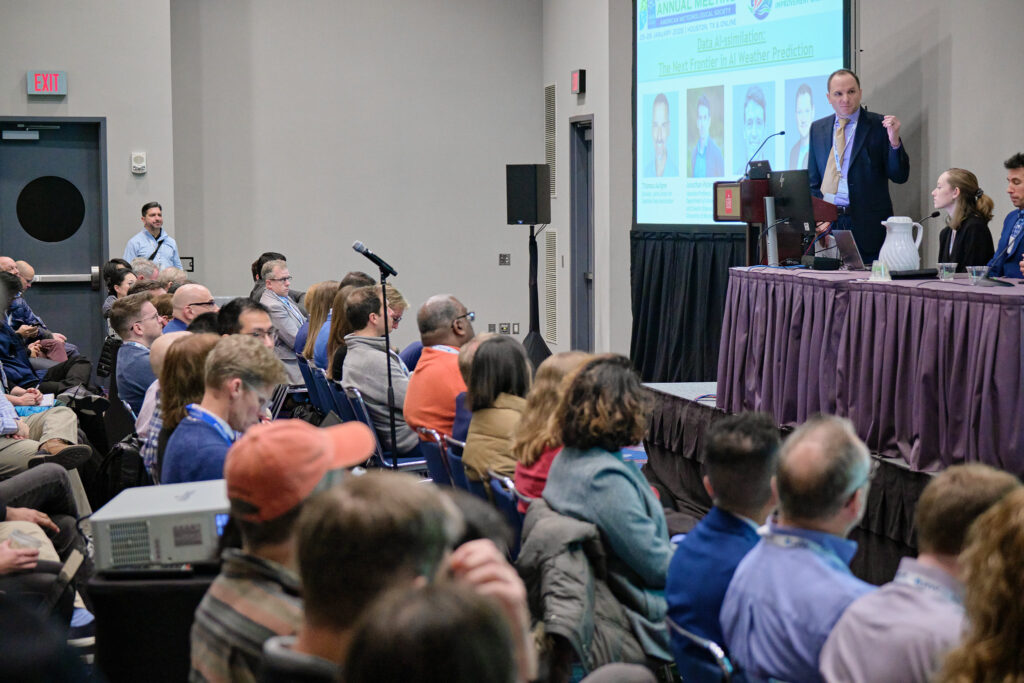
In taking stock, let’s agree at the start that AI is indeed big. This year’s 25th Conference on Artificial Intelligence for Environmental Science boasted some 45 sessions and a clutch of poster events spread over the meeting’s four days. A quick look at the other conference and symposia listings failed to turn up anything that came close in terms of session numbers. For comparison, consider the 42nd Conference on Environmental Information Processing Technologies. It comprised 15 sessions plus poster sessions—more representative of the average.
I didn’t select that latter conference at random. Its origins date back to the mid-1980s, when it was introduced under a different title: the Conference on Interactive Information and Processing Systems (IIPS).
From its inception, IIPS transformed the AMS Annual Meetings. In years prior, the Annual had been attended by a few hundred people at most. Meetings had a low-key vibe. Venues were chosen by Ken Spengler (the first AMS executive director), often at the last minute. He and his colleague Evelyn Mazur would shop for cities and hotels that needed the business. They would get good deals, sometimes only a little more than a year before the event. The registration desk? Usually in the corner of a (small) hotel lobby. The exhibits area? Not much more than a card table or two staffed by retired NWS employees who were marketing Belfort anemometers and other small meteorological instruments. Sometimes in that same lobby.
Meanwhile, weather research and services were undergoing upheaval. The Reagan administration wanted to downsize government. They wanted to eliminate entirely the myriad undersized NWS Offices (that mostly collected surface data), to reduce the number of NWS Field Offices (that were providing the public services), and to downsize NWS staff from 6,000 or so down to a level more like 4,000. The U.S. weather radar network, installed in the 1950s and 60s, and based on vacuum tubes and analog technology, was aging. NWS was cannibalizing radars to get needed but obsolete spare parts. Radars lacked Doppler, limiting their utility in tornado detection and tracking. Satellite capabilities were growing; NOAA would need more—not only low-Earth orbit, but also geostationary. Global numerical models were being supplemented by local and regional models. The private sector was seeing opportunity and growing by leaps and bounds—and in some cases coming to view the NWS as a competitor rather than a partner. The huge amounts of data, the growing value and variety of those data, and unevenness in data production and in access among nations were straining the 100-year traditions of international data collection and sharing instituted and maintained by the UN World Meteorological Organization.
(Perhaps present-day eyes and minds can see present-day repetition or rhyme in this historic set of challenges.)
So, what happened back in that day? What was the outcome? Well, to begin, the NWS under its then-director, Dick Hallgren, carried out a top-to-bottom modernization and restructuring. The central technological piece put the diverse (often analog) datasets coming into the NWS field offices—the in situ surface observations, the satellite images, the radar displays, the centralized numerical weather forecasts—into digital formats on individual interactive workstations for each forecaster. Hallgren pushed his counterparts at NOAA’s research Line Office to stand up a new laboratory to accomplish this redesign. (Hallgren sought in this way to protect essential R&D budgets from the erosion that would result if and when the research funds might have to compete with inevitable NWS operational budget shortfalls). Modernization required NOAA and NWS to coordinate more closely with the private sector. Hallgren was instrumental in reaching out to the private sector at a strategic level. The growing community of practice needed a neutral venue, external to government, to foster relationships and synergy across large numbers of government, private-sector, and academic professionals. Hallgren saw the AMS as a preexisting vehicle that could adapt to meet these latter needs.
The result was IIPS. Within the first couple of years, the IIPS conference alone was bringing as many as 700-800 additional participants to AMS Annual Meetings; total attendance quickly reached—then exceeded—1,000 participants. The AMS Annual Meetings would continue to grow. Hallgren, early on in his capacity as NWS director, then as a volunteer AMS leader, and beginning in 1987 as AMS executive director, would continue to add dimensions and heft to the meeting. The Annual Meetings increasingly attracted an overlay of government, corporate, and academic executives in addition to the bench-level scientists and engineers. The satellites, radars, and IT systems the government needed would portend sizable procurement contracts. Sensing opportunity, the private sector—big firms like Raytheon, Lockheed Martin, Boeing, Northrop Grumman, and IBM—began exhibiting at AMS to catch the attention of government leaders, culminating in the present-day exhibits colossus.2 Corporations and agencies began supporting student scholarships and fellowships to demonstrate high-minded community citizenship. At the same time, Hallgren convinced his extensive WMO contacts that an annual, non-Geneva, informal one-day workshop and a weeklong gaggle of scientific sessions and events at the exhibits would be a useful addition to the relatively formal and orchestrated WMO meetings. WMO leaders and heads of met- and hydro-services from around the world started showing up. This in turn made the AMS Annual Meetings even more attractive to the U.S. private sector; they could now see opportunities to build international markets for cutting-edge products and services. Which made the meetings even more attractive to government and academic leaders. Which meant they were more aware of and favorable toward the active participation of larger numbers of their scientists and engineers. The resulting positive feedback and synergy wasn’t a mere bubble. The whole was driven by a national sense of need: for better weather services, and climate, hydrologic, and ocean outlooks as well. AMS publications expanded into other disciplines, and journal submissions swelled.
Over time, the IIPS Conference was no longer the 800-lb gorilla dominating the AMS Annual Meetings. The other conferences and symposia grew in attendance and numbers. Joint conferences proliferated.
Fast forward to the present; enter AI. The AI Conference is an offshoot—one of several—stemming from what had been IIPS. Note that we’re talking about the 25th AI conference here, not the 2nd or 3rd. Visionaries have been talking up the topic for a long time. But it languished for years before seeing its aspirations matched by a surge in capability.
The potential for a new growth spurt for the AMS is enormous. And the thumbnail sketch of events given here contains lessons. For one, it would be tempting to see the need for some Dick Hallgren of the present day. Certainly he played a pivotal global role decades ago (see also here). But Dick, if he were still alive, would quickly turn the spotlight on others who had helped him. He would emphasize the need for a community of practice, pulling in a common direction. Future growth will result only as part of a larger context: purposeful, sustained public–private–academic collaboration; investments in supportive soft and hard infrastructure; and a track record of success in harnessing AI for societal benefits, highly visible and broadly distributed, both domestically and internationally.
Dick would say that the AMS, its members, and the community we serve can play a powerful part in creating such an expanded future.
Which returns us to the title of the post. Based on the historical precedent, will our AI-enabled future likely be a positive one? Or only possibly?
I’m going with likely. But that’s contingent. It’s up to you and me, and how we all respond in the moment. More in the next post…
- The quote, like so many, has a complex provenance. It also has a double meaning and a special poignancy here. To oversimplify, AI accomplishes weather forecasting by starting with present conditions, then sifting through mountains of data to find similarities in past weather patterns and noting how they evolved. Irving Krick, a bright but maverick personality, had touted such an approach as early as the 1930s. A tireless self-promoter, Krick claimed his approach was superior to physics-based weather prediction. He even tried to credit the success of the famous D-Day weather forecast for Normandy to this approach and his personal role—a gross, altogether unseemly overreach. He also pioneered in weather-services-for-profit, extending beyond mere forecasts to weather modification. Both the promoter and the approach have been discredited and vilified by the meteorological establishment, including the AMS. It’s mindblowing to see the approach resurface in this present AI guise. Want to probe this rabbit hole in more detail? This Wikipedia article on Krick, and this Jesse Katz 1985 piece from the Los Angeles Times, will give you a flavor. ↩︎
- The firms (and federal agencies) also began funding hundreds of thousands of dollars in scholarships and fellowships. ↩︎