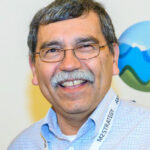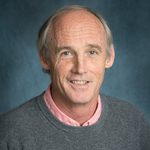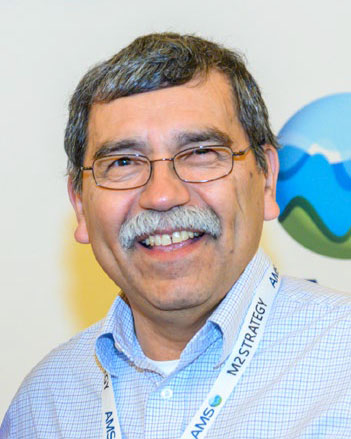
September 15-October 15 is Hispanic & Latino/a Heritage Month. In this post, we spotlight the exceptional career of one of our community members: Jose D. Fuentes.
Jose D. Fuentes is a professor of atmospheric science at Penn State University, where he studies and teaches the processes governing exchanges of energy and gases between Earth’s surface and the lower atmosphere. His research examines how changes in atmospheric composition influence climate, air quality, and biosphere–atmosphere interactions. To address these questions, he combines field observations with numerical modeling. His field programs involve the deployment of instruments on towers,
tethered balloons, drones, and research aircraft in environments ranging from the high Arctic to the Amazon rainforest, West Africa, and more. Fuentes earned a B.Sc. in Meteorology from Millersville University and both his M.Sc. in Agricultural Meteorology and Ph.D. in Micrometeorology from University of Guelph in Canada. Before joining Penn State, he served as a research scientist at Environment Canada and later held faculty positions at the University of Virginia. Throughout his career, he has actively promoted the participation of underrepresented groups in science and engineering, including serving as chair of the congressionally mandated Committee on Equal Opportunities in Science and Engineering, which advises the National Science Foundation.
What are a few highlights from your career?
My career spans atmospheric research, international field campaigns, teaching, and efforts to broaden participation in science and engineering.
My research has advanced understanding of biosphere-atmosphere interactions, particularly carbon cycling in coastal and forested environments and forest emissions of hydrocarbons that contribute to the formation of atmospheric oxidants and aerosols. By combining field observations with numerical modeling, I have clarified how vegetation exchanges gases with the atmosphere and how those exchanges affect atmospheric chemistry, air quality, and climate. My field campaigns have taken me from the high Arctic to the Amazon rainforest, West Africa, Panama, the Marshall Islands, Canada’s boreal forests, and numerous sites across the United States. These investigations have used instruments deployed on towers, balloons, drones, and research aircraft. After earning a meteorology degree from Millersville University and graduate degrees from the University of Guelph, I worked as a research scientist at Environment Canada and held faculty appointments at the University of Virginia before joining Penn State. Throughout my career, teaching and mentoring have remained central to my work, helping students understand the processes governing Earth’s atmosphere, weather, and climate. My contributions have earned recognition from universities and professional societies. The University of Virginia awarded me the Cavalier’s distinguished professorship for excellence in teaching and mentoring, and I received the Virginia Outstanding Faculty Award for excellence in teaching, research, and public service. The American Meteorological Society, the American Association for the Advancement of Science, and the American Geophysical Union elected me a Fellow. Throughout my career, I have championed opportunities for underrepresented groups in atmospheric science. For several years, I chaired the congressionally mandated Committee on Equal Opportunities in Science and Engineering, which advises the National Science Foundation on expanding participation by underrepresented populations and people with disabilities across the nation’s STEM enterprise.
What are you most proud of in your professional life?
I take particular pride in teaching and mentoring several generations of students who have built successful careers. My former students now hold faculty positions and leadership roles in the private sector, where they advance scientific knowledge, apply their expertise, and mentor others. For me, a lasting measure of professional achievement is helping students develop the knowledge, confidence, and independence to pursue their goals and support the next generation. I also take pride in my efforts to broaden participation in atmospheric science, and I welcome universities’ adoption of strategies that foster inclusive academic environments and support the professional development of traditionally underrepresented groups.
Have things changed for Hispanic & Latino/a meteorologists or scientists over the years? What still needs to change?
Professional opportunities for Hispanic and Latino/a atmospheric scientists have expanded, although progress remains slow and uneven. More are earning atmospheric science degrees, while professional societies provide networking, mentoring, collaboration, and visibility that support career advancement and offer role models for younger students. Persistent barriers include financial constraints, inadequate institutional support, and limited research opportunities. Rising tuition restricts access to higher education, while underfunded schools often lack the courses, resources, and guidance needed to prepare students for science degrees. Priorities include stronger science education in underserved schools, affordable higher education, paid research opportunities, and sustained mentoring through graduate school and professional careers. Partnerships with Hispanic-serving institutions can broaden access to research and advanced degrees. Universities and employers must ensure fair, transparent hiring and promotion and expand opportunities to lead research and shape institutional priorities. The goal is for Hispanic and Latino/a scientists to have the resources and opportunities to thrive and contribute fully to science. Sustained institutional commitment and accountability must include assessing recruitment, retention, career advancement, and participants’ experiences.
Are there other Hispanic & Latino/a meteorologists/atmospheric scientists who have particularly influenced or inspired you?
Unfortunately, I did not have the opportunity to meet many Hispanic and Latino/a meteorologists or atmospheric scientists before building my career in the United States. Growing up in Costa Rica, I had a father who was one of my greatest inspirations and played an important role in nurturing my interest in science.
From a young age, I was also inspired by Franklin Chang-Díaz. Seeing someone from a similar cultural background achieve so much in science and space exploration helped me believe that a career in STEM was possible.
Today, I am inspired by the growing community of Hispanic and Latino scientists who continue to open doors for future generations through their research, leadership, mentorship, and service. Their work reminds me of the importance of representation and of creating opportunities for those who will come after us.