by Siyu Chen et al.
Key Messages From
Where is the Dust Source of 2023 Several Severe Dust Events in China?
by Yu Chen (Lanzhou University), Siyu Chen, Hongru Bi, Jie Zhou, and Yue Zhang. Published online in BAMS, November 2024. For the full, citable article, right click on the title above for options.
Dust aerosols are the most abundant type of aerosols on land, making up half of all tropospheric aerosols. Approximately 2 billion tons of dust are lifted into the Earth’s atmosphere each year. Driven by factors such as global warming, rapid population growth, and excessive land reclamation and grazing, Mongolia’s ecosystem has been seriously degraded. This has led to increased soil wind erosion and a rise in cross-border dust transport, which has significantly contributed to dust weather in China. Although China has implemented policies like grain-for-green and grazing exclusion, the frequent dust activities have still attracted public concern.
Accurately identifying and evaluating the contributions of different dust sources to downstream areas is crucial. Our team has systematically analyzed the dust sources in East Asia by using ground observations, satellite remote sensing, and the improved Weather Research and Forecasting model coupled with chemistry, WRF-Chem. Observations revealed substandard air quality in northern China during spring 2023. The number of days with daily average PM10 (particulate matter of 10 microns or less) concentrations exceeding air quality standards (150 micrograms per cubic meter, μg m−3) in northwest China and North China accounted for about 92 days that spring. These frequent dust events have resulted in the maximum PM10 concentrations exceeding 3,000 μg m−3 in northern China and 500 μg m−3 in the middle and lower reaches of the Yangtze River, and even exceeding 250 μg m−3 in the Tibetan Plateau. PM10 concentrations in Hohhot were greater than 3,000 μg m−3 for as long as 5 hours, which poses a serious threat to local agricultural production, transportation, and human health.
To better understand the impacts of different potential dust sources on China and downstream regions, our research team employed an improved numerical model combined with multisource observations. We successfully reconstructed East Asian dust events in spring 2023 and precisely characterized the transport pathways of dust from various Asian dust sources. The contributions from Mongolia; Inner Mongolia, China; Xinjiang, China; Central Asia; and South Asia to the dust concentration in downstream regions is revealed from multiple perspectives. Dust from Mongolia showed stronger downstream transport than Xinjiang or Inner Mongolia. Specifically, Mongolia contributed 44% of the dust concentrations in downstream regions, while Inner Mongolia (and Xinjiang) 34% (16%). Quantitative analysis showed that Mongolia accounted for 56% of dust concentrations in North China and 51% across the Korean Peninsula. This poses a serious threat to socioeconomic development and human health in downstream regions. In addition, it is noted that Inner Mongolia contributed 46% and 40% of the dust concentration in southwest China and southeast China, respectively.
Our vertical dust source analysis across multiple regions revealed Mongolia as the dominant atmospheric dust concentration contributor to the lower troposphere over North China, the Korean Peninsula, and surrounding areas, including the East China Sea region. While the Taklimakan Desert exhibits the strongest dust emissions in East Asia, topographic barriers significantly limit Xinjiang’s contribution to lower-atmosphere dust concentrations in North, southwest, and southeast China, as well as the Korean Peninsula and the surrounding area, and the East China Sea region, compared to other source regions. Moreover, Central Asia and Xinjiang are major dust contributors in the upper atmosphere over North China, the Korean Peninsula and its surroundings, and the East China Sea and its surrounding area. Our study provides scientific references for clarifying the contribution of different Asian dust sources, especially Mongolia, to dust in China and downstream regions, and it emphasizes the urgent need for international cooperation on dust disasters.
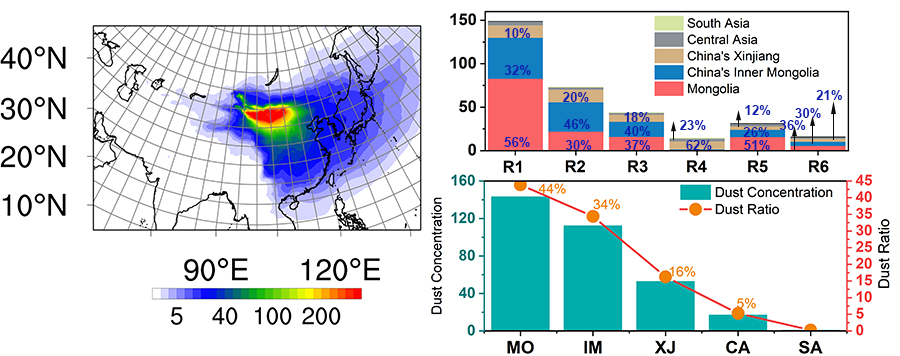
Surface dust concentrations from Mongolia, and the main dust sources in downstream regions.
METADATA

“Dust isn’t just data—it’s childhood memories of closed schools and masked commutes. Those days when outdoor activities were canceled and we had to wear masks just to step outside left a lasting impression on me. I study aerosols to turn hazy skies back to blue, to understand how these particles can have such a profound impact on our environment and health.”
—Siyu Chen, Lanzhou University
A Brief Conversation
with the Author
BAMS: What would you like readers to learn from this article?
Siyu Chen (Lanzhou University): We want people who read our article to notice that there is a spatial heterogeneity in the dominant sources of dust concentration. The main dust source in southwest and southeast China is Inner Mongolia. Dust concentrations over the Tibetan Plateau primarily originate from Xinjiang, driven by meridional circulation transporting dust from the Taklimakan Desert. Moreover, Mongolia is a major dust source influencing North China and the Korean Peninsula. Overall, Mongolia has a greater impact on the dust concentration in downstream areas than other dust sources. Generally, dust emission often occurs in dust source regions; however, the impact of atmospheric circulation on dust transport to downstream regions cannot be ignored. Solving this crisis requires global cooperation, not just local policies.
BAMS: How did you become interested in the topic of this article?
SC: In recent years, large-scale dust storms that had lain dormant for many years have made a comeback in East Asia. The 2021 “315 Event” shocked China—PM10 hit 7,000 μg m−3 in Beijing! This extreme dust storm resulted in structural damage to agro-pastoral infrastructure (greenhouses, livestock housing) and residential properties, with preliminary assessments indicating direct economic losses surpassing 30 million CNY. In 2023, northern China experienced a strikingly high number of 17 dust events. In April 2025, unprecedented prolonged mega-winds occurred in North China. These winds triggered dust events that extended far beyond the usual affected areas, impacting regions such as the Sichuan Basin and even Hainan in the south. I grew up in Lanzhou, where we were often hit by dust storms. I needed answers: Where does the dust come from, and why is it worsening?
BAMS: What surprised you the most about the work you document in this article?
SC: Compared to Xinjiang, Inner Mongolia exerts a more substantial impact on dust transport to southern China (southwest China, southeast China). Moreover, even Inner Mongolia, adjacent to North China, contributes less dust than Mongolia. Dust doesn’t respect borders—neither should solutions.
BAMS: What was the biggest challenge you encountered while doing this work?
SC: Traditional models ignore dynamic dust sources like farmland. We rebuilt WRF-Chem to include these, finally matching real-world data.
—Siyu Chen, Lanzhou University
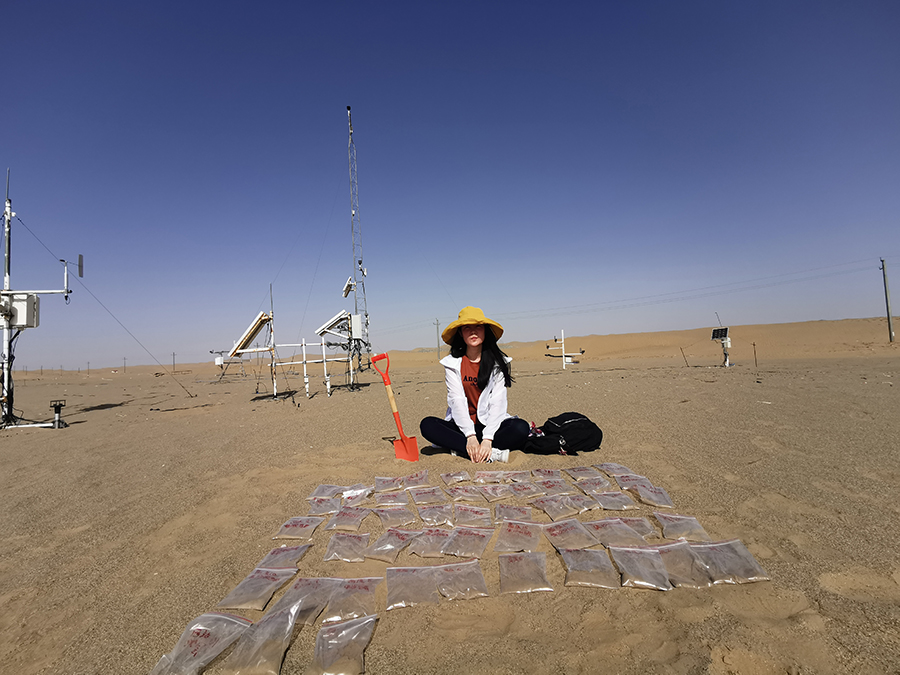
“The severe dust storm in 2025 has further made us realize that current dust research should not only focus on its forecast and early warning, but also on improving the ecological environment through human activities, which is also an important issue.”