“I must lose myself in action, lest I wither in despair.”—Alfred Lord Tennyson
Wither.
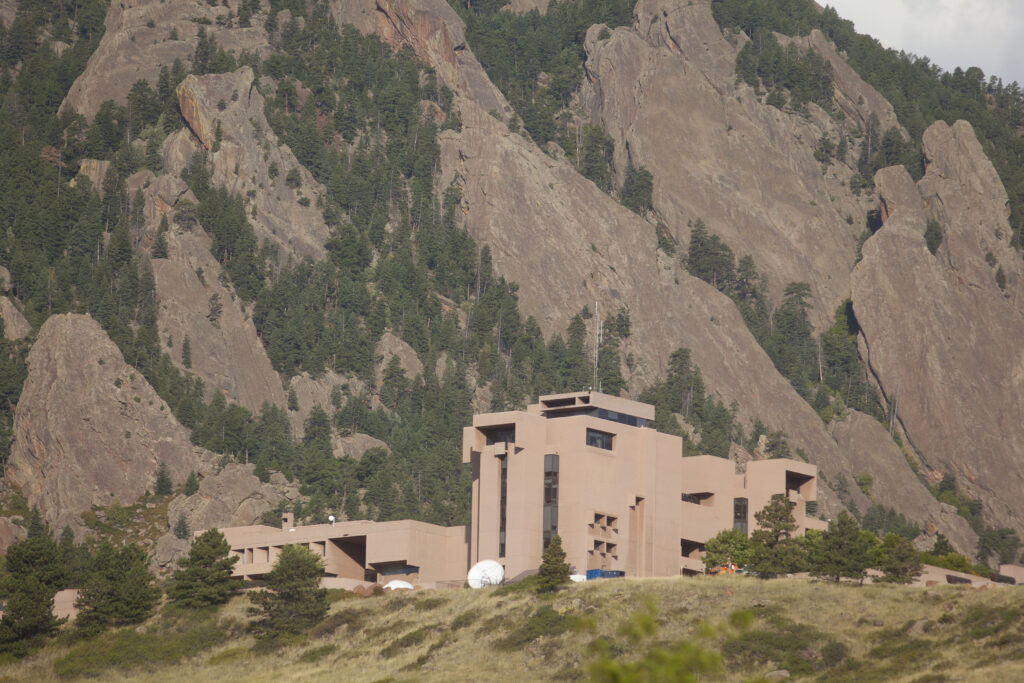
Throughout 2025, the administration wielded the wrecking ball on federal agencies (including NOAA and the Department of Commerce, where I worked for 32 years). Now it’s the turn of NSF and NCAR. News media, including PBS, covered the story extensively. A piece in Physics Today, an excellent article by Carlos Martinez in Eos, and myriad other commentaries from science and professional societies round out the picture.
The intent is to do much broader damage—not to stop at dismantling of NCAR per se. NOAA and NSF/NCAR are the roots supplying nutrients to an entire national ecosystem of effort spanning the academic community and even elements of the private sector. That enterprise of research and services helps 340 million Americans meet their food, energy, and water needs; maintain minimum standards of environmental quality; and remain safe in the face of natural hazards—not just for the short term but for the long haul. Deprived of needed streams of funding, means of innovating, and channels for communicating and coordinating effort, vital services are withering. This will leave ideologues free to form policy unencumbered by empirical realities.
This shriveling, drooping—this loss of vitality and disconnect from evidence—is occurring precisely at the moment in history that geosciences and derived services are most needed. As public needs for resources and for safety grow more urgent and simultaneously more complex and interrelated, the world is racing to incorporate atmospheric science into the artificial intelligence being constructed and mobilized for the task. For this reason, other nations are picking up the slack. They can’t afford not to. But this trend, if maintained, will remove the United States from its currently favorable leadership position—at the head of the table. The American people will in the future be dependent on the good will of others—at the table’s lower end.
Weather.
“Everybody talks about the weather, because no one is allowed to talk about the climate.” —Mark Twain, if he were speaking and writing in the year 2026
In the face of the problem, NSF has asked for community input. Their Dear Colleague Letter (DCL) merits a careful, word-by-word reading in its entirety, but here is an excerpt on the big picture:
NSF is seeking transformative and creative concepts that enable efficient and cost-effective operations, management and continued evolution of the following capabilities:
- Atmospheric observational platforms,
- Cyber infrastructure and computing capabilities, including atmospheric and space weather modeling and forecasting research, and
- Training and development for students and community members on weather and space weather modeling and forecasting.
As stated in the December 17 announcement, NSF is exploring options to transfer stewardship of the [NCAR-Wyoming Supercomputing Center (NWSC)] to an appropriate operator; to divest of or transfer the two NSF aircraft that NCAR manages and operates to another federal agency; and to redefine the scope of modeling and forecasting research and operations to concentrate on critical national needs such as seasonal weather prediction, severe storms, and space weather. NSF is considering multiple approaches for supporting weather science infrastructure.
Following requests for expressions of interest or concepts of operation with respect to some specific details, the DCL then requests responses to these additional questions:
- Are there any areas in which NCAR activities or capabilities duplicate those of other government agencies, universities, or the private sector?
- Are there transformative prospects for observational platforms and the resulting data that are currently unexplored or underutilized?
- Are there other concepts for management and operations of NCAR activities that differ from the current model that NSF should consider?
- What should the performance objectives and metrics be for a restructured atmospheric research center?
Note that the vocabulary of this letter has been constrained (and that’s true of the fuller letter as well). The word climate nowhere appears—a forceful reminder that work under that label was the direct target of the wrecking ball. Two ironies come to mind. One is that human progress over the past few thousand years may have owed much to the relative stability of climate; we’ve tuned our success to that narrow range of climate conditions.1 If climate had been more variable throughout this period, our human progress might have been slowed. On the other hand, we might not have made the somewhat arbitrary distinction between weather and climate that has gotten us in this political pickle—we might have instead focused on a seamless whole. Second, Walter Orr Roberts, who played a major role in founding NCAR, had a personal climate-research portfolio—but primarily focused on the possible role of solar variability in shaping that climate. Fortunately for NCAR and the history of the field, he was able to construe the need for national and global research—and world action—more broadly. (Considering today’s politics, his biography makes interesting reading.)
One great challenge throughout this entire process is the disposition or repositioning and possibly repurposing of the assets and programs that had been operating under other labels. The particulars will make the difference between transformation and dissolution. The inability to give these programs their name won’t make the problems go away, and won’t make their resolution any easier.
Whither?
“If you’re going through hell, keep going.“—Winston Churchill
“Let someone else praise you, and not your own mouth; an outsider, and not your own lips.” —Proverbs 27:2, NIV
Churchill was right to encourage his fellow Brits to keep going during the hell of World War II. The same holds true today. The question then arises: what does “keep going” look like for NCAR and the larger NCAR community? That’s what matters most at this point. The atmospheric research community is a bright, lively crowd, bubbling with ideas. If there was ever a time for participating, versus holding back, for brainstorming, making your views known, now is that time.
An observation and a hope. First, the observation. It’s important at this time to surface the full range of possible ideas. At the same time, it’s easy and natural for outsiders and bystanders to have an inflated idea of their/our insights. Greater weight ought to be given to the ideas coming from the NCAR staff and those outsiders closely coordinated with NCAR and its programs.
Speaking of Walt Roberts, he’s part of my reason for saying this. Half a century ago, I was a relative newcomer to the Boulder scene, working at the NOAA labs down the hill from NCAR. For some reason that I can no longer recall, I found myself in a one-on-one conversation with the man in his UCAR office. In the course of our talk, he said this: “The most important trend in society today is the decline in the effectiveness of volunteer work.”
!!!
I can’t remember how this came up—and I haven’t heard too many others saying anything similar since. But I do remember the remark itself. In the decades following, I had a handful of opportunities to review this or that aspect of NCAR’s work, and one stint on a SPEC-review of NCAR as a whole. Each time I’d reflect on and be humbled by the complexity and finely tuned nature of NCAR and its programs. It was like lifting the hood of a Rolls-Royce as opposed to my lawn mower. How to offer something constructive and useful based on the reflections of half-a-dozen reviewers, meeting only for a day or two? The same problem faces the responders to the DCL. In the event that the framers of the DCL are indeed open to the input they request, it would make the exercise more effective to consider it the first step of a two-step process—something akin to the Delphi method. The DCL responses could be summarized and made known to all the responders, who would then be invited to modify their inputs.
Now for the hope. We’re talking about NSF and NCAR here—institutions created for the purpose of innovation. My hope is that responses to the DCL contribute to the following goal: that whatever comes out of this disaster turns out to have the character of something-plus versus something-minus. Again, the particulars of that should come from those directly affected, rather than the much larger crowd of those of us on the sidelines. NCAR personnel and their families are best equipped and positioned to articulate that vision; the rest of us then need to rally around and help as best we can. But I do hope that the changes will move NCAR toward added emphasis on research application, extending to end use—given resource constraints, probably achieved in large part through outside collaboration.
This will accomplish two things. It will extend and accelerate the benefits from NCAR research, to be sure. But it will also expand NCAR’s circle of friends. Those who know NCAR the best like it the most. That’s admirable. But those who know NCAR the best tend to be atmospheric scientists themselves. To outsiders, expressions of support from atmospheric scientists look merely self-serving. Support needs to come from farmers, from the transportation community, from the energy sector, from emergency managers, from the financial sector, etc. USDA’s Cooperative Extension Service and NOAA’s National Sea Grant Program provide examples of the kind of collaborations needed, and the wide popular support desired.
- As discussed at greater length in the book, Living on the Real World. ↩︎