By Paul H. Gross, CCM, CBM, AMS Fellow

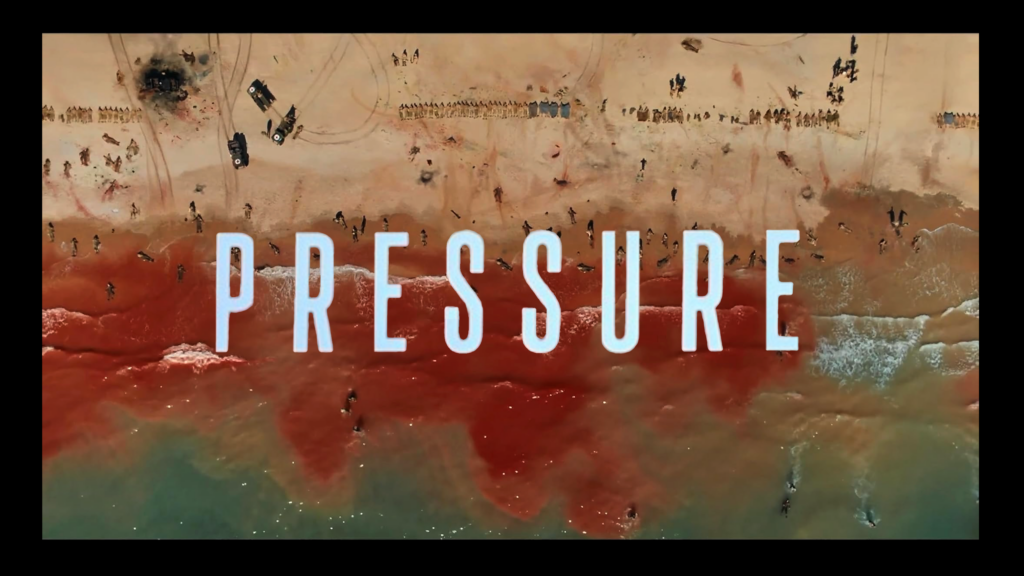
I eagerly anticipated the release of “Pressure” more than most. As a weather historian, I spent three-and-a-half years researching the weather and weather forecast process behind Operation Overlord (the code name for the D-Day invasion) back in the early 1990s. The documentary I wrote and produced to coincide with D-Day’s fiftieth anniversary is considered by many to be the definitive story about history’s most important weather forecast, and was considered so historically significant that it was added to the D-Day archive at the Dwight D. Eisenhower Presidential Library, the British Meteorological Archive, and the Museums of Television and Radio History in New York and Chicago.
So, I approached the movie with trepidation. How historically accurate would it be? At the movie’s beginning, it said “Based upon a true story.” A more appropriate statement would be “Loosely based upon a true story.” First, let’s discuss what the movie got right.
The synoptic set-up was correctly portrayed as it was in early June 1944. In what had become more of a winter-type pattern, incredibly atypical for early June, deep lows were stacked up across the Atlantic. The movie also accurately portrayed the meteorologists hand plotting and analyzing synoptic maps. The viewing public certainly saw a nice visual of what operational meteorology was eighty-two years ago.
However, when it comes to the forecast process set up by the Allies, the movie completely mischaracterizes what actually happened, right from the beginning. First, Pressure implies that Group Captain James Stagg, who headed the weather team, joined the forecast unit just three days before D-Day. This is incorrect: he was part of the Allies’ forecast team for many months before that. Furthermore, Stagg’s appointment to head this vitally important military unit greatly upset the Allies, because he was a civilian! So, the British instantly made him “military” and gave him the title Group Captain. Truly, I can’t make this stuff up!
Next, the movie greatly implies that all of the forecasters were working in a single office. This is wrong. The Allies set up three different weather forecast centers: an American office code named “Widewing,” the British Admiralty weather office, and the British Meteorological Office. The meteorologists at these three offices never met in person; they plotted and analyzed their own maps, made their own forecasts, and then discussed their interpretations over the phone at least twice a day on scrambled teleconference calls without seeing each other’s charts. While the movie makes it Group Captain Stagg versus American Colonel Irving Krick, it is more accurate to say that the American weather office forecasts using Krick’s analogue forecast technique differed from their British counterparts. You can imagine how difficult it was to try and work out these differences over the telephone! If only they had Zoom back then.
Next, the movie implies that Stagg was the sole synthesizer of the differing forecasts and the one to communicate a single forecast to General Eisenhower and the Commanders in Chief. What the movie neglects is that there was another weather officer who worked with Stagg: American Colonel Donald Yates. Yates’ presence was vital, because Stagg was NOT a meteorologist (he graduated college with a Master of Arts degree and became a science teacher, then got his PhD in terrestrial magnetism and later worked at the British Met Office). Yates was a meteorologist. He listened to those scrambled teleconference calls with Stagg, worked out the forecast with him, and accompanied him to the Commander in Chief meetings.
Finally, while the movie accurately portrays how the weather made things incredibly difficult for the beach assault troops, it really does not give the whole story. Paratroopers jumping into Normandy in the middle of the night had great difficulty due to the cloud cover. Some were dropped many miles from their intended drop zones. Furthermore, the cloud cover is what compromised some of the aerial assault at dawn on the Normandy coastal defenses. It was this inability to disarm the coast that caused the horrific bloodbath on Omaha Beach.
There is so much more to the D-Day story that also wasn’t told. For example, four weather observers accompanied by radiomen went into Normandy overnight — two by parachute with the paratroopers and two by glider. Furthermore, had General Eisenhower been conservative and postponed the invasion until nearly two weeks later — the next time low tide came at the needed time — the forecast was positive, but a surprise storm hit that was considered the worst to impact the English Channel in fifty years. An invasion launched into that weather would have resulted in failure.
If you’d like to see my twenty-three-minute (the commercials have been edited out) documentary, Forecast Overlord, you can view it here.
You’ll hear from three of the invasion meteorologists themselves, excerpts from a James Stagg 1976 BBC radio interview, recollections from one of the weather observers who parachuted into Normandy with the overnight paratroopers, and D-Day soldiers, sailors and airmen discussing the weather’s impact on history’s greatest military operation
Sean Potter, who brilliantly moderated an AMS webinar with the film’s director, Anthony Maras, and his meteorological advisors said it best to me: Pressure is “not a documentary.” And Sean is right. It is a drama. Like many movies, it took a true story and used a lot of poetic license. This does not mean it is a bad movie. On the contrary. It is a very good movie, but we in the atmospheric and oceanic sciences should also know the truth, which is why I wanted to write this.
As a postscript, I want to share that I was able to get General Donald Yates (ret.) on the phone while researching my documentary. Unfortunately, even though I explained that I was a fellow meteorologist working on a historical scientific documentary, he had a great distrust of the media and would not let me interview him or even just record the phone call. It was a short conversation, but he did tell me one thing that I’ll always remember: General Eisenhower inherently trusted the weather team and the forecasts he was getting from him and Stagg. And in a 1964 interview, Eisenhower summed it all up: “I knew it couldn’t fail, except for the weather.”