This article is part of a series featuring the Doppler on Wheels team and tornado season. Read the first article here, introducing the team, and the second article here, about recent findings from 2024’s Duke and Greenfield tornadoes.
As a violent, rain-cloaked tornado bore down on the town of Greenfield, Iowa, Jen Walton was racing right into its path. Even for an experienced storm chaser, it was a heart-pounding maneuver. “We knew the tornado was already quite close, and moving quickly, and that we had very little time,” she said in a recent interview. “The short drive felt like an eternity as we drove toward a wall of white.”
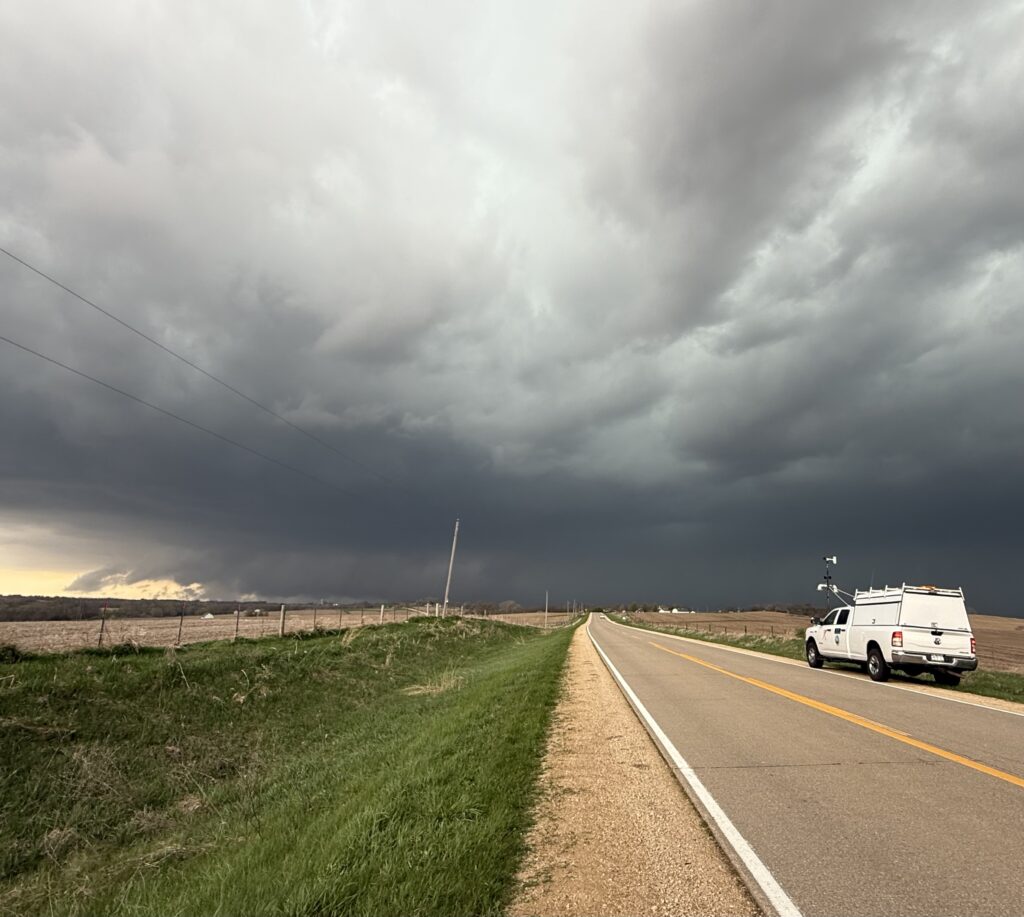
Walton was part of the Doppler on Wheels (DOW) team of storm researchers. Her goal: deploy a “Pod” with meteorological instruments as close as possible to a tornado’s radius of maximum winds to help the team learn more about the near-surface dynamics of these deadly storms. Walton was in one of the “SCOUT” mesonet deployment vehicles, which had been tucked to the east of Greenfield with a DOW radar truck that was scanning the storm. Walton remembers clearly getting the call from DOW founder Josh Wurman as the tornado appeared on track to pass west of town.
“Okay, SCOUT — please turn around and head back toward Greenfield to drop Pods.”
The whole day, May 21, 2024 had been a sprint for the team — officially the Flexible Array of Radars and Mesonets (FARM) Facility, associated with the University of Alabama in Huntsville — as they rushed to catch weather systems moving at 50+ miles per hour with their instruments and radars. When it became clear that the interception point was Greenfield, SCOUT drove farther in, aiming to place Pods and mobile mesonets as close as possible.
Yet even as they deployed, the tornado’s path was shifting, putting it on a much deadlier course — straight toward the SCOUT team, and central Greenfield.
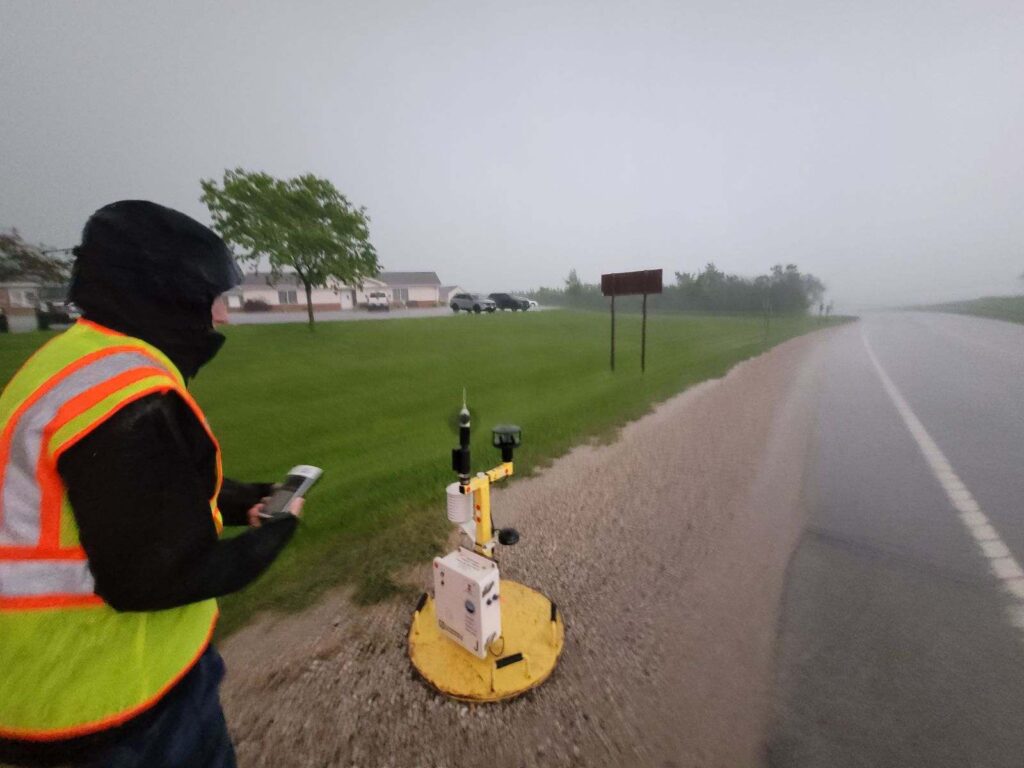
“It was pouring rain at that time,” Walton recalled, “and we had no visibility of what was in front of us. [SCOUT] pulled up just short of the center of town and [we] threw ourselves out of the vehicle into rain that was blowing sideways — not in an outflowy way, but in a left-to-right way, indicative of being next to something that is rotating rapidly, drawing rain curtains around it.”
<Jen Walton deploys a Pod with meteorological instruments in Greenfield, Iowa, on May 21, 2024. [Photo credit: FARM Facility]
The SCOUT team knew the tornado was close. “As we pulled the Pod out of the truck and placed it on the side of the road, debris began to fall around us,” Walton said. “Leaves and branches, pieces of insulation, unrecognizable pieces of wood, other things we couldn’t identify. I took a photo of our GPS with the Pod, then looked up and saw sunlight. My brain registered that I was looking up into the RFD cut and that we were quite literally next to whatever was hiding in the rain. I flew back to the truck and shouted, ‘WE HAVE TO GO NOW,’ and we fled back toward the DOW scanning on the east side of town.”
They didn’t know it at the time, but as they rushed back, the DOW 8 vehicle was being hit by a second tornado. “While we were scanning and mapping the very intense tornado approaching Greenfield, a second tornado formed just to our southeast and hit our DOW,” Josh Wurman told AMS Headlines. “We were paying attention to the main tornado but all of a sudden the winds at the DOW were blowing very strongly … in the ‘wrong’ direction. We were fine; the DOWs are heavy and armored. But this was a reminder of the complex hazards of tornadic storms, and the limits of predictability and of our knowledge.”
When the SCOUT vehicle made it back to the rendezvous point, Walton said, “We pulled up in front of [the DOW], and took a deep breath.”
Soon, Wurman radioed the team to proceed into Greenfield for a damage assessment.
“As we pulled up to retrieve the Pod, it was a relief to see that most of the buildings in that immediate vicinity were intact, albeit with some beams embedded in roofs,” said Walton. “We walked around a little bit, but something told me not to go further into town. Instead, I wandered around in front of the building next to our deployment site, and then eventually walked around the back — and was appalled to find that just behind that building was… nothing. Trees stripped bare, foundations stripped … it was extremely difficult to take in. I couldn’t reconcile it with the intact building right next to me.”
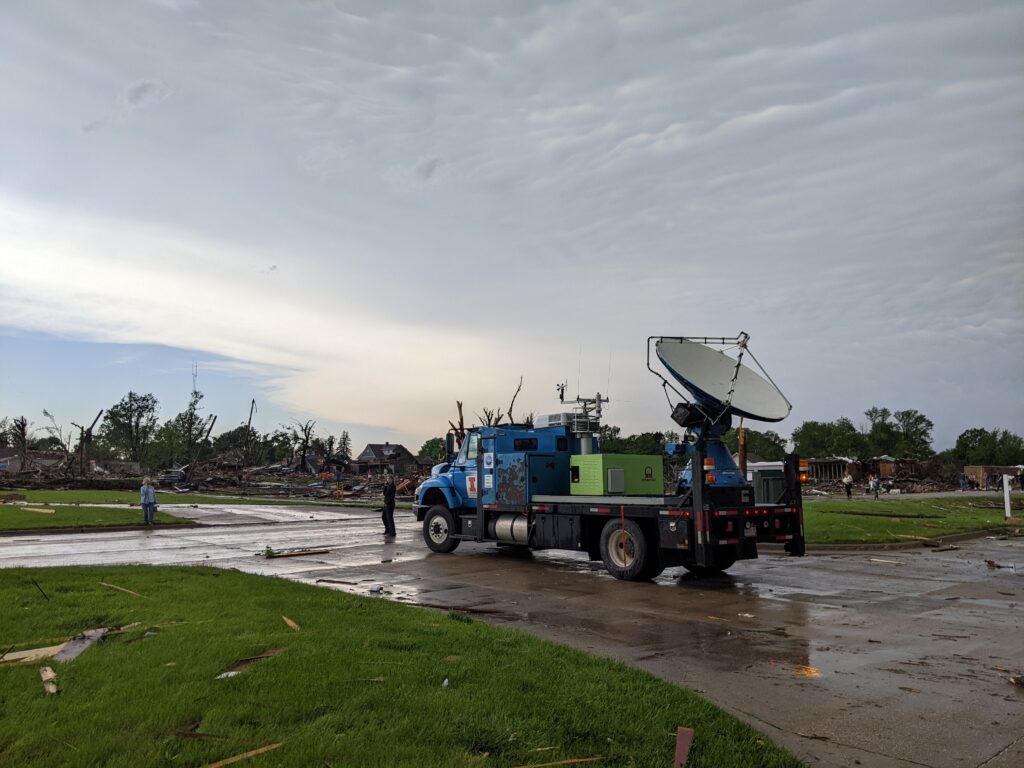
Instead of continuing north as predicted, the tornado had made a right turn through the center of Greenfield. “It had narrowed to a small and incredibly violent vortex,” Walton said, “Which is why I had seen an intact building just feet from absolute destruction.”
Chasing a Dream
Walton’s association with FARM and the DOWs marks an unusual (although not unprecedented) collaboration between storm chasers and meteorological field researchers. Using truck-mounted radars and other mobile instruments, the DOW team gets close to severe weather to obtain key data not observable from farther away — a type of research that works well with the skills of a storm chaser. Walton got involved with the team through her work as founder of Girls Who Chase (GWC), an organization that promotes and supports women’s participation in storm chasing and meteorology.
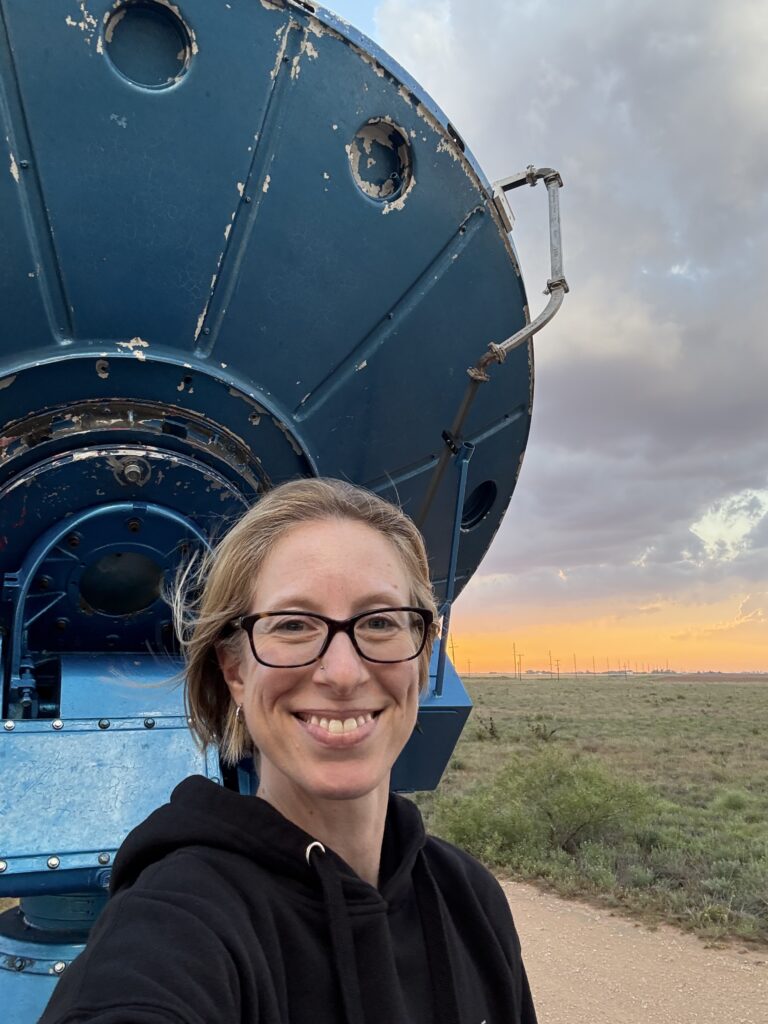
Although she had always been interested in severe weather, Walton only started storm chasing when she was nearly 20 years into her primary career of climate communication. “I actually worked across the street from the original DOW hangar in Boulder [in 2009-2011], and would drive past the hangar with my head basically hanging out the window, staring and wishing I was driving in there instead,” she said.
When she started storm chasing in 2018, she quickly noticed a lack of representation of women in the field, which led her to start Girls Who Chase as an Instagram page. It has since expanded into a multimedia platform (and AMS partner organization) that runs its own training programs on storm chasing, radar meteorology, and weather photography. 2024 was Walton’s first season with the DOWs; after meeting FARM team co-lead Karen Kosiba through GWC, the two realized Jen’s storm chasing and communications skills could both be an asset to FARM’s efforts.
<Jen Walton with a DOW radar vehicle in 2025. [Photo credit: Jen Walton]
That prediction came true almost right away; the Pod data from Greenfield turned out to be part of a crucial information set that the FARM team is now using to improve understanding of how tornadic winds interact with human-made structures.
Working with Walton in a SCOUT vehicle this field season is Anastasia Tomanek, a graduate student in the atmospheric science department at Colorado State University and member of the FARM team who also supports the management of Girls Who Chase.
Tomanek previously worked in music education, but later also made a career pivot toward meteorology. “In 2011, as I began exploring college and career options, women pursuing STEM were not as encouraged and supported as they are today,” Tomanek noted in a written interview with AMS Headlines.
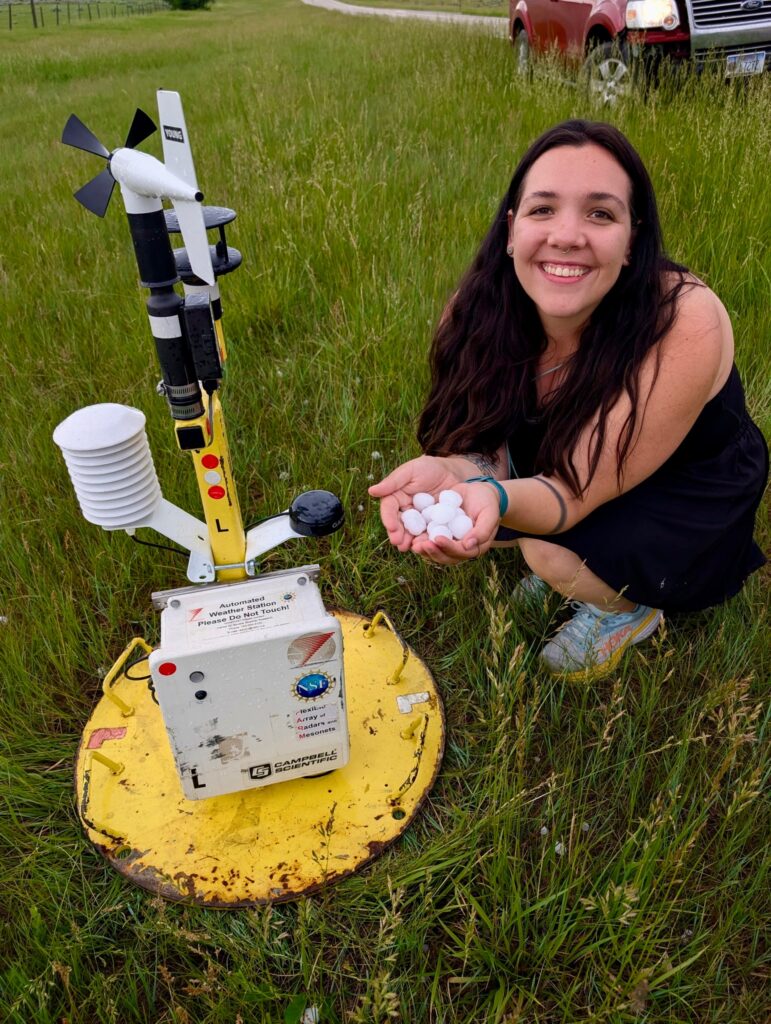
Online videos, TV programs, and live streams about severe weather sparked Tomanek’s childhood interest in storm chasing and the DOWs. She began storm spotting as soon as she had her driver’s license, then chasing storms starting in college in 2013. In 2020–21, she made the switch to atmospheric science and enrolled for her second bachelor’s degree at the University of Wisconsin-Madison. While studying there, she was awarded the AMS Women in Science Scholarship Award, and in her last year was selected for the summer FARM Facility Radar Institute. Paired with networking efforts, this soon led to a deployment on Hurricane Milton with the DOWs. The deployment affirmed her love for field research: “monitoring instrument readings, staying up-to-date on storm forecasts and observations, and eventually sleeping in the vehicle at a site safe from storm hazards.”
<Anastasia Tomanek with a Pod during an ICECHIP project deployment in 2025. [Photo credit: FARM Facility]
Later came funding from the UCAR SOARS program to work with FARM on the ICECHIP hail research project and oversee crews of students in mesonet/Pod vehicles.
“While driving through the Oklahoma and Texas panhandles behind Jen in DOW B, I burst out laughing, much to the confusion of my carmate, in a moment of pure joy. I couldn’t believe I was participating in a major severe weather field campaign, let alone working with the very team that inspired me over 15 years ago.”
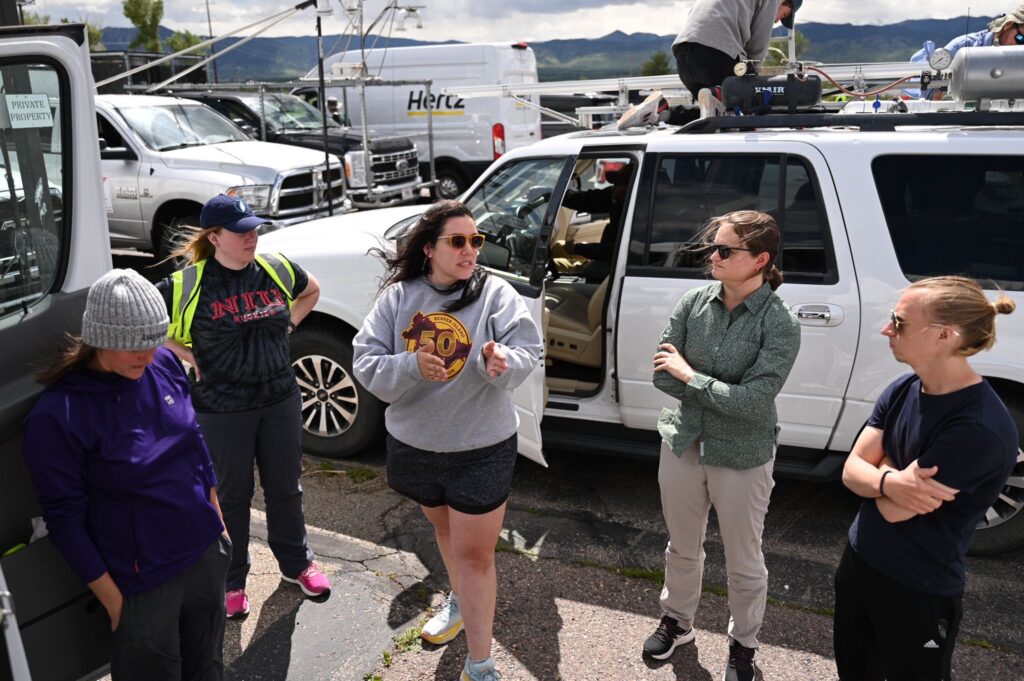
They both believe more women should have access to this kind of opportunity; it’s part of the reason Walton started Girls Who Chase. GWC is helping tackle key challenges that women and other underrepresented groups face in science-adjacent fields — from lack of representation making them feel they don’t belong, to self-doubt about their own qualifications, to safety concerns (driven by both weather and people).
“Previous media coverage told us storm chasers were predominantly male, perhaps loud, blowing out windshields in hail and driving into tornadoes — then culture assimilated that notion,” said Walton. “Media wants to give culture what it demands, so it fed us more of the same type of chasers.”
Yet both say they are seeing strong evidence of change. “Asking ‘why is it like this?’ helped interrupt the pattern,” Walton said. “Media generally were happy to mix things up, and the more folks saw women storm chasing, the more women saw themselves storm chasing, getting meteorology degrees, leading storm chasing tours, or participating in field research.”
Walton estimates an approximately 10%–15% increase in female-identified chasers in the last five years, based on anecdotal data, statistics from the National Storm Chaser Summit, and the Girls Who Chase annual Spring Training. “Several degreed meteorology programs have recently reported up to half of enrolled students identifying as female,” she adds.
Tomanek’s experience reflects this. Pursuing her second bachelor’s degree in 2020, she said, “the students were nearly 50% women; however, there was still a lack of representation regarding individuals of color. As an Indigenous diaspora adoptee, representation in the weather, climate, and water enterprise is a cause I have continually advocated for. Girls Who Chase has allowed me to pay it forward for others who have felt isolated as I once did.” She’s proud of the progress she has witnessed. However, “there is always room for improvement. The storm chasing community must be proactive in treating women equally and with respect.”
Room for Collaboration
The goals of recreational storm chasing are often different from those of researchers, yet at times the two make excellent partners.
“It’s been great working with Jen and Anastasia,” Karen Kosiba told AMS Headlines. “They have a good head on their shoulders, and [they’re good at] working with instruments. It’s great to partner up with people who are like-minded and who have a storm chasing interest and also are interested in contributing to good science. … It takes a lot of work to document things right, to be in the right place [and] be asking the right questions that are scientifically interesting.”
Walton noted that “the storm chasing skillset is extremely useful to field-going research teams operating in fast-moving environments in proximity to sometimes dangerous weather.” A storm chaser “has the ability to operate calmly in a high-stakes environment, has the experience to immediately recognize and respond to storm behavior, and knows how to strategize getting the job done despite all the usual limitations (poor road network, limited cellular data, etc.).”
In addition to field research, Walton sees room for more collaborations. Storm chasers can provide real-time field coverage that feeds into weather warnings and risk information; educate the public; and serve as local/regional weather and climate experts. Even people who distrust “experts” are likely to believe the danger when they see a livestream of a tornado on the ground. And organizations like Girls Who Chase can provide a more accessible entry point into the world of atmospheric science.
“Storm chasers are able to convey real-time information and imagery in ways that, as little as five years ago, weren’t possible,” Walton noted. “We’d like to see additional productive partnerships between meteorologists, chasers, and media that all contribute toward this endeavor.”
Why Chase Data?
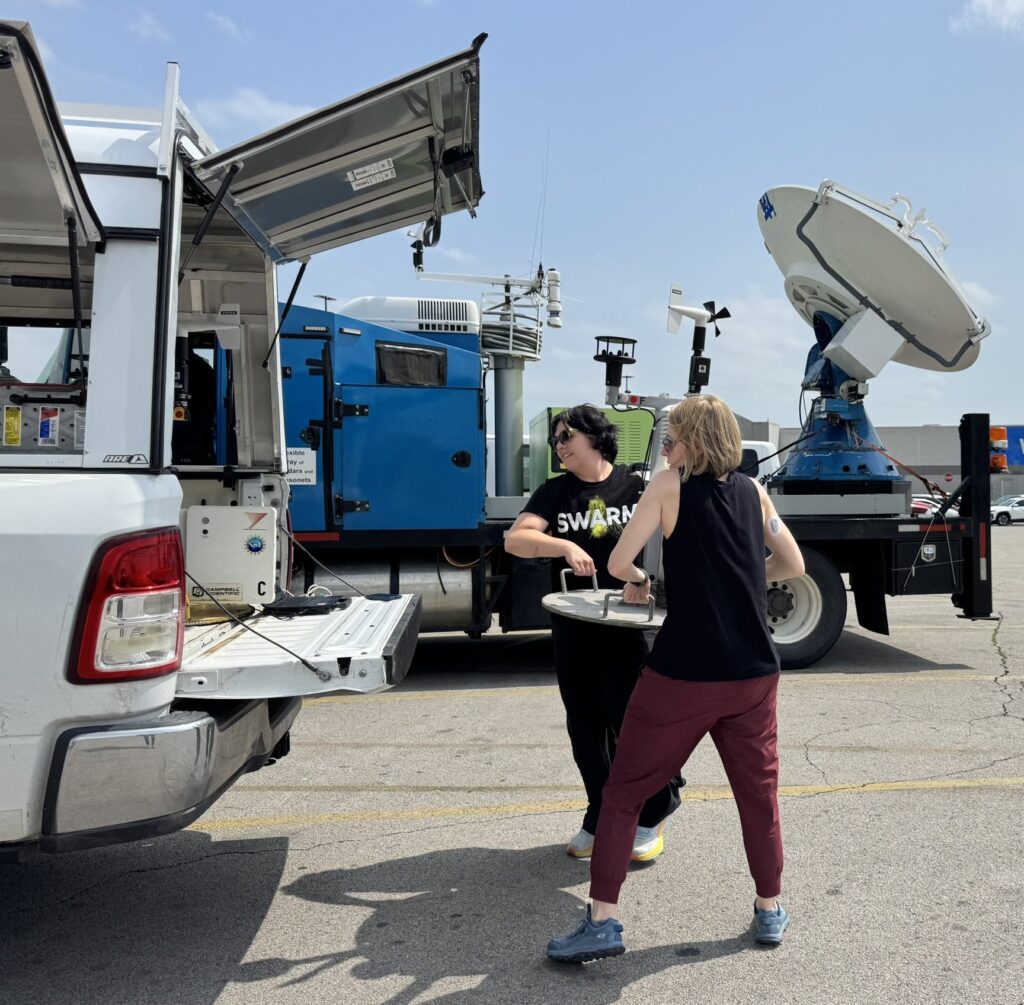
Being on the FARM team combines a passionate interest in severe weather with the chance to contribute important knowledge. In 2026, Walton and Tomanek are again deploying Pods with weather instruments and mesonets on the SCOUT team, for both ICECHIP hail research and the Boundary Layer Evolution and Structure of Tornadoes (BEST) project. Projects like these employ many people from all walks of life to answer key scientific questions, from understanding supercell dynamics to finding out what types of roofing material best withstand hail.
“With mesonets, you sometimes get really close to stuff, which is a good challenge for me as a chaser,” says Walton. “And I am just not giving up until we can get a Pod in a tornado.”
Tomanek agreed. “I have the confidence to deploy Pods in the path of a tornado because I know the DOW team has our back. … I have always been driven to understand the surface conditions in a tornado; the prospect of analyzing Pod data I deployed would be the ultimate win!”
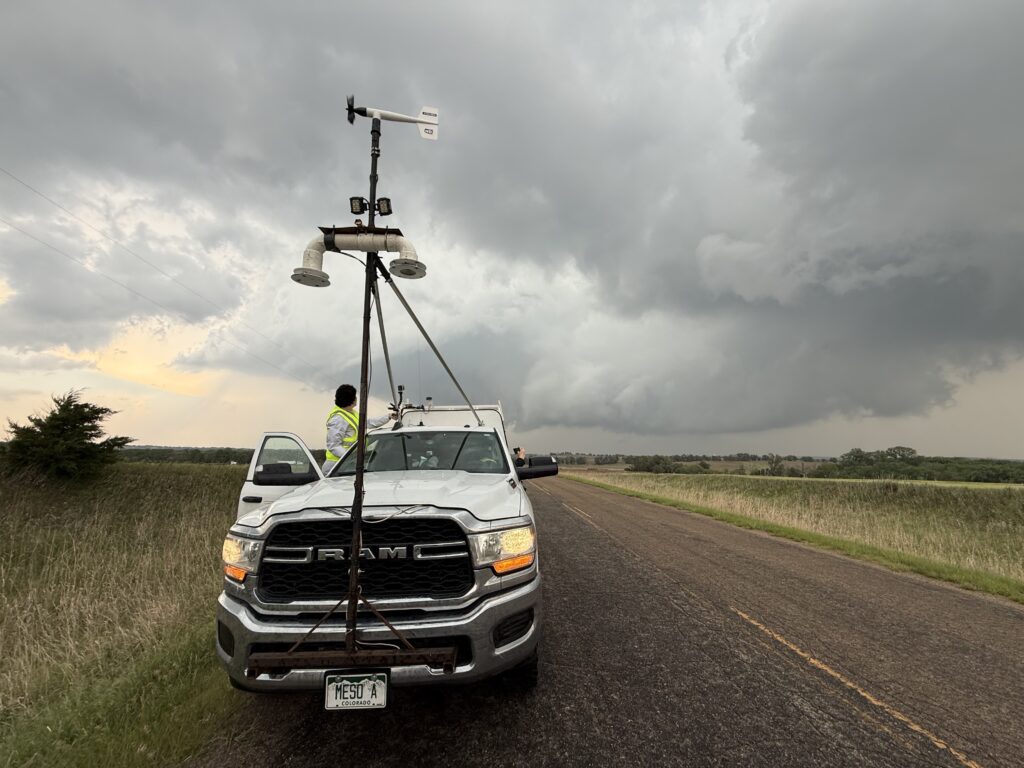
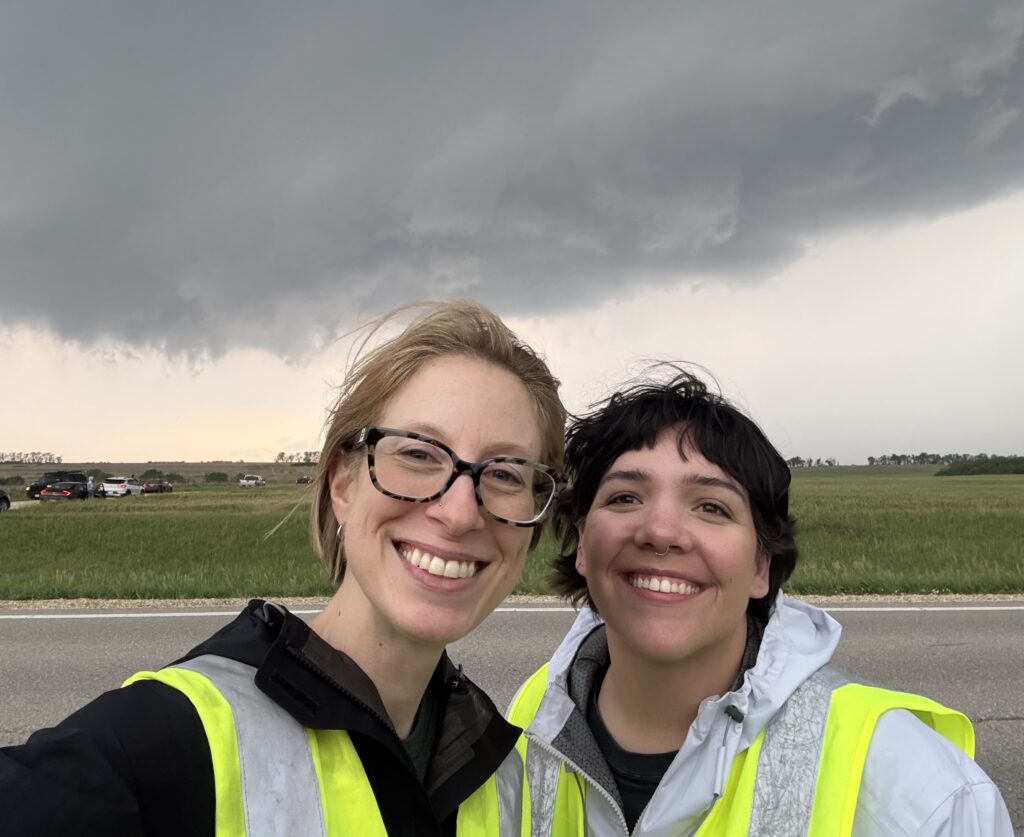
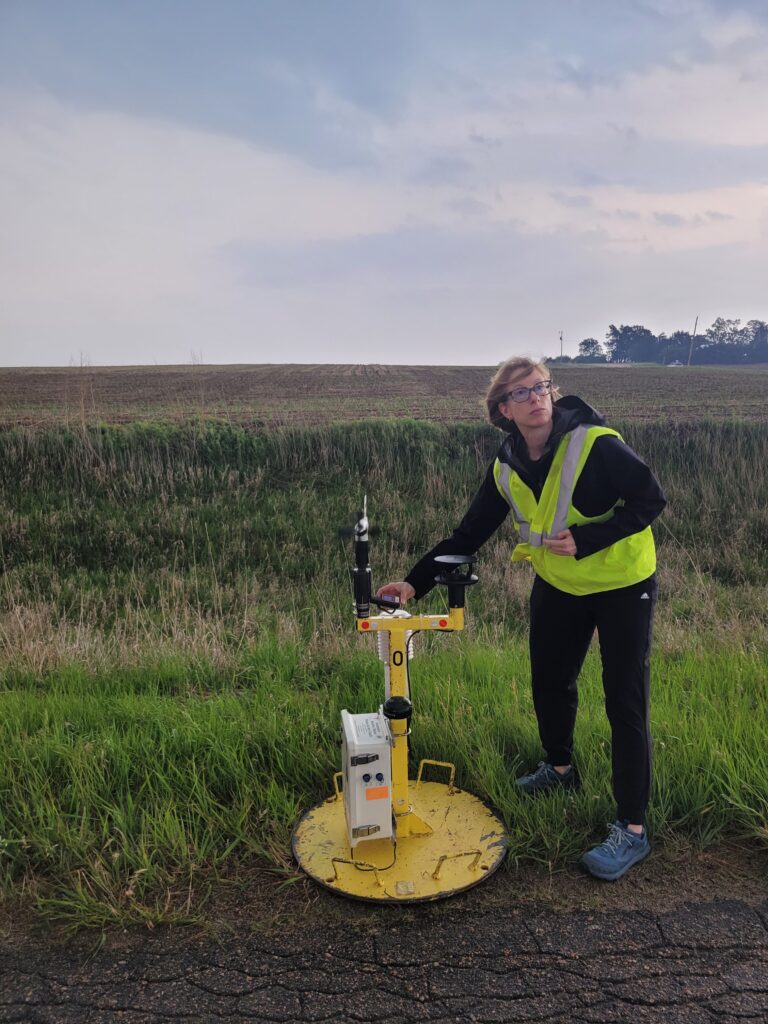
The importance of the work makes up for the occasional missed photo op and being tied to the FARM team’s goals and schedules. For Tomanek, it’s a culmination of her love for both research and storm chasing.
“I chase because I love experiencing the atmosphere firsthand and conceptualizing the processes studied in the classroom,” she said. “Consequently, I view field work with the DOWs as an upgrade — transforming a personal passion into scientific contributions.”
Walton also wouldn’t trade her work with the DOWs. “Severe weather research and communication is one of the few ‘jobs’ I’ve had in my life where I am just fine if I think about it all day, spend every day and night with the same people obsessively talking about the same thing, and don’t look at a clock. I could do it always and forever. That’s how I know I’m in the right place with the right people.
“Greenfield was my first significant tornado event that had done major damage to a populated area, and it was a lot,” she said. “But as I processed what I had seen, there was a bright spot: that the reason I was there was to help people better prepare for events just like that one. The research we were doing, and the calculated risks we took, mattered and would make a difference.”