A paper in the AMS journal Weather, Climate, and Society examines how multiple meteorological factors interact with rates of gun violence in New York City. Published online in June, the paper uses daily meteorological data along with NYC crime data from January 2006 through December 2022, looking not at single factors like temperature, but at the combination of temperature, air mass type, and precipitation.
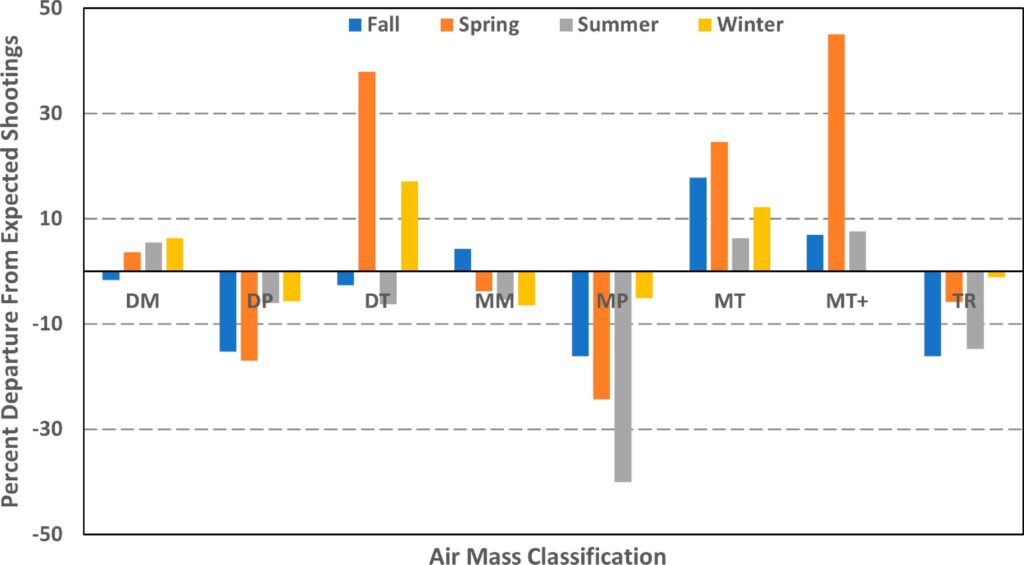
The authors found that (after controlling for other social factors), “hotter, drier air masses tend to increase shootings, especially in the spring, while cooler, wetter air masses tend to decrease shootings, especially in the summer.”
We spoke with the paper’s lead author Peter Forbin and co-author Adam Kalkstein about the implications of their research.
There have been other papers regarding the effects of weather on gun violence. How is this one different? What does it show that is unique?
This study differs from previous work by using air mass classification to represent daily weather, rather than relying on individual variables like temperature and precipitation. Air masses capture the overall character of the atmosphere, offering a more comprehensive view of environmental conditions. The analysis is also conducted separately for each of New York City’s five boroughs, instead of treating the city as a single unit. This approach reveals that while weather influences shootings citywide, the effects vary by borough. Areas with higher baseline crime, such as the Bronx and Brooklyn, show smaller changes in response to weather, while lower-crime boroughs experience more pronounced effects.
What are the limitations to this research/your conclusions?
This study uses a single weather station in Central Park to represent atmospheric conditions for all five boroughs. While there is likely broad similarity, microclimatic variations across the city, particularly due to urban heat islands and coastal proximity, are not captured in this approach. Additionally, our shooting data depend on police reports, so incidents may be under-reported. Despite efforts to control for seasonal and social factors, some irregular patterns, such as notable spikes in shootings during holidays and school cycles, may still contribute noise to the results. Finally, our analysis is limited to gun violence and does not address other forms of violent crime, which could influence overall patterns of weather-crime associations.
What made you start researching this topic? Why is it important?
The United States Military Academy at West Point is located just 50 miles north of New York City, the nation’s largest city and a frequent destination for our students. We began researching this topic to better understand how weather and crime interact at a local level in such a complex urban environment. This research is important because identifying weather-related patterns in violent crime can help law enforcement take a proactive approach.
Is there any agreement in the literature about why you find these particular correlations?
Yes, there is a general agreement in the literature that weather influences crime primarily through psychological effects related to human comfort. On days with comfortable weather, more people tend to be outside and in closer proximity, increasing the opportunity for crime. In our study, we find that maritime polar airmasses, characterized as cold and wet, are associated with large decreases in shooting incidents across all boroughs and seasons. Conversely, maritime tropical air masses, which are humid and warm, are linked to increases in shootings all seasons. Notably, the decrease associated with maritime polar air masses is least pronounced in winter, likely because cold and damp conditions are more typical in New York at that time, whereas the largest decreases occur in summer, when such weather is more abnormal and discourages outdoor activity. In contrast, the effect of maritime tropical air masses is strongest in winter and spring, with summer showing the least additional increase.
You note in the paper that these weather-related trends are apparent after controlling for other social factors such as day of the week. How great an influence would you say that weather/airmass type has, compared with other social factors you controlled for?
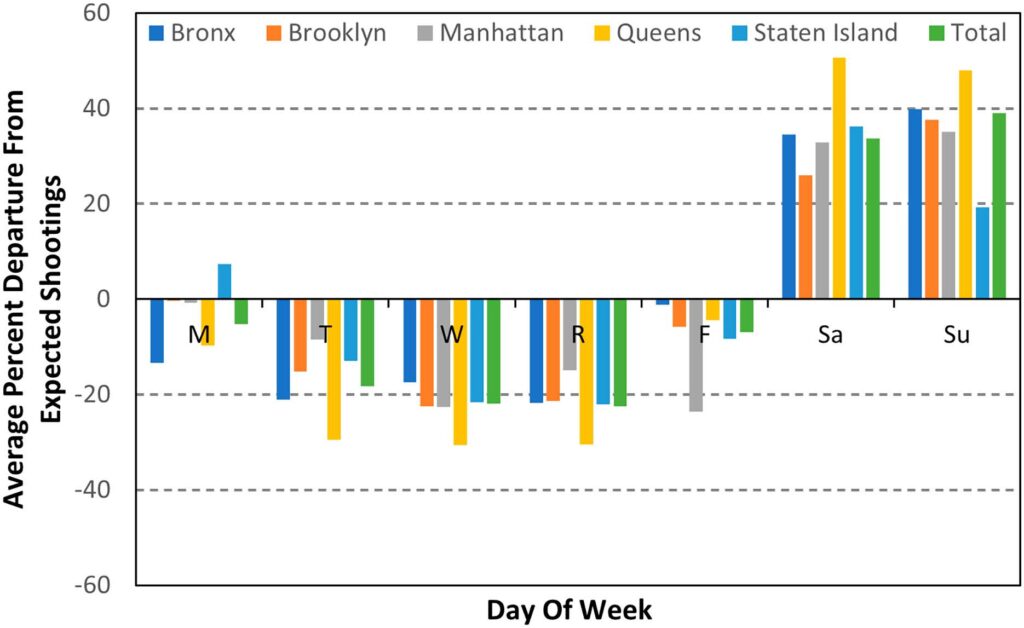
Although weather and air mass type often show large, statistically significant effects on shootings, the impact is generally smaller than that of certain social factors such as day of the week and holidays. For example, air mass type can cause departures from expected shootings of up to 40% for certain seasons and boroughs, but weekends and holidays produce even larger and more consistent swings. In fact, shootings across all boroughs are consistently higher on weekends, with Queens experiencing nearly a 60% increase compared to weekdays.
Were there any complications to the study you hadn’t anticipated?
Yes, one complication was the lack of reliable and complete weather data for boroughs outside of Manhattan. While Central Park provided consistent historical weather records, many other stations in the outer boroughs had gaps or missing data, making them unsuitable for analysis. This led us to use Central Park as the single representative weather station for the entire city.
Are there questions that still need to be addressed in this area?
Better spatial resolution for data, such as analyzing by zip code rather than by borough, could help identify regions with particularly high or low crime more accurately. Additionally, having more reliable and diverse weather stations across all boroughs would allow for a finer analysis of how local weather variations, like the urban heat island or proximity to water, contribute to the influence of crime patterns within neighborhoods. Finally, including other crime categories, such as assault and robbery, alongside shootings, could provide a more complete understanding of the relationship between weather and violent crime in New York City.
Can this research inform gun violence prevention efforts?
Yes, this research can inform gun violence prevention efforts. Even at the borough level, the study identifies areas at higher and lower risk based on air mass type and underlying socioeconomic factors. Rather than only reacting after incidents occur, this information provides a framework for law enforcement to identify hotspots and proactively adjust patrols and personnel deployment in response to forecasted weather conditions, allowing for a more targeted and efficient approach to prevention.
Find this paper online: “Exploring The Role of Air Mass Type and Weather on Shooting Incidents in New York City.”
Image at top: Photo by Pixabay.