by Sachin D. Ghude1
Delhi, India’s bustling capital, is a city of contrasts—vibrant culture, ancient history, and unfortunately, some of the world’s most challenging air pollution. Every winter, millions in Delhi wake up to a heavy blanket of smog. For months at a time, the city’s air becomes dangerously polluted, with tiny particles and smoke choking the skyline. But what if we could predict these suffocating pollution events with unprecedented accuracy, and even more, pinpoint their sources to enable targeted, effective interventions? This is precisely the ambition and achievement of AIRWISE: The Air Quality Warning and Integrated Decision Support System for Emissions, a groundbreaking initiative led by the research team at Indian Institute of Tropical Meteorology (IITM) in Pune.
The story of AIRWISE begins with a critical need. Traditional air quality models often struggled to capture the acute, localized pollution spikes characteristic of megacities like Delhi, leaving policymakers scrambling for solutions. Recognizing this gap, the Ministry of Earth Sciences (MoES), Government of India, spearheaded the development of AIRWISE. Key institutions like the IITM and the India Meteorological Department collaborated with international partners, notably the U.S. National Center for Atmospheric Research (NCAR), to further bolster its capabilities in urban-scale modeling, ensuring AIRWISE benefits from a pool of expertise. The system’s geographical focus is Delhi and its sprawling National Capital Region (NCR), a hotspot for complex air pollution dynamics. The journey began in 2018 with the launch of the first Air Quality Early Warning System (AQEWS), initially operating at 10-km and 2-km resolutions. By 2019, an enhanced AQEWS achieved an astonishing 400 m x 400 m resolution for Delhi, a world-first for an operational air quality forecasting system incorporating chemical data assimilation. The crucial Decision Support System (DSS) was integrated in 2021, adding the power of source attribution and emission reduction scenario analysis.
Delhi—home to roughly 32 million people—faces a persistent and severe air pollution challenge, particularly from October to March. This period coincides with the postmonsoon and winter seasons, characterized by unique meteorological conditions and significant anthropogenic activities. The city consistently ranks among the world’s most polluted, underscoring the urgent need for effective air quality management. The severity of pollution is exacerbated by specific seasonal drivers. Agricultural residue burning (stubble burning) in northwestern Indo-Gangetic Plain states during October-November is a major contributor. Furthermore, adverse winter meteorological conditions, including deep thermal inversions, shallow boundary layers, calm winds, and widespread fog events, trap pollutants near the ground, intensifying concentrations. Local anthropogenic emissions from transport, industry, construction, residential activities, and waste burning further compound the problem. The convergence of these factors creates a “perfect storm” for extreme pollution events, necessitating a forecasting system capable of accurately modeling both atmospheric physics and chemistry at a highly localized scale. Previous air quality models struggled to accurately predict severe pollution events, leaving decision-makers without adequate tools to protect public health. The Government of India’s National Clean Air Programme and the establishment of the Commission for Air Quality Management (CAQM) with its Graded Response Action Plan (GRAP) highlighted the urgent need for accurate, advanced forecasting tools to support policy implementation.
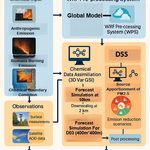
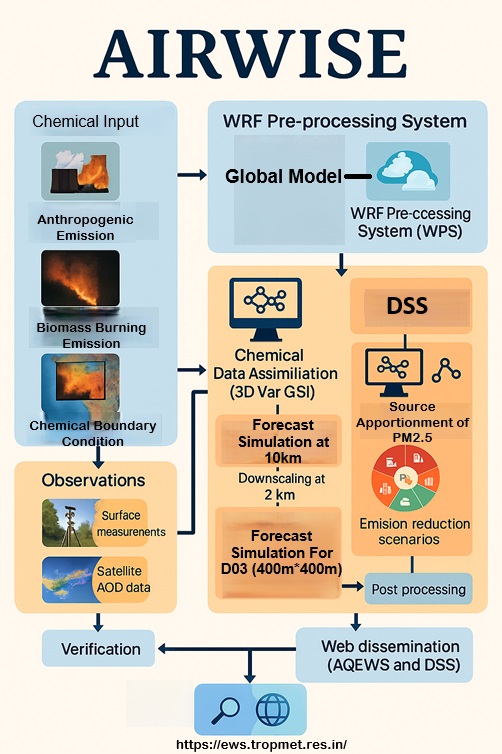
AIRWISE is a comprehensive operational modeling architecture that integrates AQEWS and DSS. It is meticulously designed to link air quality early warnings with emergency action plans for short-term air quality management. The core of AIRWISE is the Weather Research and Forecasting Model Coupled with Chemistry. It employs a three-domain nested setup, dynamically downscaling from 10 km to 2 km to a highly detailed 400-m resolution over Delhi. This ultra-high resolution, coupled with chemical data assimilation, positions AQEWS as the world’s first operational air quality forecasting system of its kind. The system employs the 3DVAR method to assimilate real-time chemistry-related data, integrating satellite AOD retrievals and extensive in situ observations from approximately 370 air quality monitoring stations across India. A multiscale approach is used for anthropogenic emissions, from global inventories to a high-resolution inventory for Delhi. This meticulous attention to emission data ensures the model has the most accurate representation of pollution sources.
The DSS component of AIRWISE is a cutting-edge global tool designed to provide model-based, real-time source apportionment for Delhi’s fine particulate load and quantify the effectiveness of various emission reduction scenarios. It transforms raw forecast data into actionable intelligence for policymakers. The DSS provides critical insights into the complex source landscape of Delhi’s pollution. The DSS quantifies contributions from seven major emission sources within Delhi, 19 NCR districts, and stubble-burning activities in Punjab and Haryana. Crucially, it provides numerous emission reduction scenarios (e.g., 20% and 40% reductions, individually and combined) to quantify the effectiveness of interventions. Forecast outputs are postprocessed and communicated to regulatory bodies like CAQM, and are publicly accessible daily via the AQEWS website. A feedback mechanism exists where GRAP stages implemented by CAQM, based on forecasts, influence subsequent air quality scenarios, creating a dynamic, adaptive management loop. The DSS was instrumental in policy evaluation, showing that implementing GRAP Stage 4 restrictions reduced the Air Quality Index (AQI) by as much as 60 units in November 2022. It also informed new policy formation, suggesting that redistributing stubble to power plants and industries could reduce hourly mean AQI by up to 38% during peak burning days, directly informing CAQM’s policy mandating power plants and industries to replace coal with stubble.
Crucially, Delhi’s air quality regulators have begun using AIRWISE forecasts to trigger emergency measures. The city’s new Commission for Air Quality Management relies on these warnings to enforce the local “graded response action plan,” imposing restrictions (like closing schools or stopping construction) when a severe pollution event is predicted. In practice, this means Delhi can now plan ahead: people get several days’ notice to take precautions (staying indoors, wearing masks), and officials can target inspections or bans at specific factories, traffic hotspots or agricultural burning that the model indicates are to blame.
AIRWISE stands as a critical, science-driven tool for air quality management in India’s national capital, successfully integrating advanced forecasting with actionable decision support. Its high-resolution capabilities, robust data assimilation, and direct linkage to policy implementation mark a significant leap forward in addressing complex urban air pollution. The system reliably predicts air quality trends, provides crucial information during extreme pollution events, and offers invaluable insights into source apportionment and intervention effectiveness, empowering policymakers to make informed, science-based decisions. It has transformed air quality management in Delhi. While challenges persist, ongoing efforts promise to further refine AIRWISE’s accuracy and effectiveness. Planned enhancements and a future scope for AIRWISE include dynamic emission inventories using near-real-time high-resolution satellite datasets and deep-learning techniques, enhanced chemical mechanisms to include missing aerosol species, and the development of multimodel ensemble forecasts.
The big picture is clear: By predicting smog storms, AIRWISE could help save lives. Chronic air pollution is a leading cause of illness in Delhi and other dusty cities. Having a reliable warning system flips the usual script—it turns pollution forecasting into an advance “alert” rather than an after-the-fact analysis. Communities could pause outdoor work or switch to cleaner fuels on high-risk days, and industries can trim emissions preemptively. If this technology is widely adopted, smoggy winters may come with at least a handful of clear days where predictions and precautions spare millions from choking smog—a small but vital breath of fresh air. The planned expansion to other Indian megacities including Mumbai, Kolkata, Ahmedabad, Pune, and Jaipur underscores its potential to serve as a cornerstone for sustainable urban air quality management across the nation, contributing significantly to public health and environmental sustainability.
A Brief Conversation
with the Author
“My interest in meteorology began during my early research years in Delhi, where I experienced firsthand how air pollution intensifies during winter. Despite having similar populations and industries as other megacities like Mumbai, Bengaluru, Pune, or Chennai, Delhi faces uniquely severe winter pollution. This piqued my curiosity: why does Delhi choke when others don’t?
“The answer lies in meteorology. During winter, Delhi experiences deep thermal inversions, weak winds, and a shallow boundary layer. These conditions trap pollutants near the ground, turning the city into a gas chamber. I realized meteorology wasn’t just about weather—it was key to understanding and predicting air quality. Yet, traditional models couldn’t capture sudden pollution spikes or explain their sources accurately. This challenge led to my involvement in developing AIRWISE, an ultra-high-resolution forecasting and decision-support system. It merges chemical weather models with real-time data to forecast pollution events at 400-meter detail and identify sources like stubble burning and traffic.
“Understanding how the atmosphere interacts with emissions became my passion. Through this work, I saw how science can guide real-world actions to protect health. That early curiosity about Delhi’s choking winters evolved into a lifelong mission: using meteorology to make the air in our cities cleaner and safer to breathe.”
—Sachin Ghude, Indian Institute of Tropical Meteorology, Ministry of Earth Sciences
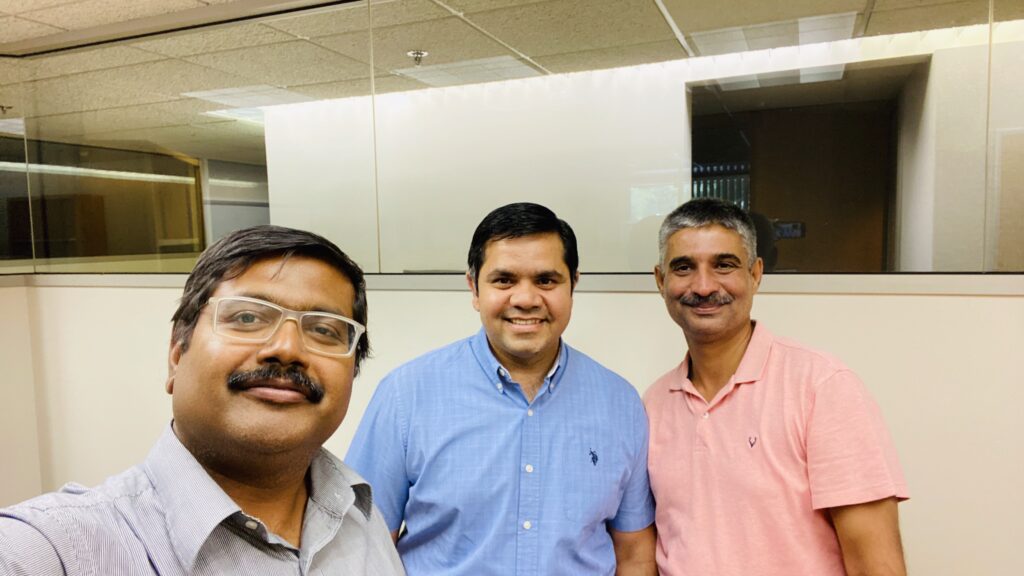
“Back in 2011–12, thanks to the BOYSCAST fellowship from the government of India’s Department of Science and Technology, I had the chance to work at NCAR, where I first met Rajesh and Mrinal. Over countless discussions, Rajesh and I dreamed of building India’s own air quality forecasting system. This selfie marks a small celebration of that dream coming true—the successful implementation of the AIRWISE project.”
BAMS: What would you like readers to learn from this article?
Sachin Ghude (Indian Institute of Tropical Meteorology, Ministry of Earth Sciences): Our article highlights how science can play a powerful role in protecting public health—especially when it’s closely linked to real-world decision-making. Delhi, one of the world’s most polluted cities, faces complex air quality challenges, particularly during winter. Until recently, there was no accurate system to predict when or why extreme pollution events would strike.
This article showcases how AIRWISE, developed by the Indian Institute of Tropical Meteorology (IITM) under the Ministry of Earth Sciences (MoES), is transforming air quality management in Delhi. AIRWISE uses cutting-edge chemical weather modeling and real-time data from satellites and over 370 monitoring stations to deliver highly accurate air quality forecasts at an exceptional 400-meter resolution. This allows authorities to predict extreme pollution events several days in advance. What makes AIRWISE unique is its Decision Support System, which links forecasts directly to action. It identifies pollution sources—such as stubble burning, transport, and industry—and simulates the effectiveness of various emission-reduction strategies. This information enables bodies like the Commission for Air Quality Management (CAQM) to take timely, targeted steps under the Graded Response Action Plan.
What readers should take away is this: pollution is not inevitable. With the right scientific tools, it’s possible to predict, prepare for, and even prevent the worst pollution episodes. Forecasts can now trigger real-world responses like school closures or emission reductions, helping millions breathe easier. AIRWISE sets a new benchmark—not just for India, but globally—on how science and governance can work hand in hand to improve urban air quality and safeguard communities.
BAMS: How did you become interested in the topic of this article?
SG: My journey into air pollution research began during my PhD days in Delhi between 2002 and 2005. I was studying ozone pollution, but more than the data, it was the air I breathed every day that left a lasting impression. Delhi’s pollution wasn’t just a research topic—it was part of my daily life.
After completing my PhD, I moved to Pune to join IITM. The difference was stark—Pune’s air was much cleaner. It made me realize just how serious and localized air quality issues could be. In 2015, I launched a winter fog campaign in Delhi. What I found was deeply concerning. Pollution events were not only more frequent but far more severe, often crossing AQI 500. Despite this, there was no system in place to warn people in advance or guide short-term policy action.
Then came a pivotal moment in 2017. Our then-secretary at the Ministry of Earth Sciences, M. Rajeevan, called and asked: “Can IITM develop an air quality early-warning system for Delhi—in three months?” With strong institutional support, we accepted the challenge. That’s how the first version of India’s Air Quality Early Warning System was born.
My curiosity turned into commitment. I became deeply fascinated by how emissions, weather, and atmospheric chemistry interact to create extreme pollution episodes. The formation of the CAQM in 2021 gave our efforts real-world impact, linking science with policy.
Today, our AIRWISE system not only forecasts pollution but helps policymakers take action before it’s too late. This is what keeps me going: the belief that science, when connected to society, can help us all breathe a little easier.
BAMS: What surprised you the most about the work you document in this article?
SG: What surprised me most while documenting the AIRWISE initiative was realizing that Delhi’s air pollution is not just Delhi’s problem. It has three equally significant legs: emissions from within Delhi, from the surrounding National Capital Region districts, and from the broader Indo-Gangetic Plain. Each contributes roughly one-third to the city’s pollution burden—highlighting how regional collaboration is essential for clean air in Delhi.
Another key revelation was the critical role of winter meteorology. Even on days when stubble burning is absent, Delhi suffers from choking pollution due to calm winds, strong inversions, and a shallow boundary layer that trap pollutants near the surface. In fact, these meteorological conditions can worsen pollution just as severely as the days when stubble smoke engulfs the region.
Before AIRWISE, we lacked tools to capture this complexity. But today, this system accurately forecasts air quality at 400-meter resolution, pinpoints sources, and enables early policy action. What began as a scientific model now drives real-world decisions—from school closures to cleaner industrial practices.
This work has changed how we think about pollution: It’s not inevitable—it’s manageable, if science, policy, and public awareness come together.
BAMS: What was the biggest challenge you encountered while doing this work?
SG: One of the biggest challenges we faced was in mid-2018, when I received an urgent call from our secretary at MOES. The principal secretary to the prime minister wanted a fully functional air quality early-warning system ready by October 2018. The meeting was held in the last week of June. We had barely three months.
The system had to be not only operational but also capable of chemical data assimilation—a highly advanced and unfamiliar concept to me at the time. I immediately called Rajesh Kumar, a close colleague at NCAR. I asked, “Can you help us design and build the chemical assimilation part?” He agreed without knowing whether funding from MoES would even come through.
So, while formal processes for international collaboration and funding were initiated in parallel, we just rolled up our sleeves and began. Rajesh and I worked almost alone—he from NCAR, me from IITM Pune. No large team, no cushion of time. Just urgency and belief.
We had to build everything at once—the core modeling system, the data assimilation module, the operational framework on the IITM high-performance computer, and the public-facing website for dissemination. Simultaneously, we reached out to multiple Indian ministries and agencies to get access to real-time air pollution data for assimilation. We collaborated with other MoES institutes to get this running.
The biggest stress wasn’t just technical—it was the coordination, the trust we had to build, the speed we needed to maintain. Every day mattered. There was no luxury of delay. Every module had to talk to the next, and all of it had to be tested and fail-safe.
By October 2018, we launched India’s first operational Air Quality Early Warning System for Delhi, complete with high-resolution forecasts, public access, and an operational backbone. We had done it.
What we learned is that pressure, when combined with purpose, can unlock extraordinary innovation. That three-month sprint laid the foundation for what eventually became AIRWISE, a globally recognized system helping millions breathe a bit easier.

“Here I am getting ready to dive into the stunning open waters of the Arabian Sea at Lakshadweep—a breathtaking chain of tiny islands and coral reefs off India’s coast.”
“Building on AIRWISE’s success in Delhi, our next goal is to go even deeper—down to the street level. We are developing a dynamic emissions system that updates in near real time using artificial intelligence and machine learning. This system will capture changes in local emissions from traffic, construction, and waste burning, creating a much more responsive forecast.
“We’re also working to scale this model to other polluted cities like Mumbai, Kolkata, Ahmedabad, Pune, and Jaipur. Each city has unique emission patterns and meteorological behavior, and we’re customizing AIRWISE accordingly.
“Equally important is our vision to create a user-friendly tool for policymakers. We aim to build a decision dashboard that not only shows forecasts but also suggests specific, localized interventions—such as which industrial zones need curbs or which traffic corridors require regulation.
“Ultimately, we want this science to empower people—from national regulators to local authorities—to take timely, targeted action. By combining advanced models with ground-based intelligence and AI, we’re transforming air-quality management from reactive to proactive.
“Our mission is simple: cleaner air, smarter cities, and informed decisions that protect lives. The technology is ready. Now it’s time to put it in everyone’s hands.”
—Sachin Ghude, Indian Institute of Tropical Meteorology, Ministry of Earth Sciences
- Key messages from “Air Quality Warning and Integrated Decision Support System for Emissions (AIRWISE): Enhancing Air Quality Management in Megacities,” by Sachin D. Ghude (Indian Institute of Tropical Meteorology, Ministry of Earth Sciences), Gaurav Govardhan, Rajesh Kumar, Prafull P. Yadav, Rajmal Jat, Sreyashi Debnath, Gayatri Kalita, Chinmay Jena, Shubhangi Ingle, Preeti Gunwani, Pooja V. Pawar, Rupal Ambulkar, Sumit Kumar, Santosh Kulkarni, Akshay Kulkarni, Manoj Khare, Akshara Kaginalkar, V. K. Soni, Narendra Nigam, Kamaljit Ray, S. D. Atri, Ravi Nanjundiah, and M. Rajeevank. Published online in BAMS, December 2024 ↩︎