A research highlight from the Bulletin of the American Meteorological Society
A temperature reading taken in Death Valley, California holds the World Meteorological Organization’s record as the hottest weather-related air-surface temperature recorded on Earth: 134 °F. New analysis, published in Bulletin of the American Meteorological Society (BAMS), suggests this record is “implausible.” If authorities agree, the world record may be up for grabs.
The record reading was taken at Greenland Ranch (now Furnace Creek Ranch) on 10 July 1913. In their BAMS paper, authors Roy Spencer, John Christy, and William Reid use 102 years’ worth of historical records from National Weather Service stations in the general region of Death Valley to dispute the accuracy of the world record.
By calculating the temperature lapse rate, i.e., how much of a temperature difference there normally is between the Greenland Ranch station and other, higher-elevation stations during similar conditions, they estimate that the true temperature was probably around 120 °F on the record-holding day. They also note that early readings taken from the Greenland Ranch station during that period were often anomalously hot in July — for reasons that may have been very human.
A Hostile Environment
Death Valley is often called the hottest place on the planet. Its consistently high atmospheric pressure leads to lack of precipitation and high solar heating, exacerbated by the heat-trapping effects of the valley itself, which dips below sea level. Much of the valley has little to no vegetation, meaning there is no heat relief from evapotranspiration by plants, and little shelter.
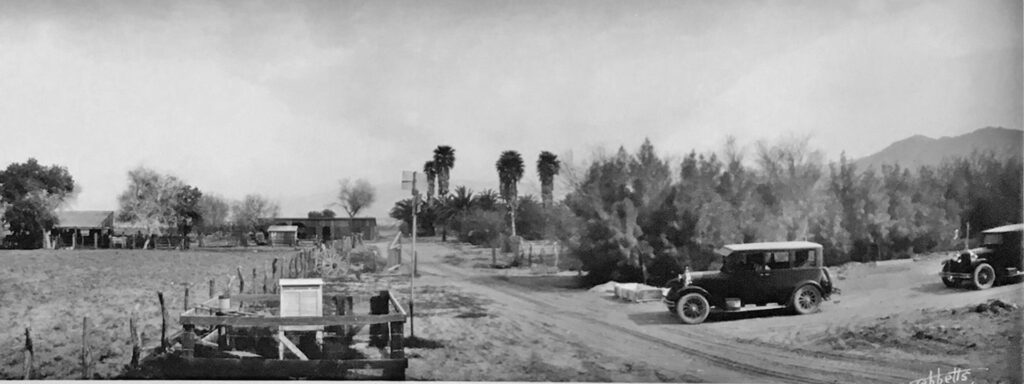
In 1911, the U.S. Weather Bureau (now the National Weather Service) — established a sheltered station with weather observing instruments at Greenland Ranch. However, at the time of the record, the ranch foreman was charged with reporting its results. He might well have had difficulty going out to the station and recording its outputs on very hot days, especially while performing his other duties at the ranch. As the authors note, even dedicated observers have struggled to collect weather observations in such an unfriendly place.
“Arguably, there has never been a more challenging environment and time in history to make weather observations than Death Valley in summer before air conditioning and other modern conveniences arrived,” they write.
In an email interview, paper co-author Roy Spencer (University of Alabama in Huntsville) adds that the foreman appears to have fudged some readings during the hottest months at the ranch, “as evidenced by inconsistencies in the measurements, such as in July of 1918 when 22 of 31 days had high temperatures that were integer multiples of 5.”
“Death Valley Illusion: Evidence Against the 134 °F World Record,” Bulletin of the American Meteorological Society.
The record of temperatures in the area was sparse before the Weather Bureau installed its Greenland Ranch station. Today, notes Spencer, we have fairly reliable readings, especially at the nearby Stovepipe Wells station installed by the U.S. Climate Reference Network (USCRN), which tends to correspond well with measurements at the Greenland Ranch/Furnace Creek location after accounting for a 278-foot elevation difference. In 1913, however, there were no other reliable stations close to Greenland Ranch, so it was hard to disprove a reading.
The Human Factor
Before 1911, temperature readings up to 137 °F were reportedly taken at the verandah of the Greenland Ranch house using unknown instruments. In preserved correspondence, Greenland Ranch staff expressed disappointment that the official U.S. Weather Bureau station’s recorded temperatures weren’t quite so hot. They had evidently hoped the official record would confirm what they’d measured at the house.
“It didn’t help that the instrument shelter was placed right next to the cooling effects of an irrigated field,” Spencer notes. The authors suspect that “the ranch foreman felt [Death Valley’s reputation as the hottest spot in the world] needed to be defended.” They suggest that the 134 °F reading may have come from the ranch house verandah, rather than from the more carefully controlled instrument station which was required to to be at a standard height off the ground, out of direct sunlight, and away from other sources of heating.
Triangulating a Century-Old Temperature
To test whether the 1913 record temperature made sense given the meteorological conditions that day, the authors brought in data from the few other weather stations in the general region.
“In the early 1900s there were only a handful of stations within 250 km of Death Valley, all of which have much cooler temperatures due to their much higher elevation,” notes Spencer. However, with a century of more trustworthy data from the 1920s to the present, they were able to demonstrate a consistent relationship between the heat at those stations and the heat measured at the Death Valley station.
Across a century of data, the margin of error between the authors’ estimated temperature based on the other stations and the actual readings at the Death Valley weather station, was around 1.3 to 2.2 °F. The estimated maximum temperature on the record-holding day in 1913 was 120 °F (plus or minus ~2 °F). The temperature supposedly measured at the station was 14 °F higher than estimated, far outside the expected margin of error.
Various experts have attempted to explain the strangely high temperature in Death Valley on 10 July 1913. As early as 1915, G.H. Willson of the Weather Bureau’s San Francisco office noted that weather patterns that day seemed fairly normal for the region, and no sufficient explanation had been found for the reading. He speculated that the event was due to descending air being “heated dynamically in passing down the western slopes of the Amargosa and Funeral Mountains to the deep valley below,” then becoming trapped and “stagnant” and accumulating radiated heat from the desert.
However, Spencer says, “virtually every summer day in Death Valley experiences the conditions [Willson] described. There are no meteorological explanations for such hot summer temperatures because solar-heated air at the surface is rapidly mixed through a super-adiabatic lapse rate with higher-altitude air [meaning that on the hottest days, temperature decreases very rapidly as air rises], limiting temperatures at instrument shelter height.”
But why were readings at the ranch house so high?
“You can get excessively hot readings if the thermometer is in direct sunlight, or if it is placed next to a sunlit wall,” notes Spencer. “One or both of these conditions were met on the north side of the veranda of the Greenland Ranch living quarters in the late afternoon in the early weeks of July. … My personal speculation is that the double-roof over the adobe ranch house would exhaust very hot air out the sides, and since the prevailing summer wind is from the south, that air would have been vented toward the north veranda. This could have further elevated temperatures taken there with thermometers.”
The authors recommend that the Greenland Ranch heat record be rescinded.

Questioning a Record
The 1913 measurement has held the WMO record since 2013, when a 136 °F record from Libya in 1922 was disqualified. “The WMO did not question the [Death Valley] record because there was little reason to with so little temperature data to compare to in 1913,” says Spencer, but “a few climatologists and meteorologists have expressed skepticism over many years … Since I was examining the U.S. surface temperature dataset anyway, John Christy [also with The University of Alabama in Huntsville, as well as the Office of the State Climatologist of Alabama] asked me to look at the world record value. He directed me to our co-author’s (William T. Reid) many years of investigating the historical background of weather measurements at Greenland Ranch … Bill has scoured libraries and museums for old photos and letters between the Weather Bureau and the ranch superintendent. Bill became convinced many years ago the measurement was not made by Weather Bureau-approved equipment in an approved instrument shelter. After reading some old books about Death Valley and its culture in the late 1800s and early 1900s, I became convinced of that, too.”
Randy Cerveny, World Meteorological Organization Rapporteur of Weather and Climate Extremes, notes that the WMO normally defers to the country in which a weather record occurred to start the process of re-evaluation, assuming it has procedures for doing so. In this case, that would be a job for the U.S. National Climate Extremes Committee (NCEC). “Since such a national evaluation involves the members of the National Centers for Environmental Information (NCEI),” and the recent government shutdown could cause delays, Cerveny notes. “The WMO will be in contact with the NCEC and other interested parties to determine the logistics of national and global evaluation of that record, given the purported new evidence.”
Even if this particular measurement is invalidated, that doesn’t necessarily mean a death knell for Death Valley’s claim on the global heat record. More recent readings at Furnace Creek have hit 130 °F and might hold up to scrutiny, although Spencer notes that the instrumentation there is now quite old, not well-ventilated, and subject to “spurious” heating influences. “What I would like to see, out of professional curiosity,” he says, “is an additional USCRN station installed about 7 miles south of Furnace Creek, at an even lower elevation than Furnace Creek station’s 194 ft below sea level, away from the cooling effects of vegetation, and over a darker surface that probably heats up more in the daytime. With such measurements I’m pretty sure the U.S. would then have a more defensible claim to the world record hottest air temperature.”
Photo at top: “Furnace Creek, CA 92328, USA,” by Vadim Manuylov, CC BY-SA 3.0. On Wikimedia Commons.