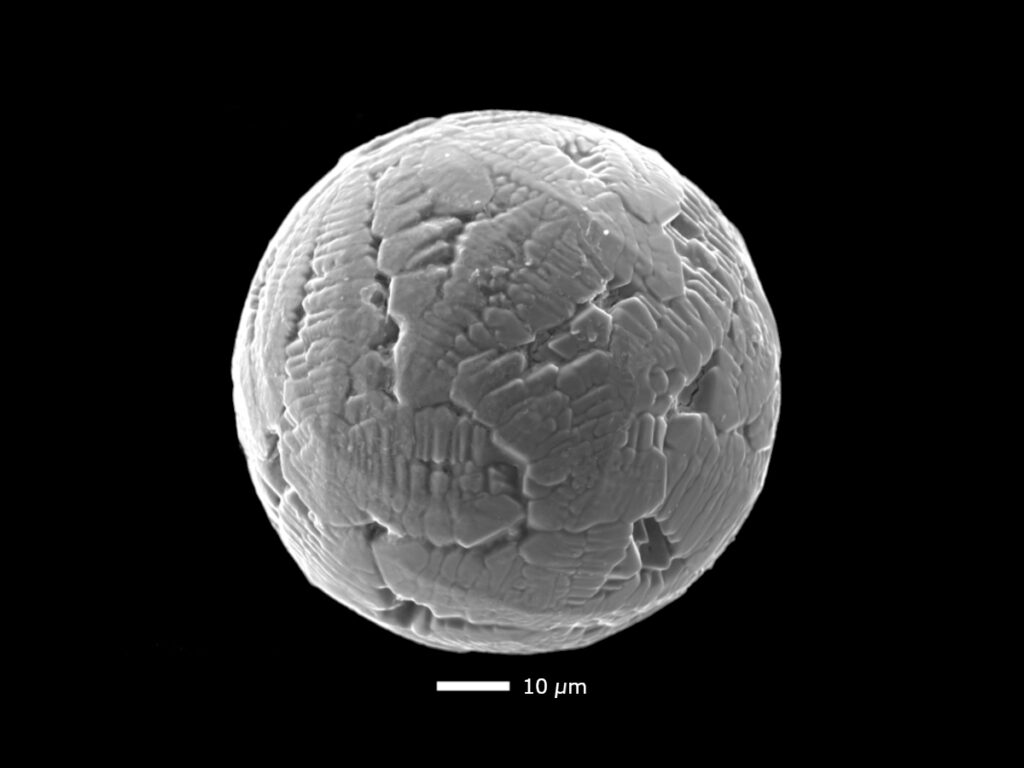
~87 million years—The age of some fossilized micrometeorites that were recently studied to help provide new insight into Earth’s past atmospheric conditions. The metallic particles melt when they fall through the atmosphere, and the iron and nickel within them oxidize when they come into contact with oxygen in the air. This causes the formation of micrometer-sized spheres, called I-type cosmic spherules, consisting of oxide minerals. After reaching Earth’s surface, the spherules become fossilized and can be preserved for billions of years. A group of researchers developed a new method that for the first time accurately measures the composition of oxygen and iron isotopes in the fossils. The ratios of different isotopes provide an archive of the chemical composition of Earth’s early atmosphere and tighten the range of carbon dioxide concentrations from ancient times. The researchers extracted 92 I-type cosmic spherules of various ages from sediments taken from various locations in Europe and also looked at 8 previously discovered micrometeorites. They then utilized micro X-ray fluorescence, scanning electron microscopy, and oxygen and iron isotope analysis to examine the spherules and quantify Earth’s carbon dioxide levels from the Miocene epoch (~8.5 million years ago) and late Cretaceous period (~87 million years ago). “Our analyses show that intact micrometeorites can preserve reliable traces of isotopes over millions of years despite their microscopic size,” notes lead author Fabian Zahnow, formerly of the University of Göttingen and now at the Ruhr University Bochum. Combining the spherule analysis with proxy and modeling data, the research was able to reconstruct Earth’s atmospheric concentrations over time, and indicated “moderate” carbon dioxide levels both in modern times as well as 10 and 90 million years ago. The study, which was published in Communications Earth & Environment, notes that the discovery and study of additional spherules would improve the precision of the analysis. [Source: University of Göttingen]