A summary of “A Linear Analysis of the Heating Footprints of the US Mesoscale Convective Systems in the Northern Extratropical Synoptic Variability,” by Zhenyu You (Georgia Institute of Technology), and Yi Deng, published in the 1 August issue of Journal of Climate. Click the paper title to access the full, citable article.
Mesoscale Convective Systems (MCSs) are among the largest forms of organized thunderstorms in the United States, occurring most frequently east of the Rocky Mountains during boreal spring. While these systems provide roughly 50%–70% of total spring rainfall over the central Great Plains, they are also known to produce strong winds, hails, and tornadoes, representing some of the most prevalent weather hazards in spring. MCSs tend to form when a specific set of local atmospheric conditions is met, including a statically unstable atmosphere and strong wind shears. While much research has examined the weather patterns that contribute to the formation of these conditions and thus MCS genesis and development, the opposite has been less explored: how does the latent heat released by these convective storms feed back onto large-scale atmospheric circulations? Understanding this “upscale” influence can reveal sources of predictability for weather at locations far from where the MCSs are generated. This is especially important as warm-season MCS events have become more frequent in recent decades, and the trend is expected to continue in a warming climate.
Our study examines how latent heating associated with U.S. MCSs affects day-to-day (synoptic-scale) weather variability across the entire northern extratropics. We employ an idealized model with a simplified representation of latent heat release. Compared with a no-heating scenario, including latent heating everywhere in the model increases the amplitude of synoptic weather disturbances and leads to better-organized storm tracks over the North Pacific and North Atlantic. Further partitioning of the heating indicates that the U.S. MCS heating alone not only boosts synoptic weather variability over the eastern United States and the North Atlantic but also promotes circumglobal propagation of large-scale atmospheric disturbances. In other words, regional heating from MCSs over the United States can help energize disturbances that extend well downstream, linking local convective activity to atmospheric circulation patterns on planetary scales. We also find that MCS heating strengthens the transient eddy forcing of the background flow and reinforces the North Atlantic westerly jet, implying that MCS activity can leave footprints in weather systems operating at longer (i.e., subseasonal) time scales.
Heating Footprints in the Mid-Latitudes
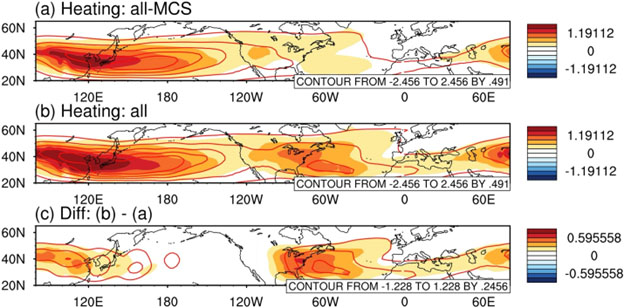
Together, these results show that localized U.S. MCS activity can influence atmospheric variability on larger spatiotemporal scales, and thus has broad implications for regional and global climate. Our research underscores the need for further studies of interactions between local storm activity and global atmospheric circulation, ultimately contributing to improved prediction and mitigation of adverse weather and climate conditions. Future work will evaluate the detailed footprints left by U.S. MCSs on the Northern Hemisphere regional water and energy cycles and investigate the effect of MCS heating on the nonlinear life cycle of synoptic disturbances using models of increased complexity.