A summary of “Extreme Weather Experiences, Emotional Reactions to Messages, and Support for Proclimate Policies,” by Asheley R. Landrum (Arizona State University), and Bruce Wang Shibo,“ in the April issue of Weather, Climate, and Society. Click the paper title to access the full, citable article.
Public conversations about climate change increasingly unfold on social media, where people encounter and react emotionally to news, advocacy, and personal stories. At the same time, more Americans are directly experiencing extreme weather events, such as hurricanes, wildfires, and extreme heat. Our study asks how these two forces—emotional reactions to climate messages and recent experience with extreme weather—interact with political ideology to shape support for energy policies. We conducted a secondary analysis of a large, national U.S. survey conducted by the Pew Research Center. Respondents reported whether their area had experienced extreme weather during the previous year; how often they came across or sought out climate-related posts on social media; how those posts made them feel; and their support for expanding fossil fuels, expanding renewables, and a set of specific “green” policies. We summarized multiple questionnaire items into simple scales and used regression and mediation models to test how ideology, experience, and emotions relate to policy support.
Three patterns stand out. First, consistent with prior work, conservatives were less likely than liberals to engage with climate content online, more likely to report feeling “annoyed” by climate attention, and less supportive of renewables and green policies (and more supportive of expanding fossil fuels). Second, among conservatives who reported recent extreme weather, these gaps narrowed: they were somewhat more likely to encounter and interact with climate posts, more likely to report “climate-concerned” emotions (anger about inaction, anxiety about the future, confidence we can reduce effects), less likely to feel annoyed—and showed small but meaningful shifts toward support for renewables and green policies. Third, emotional reactions helped explain how ideology relates to policy views: climate-concerned emotions were linked to greater support for proclimate energy policies, whereas annoyance tracked with opposition.
Extreme Weather May Shrink the Climate Divide
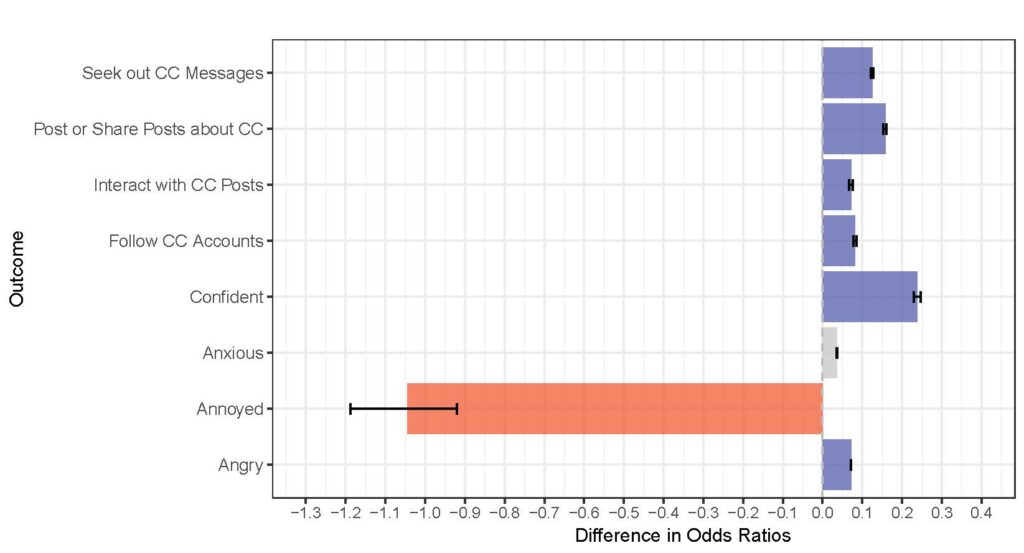
These findings suggest that lived experience with extreme weather may soften ideological resistance by altering how climate messages are perceived. For communicators and civic leaders, timely, locally grounded messages that acknowledge recent weather impacts—and that evoke constructive emotions like agency and warranted urgency—may engage broader audiences, including conservatives. Important caveats remain: the data are correlational, “extreme weather” was self-reported (and likely filtered through political identity), and the climate messages people saw were not standardized. Future research that pairs objective exposure to specific events with controlled message tests can more precisely map when and how experience shifts emotions and, ultimately, policy support.