
How can an already hot city like Houston, Texas, cope with the growing heat-safety challenges of urbanization and climate change? A workshop by the Local Organizing Committee at the AMS Annual Meeting in January brought attendees together from local, state, and government agencies; academic institutions; media; and nonprofit organizations to learn from each other and brainstorm ways to keep people safe—from pregnant people to firefighters to marching bands.
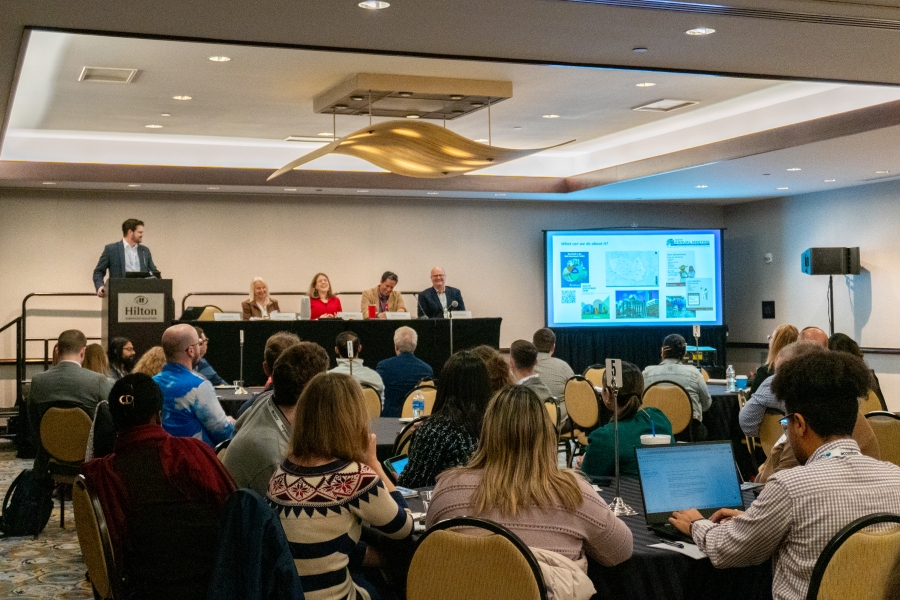
Lance Wood, a meteorologist with the Harris County Flood Control District, moderated a panel discussion in which connection was the theme of the day. Kevin Kloesel (chief science officer at Zelus and event safety meteorologist at Baylor University) talked about initiatives to connect meteorologists, academics, and other stakeholders to improve safety at concerts, festivals, and other venues. Jaime González (executive director of the University of Houston’s Institute for Ecological Resilience) discussed bringing academic researchers and nonprofits together to help mitigate heat and flood risk by improving tree and forest cover.
Leah Barton, executive director of public health for Harris County, highlighted their work on an integrated health and heat impacts dashboard, and using health data to inform worker safety and public health policies. Loren Hopkins, Houston’s chief environmental officer (who is also data science chief at the Houston Health Department and a professor at Rice University) noted efforts at the city level to integrate information on heat, heat-related illnesses (from stroke to mental health issues), air pollution, and heat-triggered events like drownings to inform public health interventions. With climate changing so rapidly, they use hospital emergency department data to inform their research, rather than mortality data that is often outdated by the time it’s fully compiled.
In a lively discussion, panelists and attendees brought their own questions, challenges, and experience to the table. Communicating and using safety guidance emerged as key issues. The National Weather Service and local governments are working hard to make heat alerts and associated public response more streamlined and effective, yet many decision-makers still have trouble accessing, understanding, or acting upon warning information.
Protecting Those Out in the Heat
Attendees raised concerns about safety for groups exposed to dangerous heat in the course of work or school activities—firefighters and high school athletes, for example. Kloesel noted that heat risk varies widely between individuals or subgroups: “A tuba player [in a marching band] is more likely to get heat illness than a flute player. The offensive lineman is more likely to get heat illness than the wide receiver.” Training sessions have to accommodate those differences. For firefighters, who often train in intense heat with full gear, it’s important to allow everyone to cool down fully between training activities, he said, referencing research done at the Fire Institute at Oklahoma State University in Stillwater.
Even people who are trying their best to stay within guidelines may err disastrously due to ignorance, lack of guidance or equipment, or other factors. Kloesel gave the example of a coach in Georgia who, not knowing the difference, planned activities using wet bulb temperature rather than wet bulb *globe* temperature (WBGT) as a heat stress measure, leading to the death of a young football player. Hopkins noted the need for research comparing the efficacy of using WBGT vs. Heat Index, suggesting that when it comes to user-friendliness, Heat Index remains the most effective and useful tool for communicating with the public.
More Risk, More Cost
Another communication challenge lies in making people aware that the risk of heat illness doesn’t go away the moment temperatures drop. Hopkins pointed out that risk remains high for two days after a heat event, and that costs during a heat wave will just keep mounting. FEMA only reimburses a city for a natural disaster if it hits a certain threshold in costs, mostly based on infrastructure damage. Preventing health impacts mostly doesn’t get federal support, yet over time it can take a major toll on a city’s budget. Money for warming and cooling centers, for example, comes out of tax dollars.
Making large-scale decisions to manage heat risk is a matter of balancing available information with practicality, noted one commenter: “Our company has studied heat under different species of trees, but … measuring WBGT or even humidity is impractical to enforce or operationalize.” Cities trying to introduce an indoor cooling standard, for example, need to base it on local conditions rather than other cities’ standards; they need to understand at what temperature a window unit will provide adequate cooling, yet acknowledge that you can’t account for all indoor conditions.
Heat management is also intertwined with other issues. Barton noted a huge spike in heat-related illnesses in 2024 due to a power outage caused by Hurricane Beryl. “We have to fix the grid, people,” she said. Similarly, flooding and heat concerns can compound. “We have a surfaces problem,” said González. There are too many reflective, nonabsorbent surfaces in many cities, and not enough nature to absorb heat and water. He urged greater investment in nature-based solutions like tree-planting as a proven strategy to create healthy solutions.
Word on the Street
One commenter asked how to make it easier for the public to understand heat information without making people feel talked-down to. González recalled seeing mothers in southwest Houston walking their children to the grocery store when it was 130°F near ground level and “you can literally feel the heat coming up through your shoes.” He noted that “if you have a community facing housing and food insecurity, concerns like heat-related illnesses are seen as secondary, but there’s a cascading effect” on health. The key is to work with communicators to make information digestible and help people understand its relevance. “Most people get their information from YouTube,” he said. “[You have to] get them to realize how important this is for their life.” Another commenter added that Reddit groups, neighborhood Facebook groups, and other social media can be an important way to make sure locals are on board.
Hopkins outlined a new effort launching in Houston this summer, working with providers to issue specific warnings to at-risk patient groups (for example, pregnant people at risk of preterm birth) when heat hits dangerous thresholds. Houston already has an alert system people can sign up for to receive warnings about specific conditions (e.g., “today you have a 15% increased risk of miscarriage due to heat”), but they need research studies to understand whether it’s effective.
Dangerous weather events can be an opportunity to improve public health if they’re handled in an integrated way, Barton said. An unusual cold snap the weekend of the Annual Meeting was forecast well in advance: “We got the message out [early] that cold was coming, got the message out about the warming centers—mostly through TV, Houston is still a TV town—but also through Whatsapp groups.” City workers went out to speak to homeless Houstonians before the event, and the Sheriff’s office, community outreach workers, case managers, violence interruption teams, and more worked together to help on the streets and in warming centers. “People were … treating it as an opportunity to help people get to a better place,” Barton added. “People were leaving warming centers to go to rehab [because] we were able to think about this moment in a new way.”
Connecting for Solutions
Successes like this require meteorologists and researchers to be integrated with other organizations for maximum effectiveness. One attendee posed the question of how to catalyze such collaborations. Kloesel responded, “You just go. Boots on the ground.” Many of his own efforts in event safety grew from his attendance at an Event Safety Alliance summit. “Next thing we were putting together a workshop … [now we have] 200 venues across the country weather-planning in ways they never were before.” They are even collaborating internationally, including in Brazil after a heat fatality there during Taylor Swift’s tour. “It’s incumbent on meteorologists to have memberships in other organizations where these weather impacts are being seen,” said Kloesel.
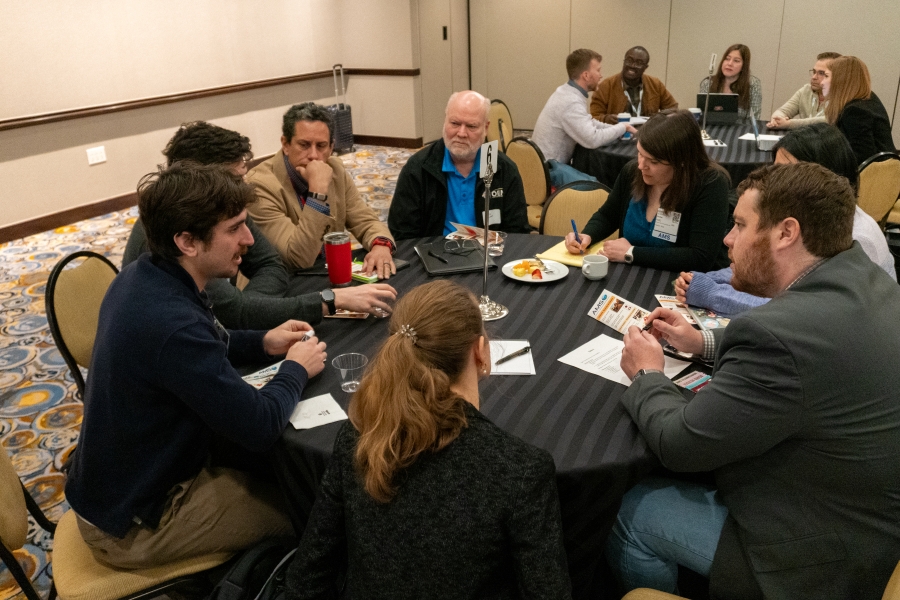
A collaborative workshop after the panel aimed to kick-start some of those connections. Attendees broke into seven groups to address key questions. For example: What are the most practical “quick wins” we can implement in the built environment to reduce heat risk? How can we better reach isolated individuals at high risk before a crisis occurs? How can Houston protect international visitors for the FIFA World Cup who aren’t used to the area’s heat?
In addition, the Local Organizing Committee and AMS staff created a pamphlet on heat risk for attendees to use in their educational efforts. The pamphlet is now available online here.
“We saw an amazing level of engagement and collaboration through this workshop,” says Lance Wood, who helmed the Local Organizing Committee’s work to put the session together. “Attendees got to connect across disciplines in ways they aren’t normally able to, and they contributed to new and creative approaches for addressing heat mitigation and messaging challenges in a changing climate.”