Eugenia Enriqueta Kalnay
1942–2024
Eugenia Kalnay, who made highly consequential theoretical and practical contributions to a wide range of scientific subjects, especially numerical weather prediction and predictability, and who was a beloved mentor to generations of students, passed away on August 13, 2024.
Eugenia’s seminal scientific contributions were marked by her exceptional creativity and singular ingenuity, often in the service of practical goals beyond the usual remit of academics. Her leadership of modeling and prediction research elevated the United States weather service to the top rank. She was the driving force behind the NCEP/NCAR Reanalysis Project, which, according to the American Academy of Arts and Sciences, “is certainly the most scientifically fertile dataset in climate science.”
Eugenia was born on October 1, 1942, in Buenos Aires, Argentina, to Jorge Kalnay, a prominent Hungarian-born architect, and Susana Zwicky, who was from Switzerland. Eugenia was the seventh of eight children. She received her Licenciatura degree (equivalent to a master’s degree) in meteorology at the College of Exact and Natural Sciences, University of Buenos Aires (1960–1965). When her mother found that she was dating, she told Eugenia, “Don’t even think about getting married before you have a Ph.D.!” But Eugenia did not obey her mother on this, and married Alberto Rivas, who was working on a very early automated computer translation of language. Later, both of them came to MIT for PhDs—Eugenia with Jule Charney, and Alberto with Noam Chomsky.
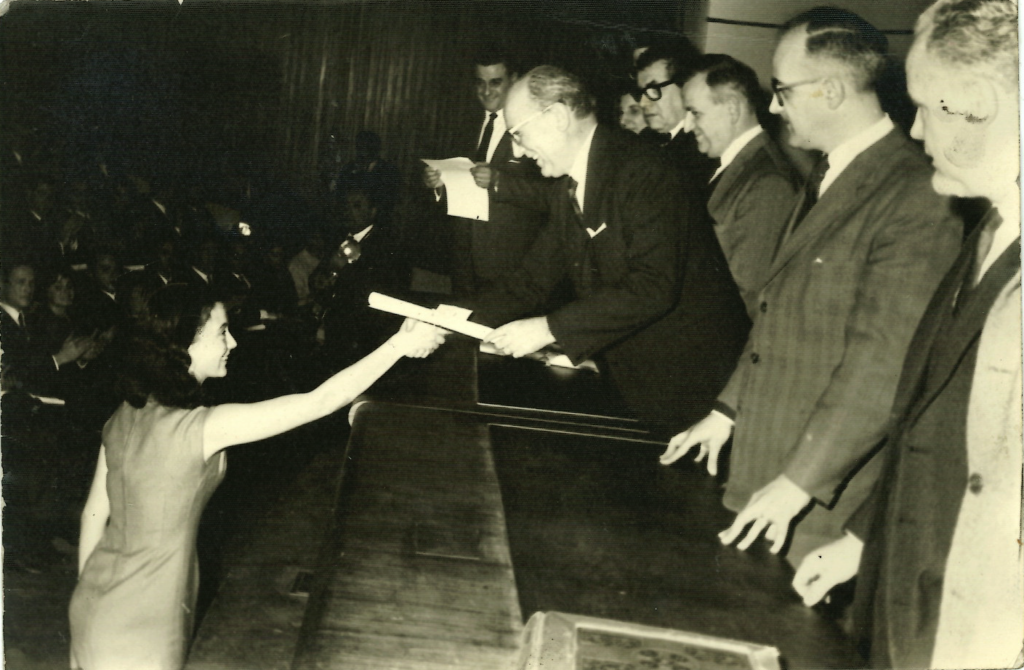
Eugenia loved Argentina. She used to say how fortunate she was that, being a woman, she was raised in Argentina. She said it was common in Argentina for a woman to be encouraged to pursue higher education, including in the sciences, and that she never felt any resistance or restrictions there about a woman studying to be a scientist. She often emphasized that she did not come to the United States because she wanted to leave Argentina. She received her master’s degree on July 7, 1965, and had started teaching at the university, but in June 1966 there was a military coup. On July 29, 1966—the infamous event known as La Noche de los Bastones Largos, or “the Night of the Long Batons”—the military dictatorship attacked her university, savagely beating students, faculty, staff, and deans. Many laboratories, classrooms, and libraries were physically destroyed, and many advanced scientific and academic projects were dismantled. Rolando García, dean of the College of Exact and Natural Sciences, advised Eugenia to escape Argentina and go work with Jule Charney at MIT in January 1967. When Eugenia came to MIT, she was shocked to find that the only women in the department were the secretaries—in sharp contrast to Argentina, where many of the leading professors, including department chairs, and about 40% of the students, were women. In 1971, Eugenia became the first woman to earn a PhD from the Department of Meteorology at MIT.
The first sentence of her thesis was: “The planets Mars, Earth, and Venus seem to have been designed with an experimental purpose in mind,” pointing out that despite being neighbors in the solar system and having somewhat similar properties, they have very different atmospheres. For her thesis, Eugenia developed a two-dimensional, density-varying numerical model—at a time when numerical models were rare—to study the circulation of Venus. Her thesis proved that the surprisingly high surface temperature (about 600 K) of Venus could not be explained by the mechanism proposed earlier by Goody and Robinson, that solar heating and cooling of the high-level Venus clouds would drive a deep, Hadley-like atmospheric circulation. Her results instead supported the “runaway greenhouse effect” proposed by Carl Sagan and others. This work began her lifelong scientific interest in Earth and planetary sciences, and in climate change, through modeling, numerical weather prediction, and data assimilation.
After her Ph.D., Eugenia could not yet return to Argentina because of the continued dictatorship. So in 1971, Eugenia, Alberto, and their one-year-old son Jorge—who was born while Eugenia was a graduate student at MIT—moved to Uruguay. Eugenia became an assistant professor at the University of Montevideo. In 1973 there was a military coup in Uruguay, and the universities were also attacked, so they decided to return to the United States, where Eugenia became the first female faculty member (assistant and associate professor) in the Department of Meteorology at MIT, teaching numerical weather prediction. In 1979 she moved to NASA’s Goddard Space Flight Center at the invitation of Milt Halem.
That same year, Eugenia joined Milt Halem’s Global Modeling and Simulation Branch (GMSB), heading up the weather sub-branch. She developed an extension of the GISS second-order accurate model into the GSFC fourth-order dynamical forecast model. For more than a decade, it was the workhorse model for GMSB, used for hundreds of First GARP Global Experiment (FGGE) operations assimilating a unique network of satellites, balloons, and other special observing systems. These experiments led to Eugenia’s deep interest and pioneering contributions in data assimilation and its impact on forecasts.
A major contribution was her work with Ross Hoffman on the development of lagged average forecasting (LAF) from ensemble statistical forecast analysis. Unlike Monte Carlo forecasting, in which perturbations in the initial conditions are randomly chosen errors, LAF perturbations are influenced by the actual background large-scale flow, thus containing the “errors of the day.” This method was further improved by Eugenia and her colleagues with the scaled LAF (SLAF), which scales the perturbations from lagged forecasts according to their different error growth rates. In 1984, Eugenia became Head of the Global Modeling and Simulation Branch, the first woman to head such a NASA branch.
In 1987, she became director of the NOAA Environmental Modeling Center (EMC) of the National Centers for Environmental Prediction (NCEP), again the first woman to hold this position. With Zoltan Toth she developed the breeding method, a nonlinear generalization of the method used to construct Lyapunov vectors, for ensemble forecasting. It was adopted by the operational ensemble forecasting system at NCEP in 1992. During Eugenia’s leadership, EMC became a world-renowned center for innovation in data assimilation and weather prediction. This work culminated in the 40-year NCEP/NCAR reanalysis, a landmark for climate science that for the first time made 40 years of global atmospheric analyzed data universally accessible. Kalnay et al. (1996), the paper published in BAMS describing the reanalysis, is the most cited paper in all geosciences.
In 1997, Eugenia was appointed Lowry Chair Professor at the University of Oklahoma. Two years later, she moved to the University of Maryland as chair of the Department of Atmospheric and Oceanic Science. From 1999 until her retirement in 2023, she held appointments first as professor, since 2002 as Distinguished University Professor, and since 2008 as the Eugenia Brin Endowed Professor in Data Assimilation in the Institute for Physical Science and Technology.
At the University of Maryland, Eugenia generalized the application of the breeding method, extending it to identify and determine the origins of instabilities of various dynamic systems beyond Earth’s atmosphere, including oceans, rogue waves, and the Martian atmosphere. With her students, Eugenia further enhanced the breeding method by introducing the breeding interval, which empowers the method to identify instabilities of different temporal scales in coupled dynamic systems. They later used this approach to identify ENSO-related slow-growing modes using the NASA Seasonal-to-Interannual Prediction Project (NSIPP) coupled general circulation model. For the first time, Eugenia and her students derived the bred-vector-based kinetic energy equation to identify the origin of flow instabilities and explain energy conversions. This method allows the full governing equation to be used without any explicit temporal or spatial averaging, and was used to explain oceanic instabilities. Using the breeding method, Eugenia and her student, Steven Greybush, studied the instability of the Martian atmosphere, a field in which they continued collaborating, from data assimilation to, most recently, the development of a reanalysis dataset.

By integrating ensemble methods with data assimilation, Eugenia made unique contributions to ensemble data assimilation and numerical weather prediction. She extended her earlier work on the breeding method to develop the Local Ensemble Transform Kalman Filter (LETKF), which became a major component of operational assimilation and forecast systems. Bred vectors represent growing modes—what Eugenia called “the errors of the day.” The goal of data assimilation is to produce more accurate forecasts, which requires suppressing growing error modes. Eugenia was extremely excited to find that the structures of the bred vectors were similar to the analysis and forecast errors of the day. This inspired her idea of making corrections to the forecast state in directions constrained by the bred vectors.
At the time, the most sophisticated data assimilation method was four-dimensional variational (4D-Var) assimilation, adopted by the European Centre for Medium-Range Weather Forecasts (ECMWF), which produced the most accurate medium-range weather forecasts. This method is technically complex, as it requires developing the adjoint of the forecast model. As all her students and close collaborators remember vividly, Eugenia always encouraged them: “What 4D-Var can do, an Ensemble Kalman Filter can do as well!” Eugenia and her group developed numerous techniques for LETKF that made it comparable to 4D-Var, including the no-cost smoother, run-in-place, analysis weight interpolation, and low-dimensional model error estimation. Another of Eugenia’s innovations was a mathematical formulation to estimate forecast sensitivity to observations using an ensemble method rather than an adjoint-based approach. More recently, ensemble approaches have become more widely adopted.
In addition to theoretical developments in ensemble data assimilation methods, Eugenia also contributed to adapting coupled data assimilation to improve analysis and prediction across multiple Earth system components. In collaboration with Inez Fung, Eugenia and her students demonstrated the feasibility of estimating surface carbon flux through coupled atmosphere–carbon data assimilation. They developed the variable localization technique that removes unreliable background error correlations for state–observation pairs. Eugenia also worked extensively on atmosphere–ocean coupled data assimilation. With her students and postdocs, she evaluated different coupled data assimilation strategies using various state-of-the-art approaches in a hierarchy of coupled models, ranging from the simple coupled Lorenz model to the complex NOAA coupled model for seasonal prediction. This work demonstrated the potential of strongly coupled data assimilation using ensemble methods.
Eugenia’s arrival at the University of Maryland had a transformational impact on what became the Department of Atmospheric and Oceanic Science. Her work on data assimilation immediately appealed to Jim Yorke and the nonlinear dynamics faculty in the Math Department, and together with Yorke and Brian Hunt she founded the interdisciplinary Chaos Group. Her strong connections to nearby NASA and NOAA laboratories, as well as her international collaborations, strengthened the department by enabling external partnerships and creating more rigorous programs, while the breadth of her interests made the department more interdisciplinary. She led a revamping of the graduate curriculum, expanding instruction in the broader areas of Earth’s climate, oceans, statistics, and data assimilation, and hiring new faculty in these areas.
During her last decade, Eugenia, in collaboration with Safa Mote and her son, Jorge Rivas, worked on integrating human activity into Earth systems to model actions that can lead to sustainability. At the award ceremony of the National Academy of Sciences for the 2009 International Meteorological Organization Prize, Eugenia encouraged leading Earth system scientists and modelers to incorporate bidirectional feedbacks between the human system and the Earth system. Eugenia, Mote, and Rivas developed the groundbreaking Human and Nature Dynamics Model (HANDY). HANDY modeled the dynamic rise and fall of societies after the Agricultural Revolution and before the Industrial Revolution. Notably, HANDY showed that high economic inequality alone can lead to societal collapse. The resulting paper became, at the time, the most downloaded paper in the journal Ecological Economics.
Eugenia and the HANDY team then led a major perspective paper that included an interdisciplinary group of distinguished natural and social scientists and engineers. The “Modeling Sustainability” paper established the need for developing dynamical human system models and coupling them bidirectionally with Earth system models. The paper argued that both growth in human population and consumption per capita were contributing to the massive and still-growing human impact on the environment. The result has been domination of almost all natural subsystems of the Earth system by the human system. As ever, the Earth system greatly impacts the human system. Therefore, the feedback loops between the two systems must be dynamically modeled to capture the behaviors of these coupled systems.
This work led to research into specific impacts of land–atmosphere feedbacks. Eugenia posited that wind and solar energy installations would induce feedback loops analogous to the Charney surface albedo mechanism and the Sud surface friction mechanism, but in the opposite direction, leading to increased precipitation and vegetation in the Sahara and Sahel regions. Eugenia and her colleagues confirmed this hypothesis using a coupled atmosphere–land model. The resulting paper in Science was recognized as one of the 10 most impactful climate science papers in 2018.
Eugenia and the HANDY team then published a paper on the relationship between coupled dynamic modeling and dynamic carrying capacity. In ecology, carrying capacity had traditionally been treated as a prescribed constant. They showed that in the human context, carrying capacity is a variable produced by the endogenous dynamics of the Earth–human system and its nonlinear feedbacks.
In addition to research, Eugenia always cared deeply about education. Her book, Atmospheric Modeling, Data Assimilation and Predictability, first published by Cambridge University Press in 2003, has been cited more than 5,000 times and widely adopted as a graduate textbook for numerical weather prediction and data assimilation. Eugenia revised the book for a second edition, updating its data assimilation chapter—a topic that has advanced rapidly since the first edition—and expanding its scope, as reflected in its new title: Earth System Modeling, Data Assimilation and Predictability: Atmosphere, Oceans, Land and Human Systems. This book, coauthored by Safa Mote, and Cheng Da, was published in 2024, shortly after Eugenia passed away.
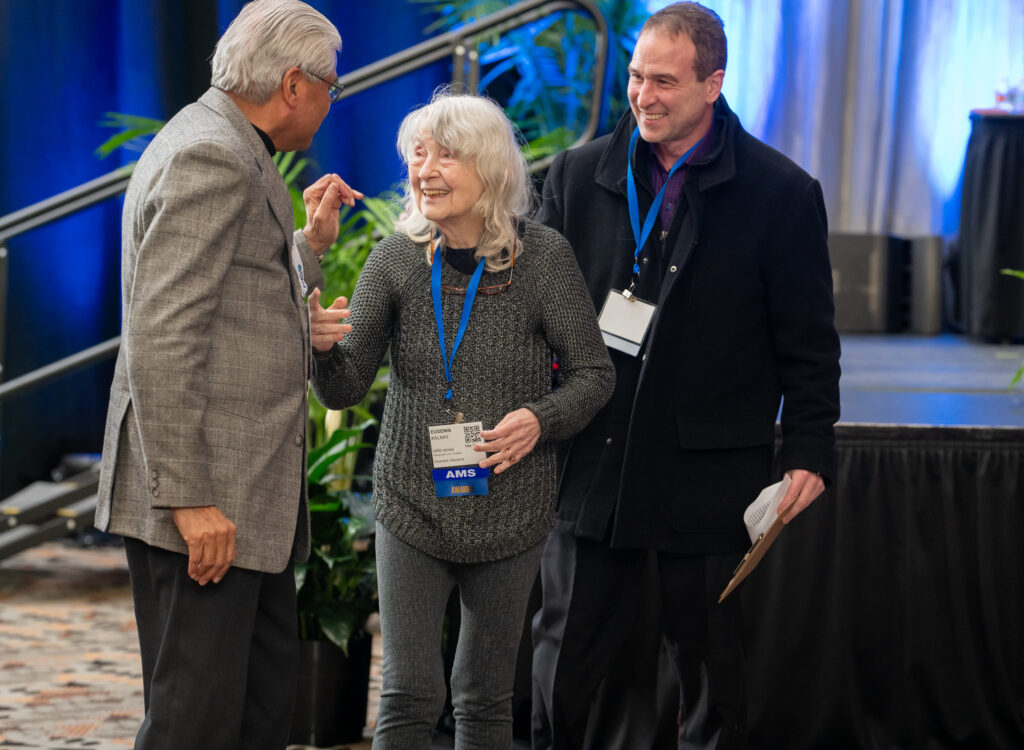
Eugenia considered her proudest academic achievement to be working with her students. The wide range of thesis topics reflects her broad interests, spanning weather and climate prediction and extending into oceanography, land surface processes, the role of humans in environmental variability, and climate change. Eugenia was more than an advisor to her students; she was a loving friend. She mentored, advised, or co-advised 45 PhD students, and 13 of her PhD advisees became faculty members nationally and internationally. Eugenia’s achievements and service to society were celebrated at the AMS Eugenia Kalnay Symposium in 2015.
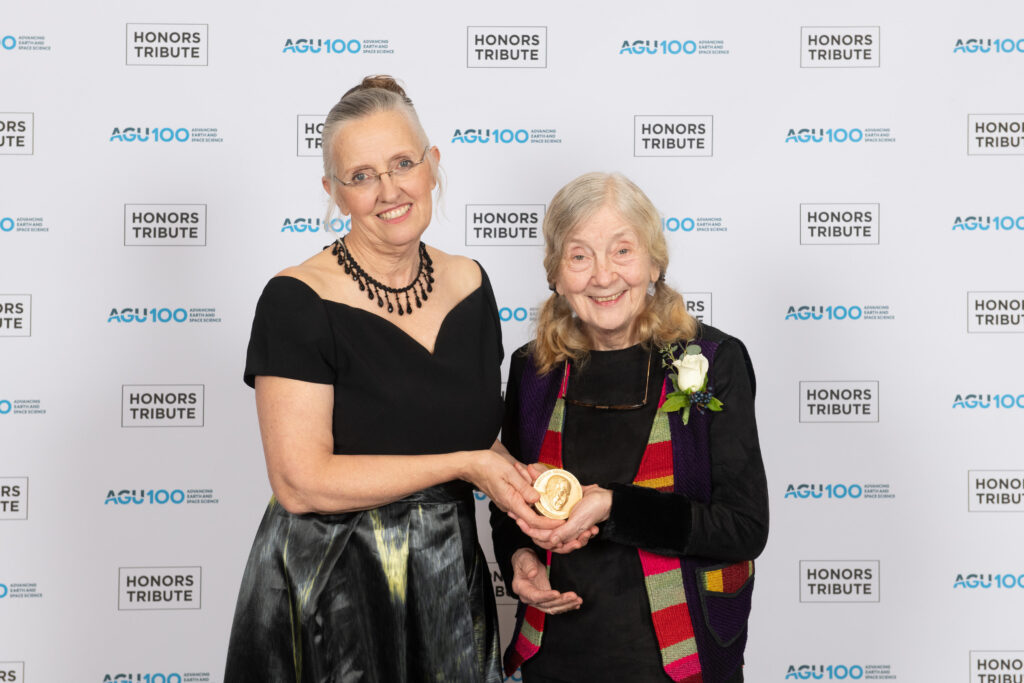
Eugenia received many honors and awards for her scientific contributions and service to society, including the NASA Medal for Exceptional Scientific Achievement (1981); AMS Fellow (1982); Department of Commerce Gold Medals (1993 and 1997); the Jule G. Charney Award (1995); election as a member of the National Academy of Engineering (1995); Foreign Member of Academia Europaea (2000); member of the Argentine Academy of Sciences (2003); World Meteorological Organization IMO Prize (2009); Joanne Simpson Mentorship Award (2015); election to the American Academy of Arts and Sciences (2015); AMS Honorary Member (2015); AGU Roger Revelle Medal (2019); and the Jagadish Shukla Earth System Predictability Prize (2023).
—Jagadish Shukla, Mark Cane, Jim Carton, Cheng Da, Milt Halem, Takemasa Miyoshi, Safa Mote, and Jorge Rivas.