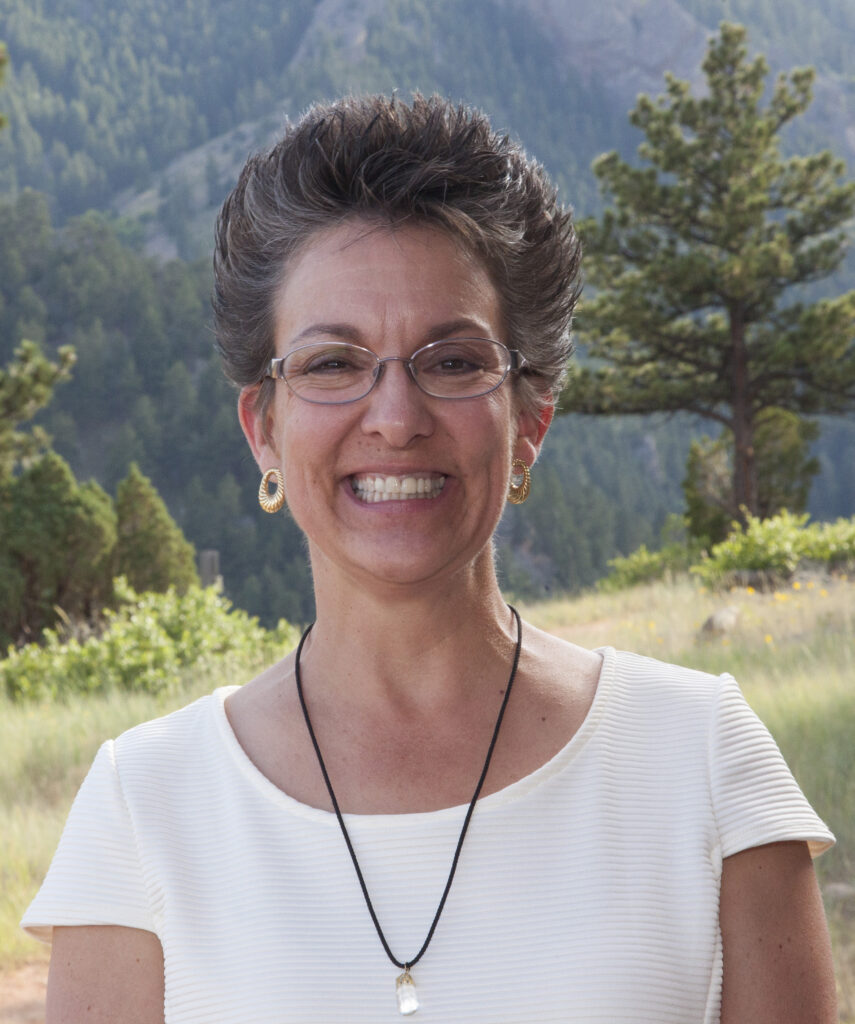
March is Women’s History Month. In this post, we spotlight the exceptional career of one of our female community members: Wendy Abshire.
Wendy Abshire retired in 2023 as the director of the AMS Education Program, and before that worked three-and-a-half decades in research, education, and management at NSF’s NCAR/UCAR. At the COMET Program she led teams and created materials for MetEd. She is the incoming AMS EEC Commissioner, an AMS Fellow, former AMS Councilor and AMS Planning commissioner, two-time AMS Annual Meeting cochair, and recipient of the AMS Charles Franklin Brooks Award for Outstanding Service to the Society and the AMS Father James B. Macelwane Award.
What are a few highlights from your career?
My career started in the most wonderful way when I was hired as a student assistant at NSF’s NCAR at the age of 19 and spent several years working on groundbreaking research related to microbursts and aviation safety, boundary detection and convective initiation, and nonsupercell tornadoes! After graduate school I was the first meteorologist hired by the COMET Program to work with experts and instructional designers to create distance learning education materials to help prepare National Weather Service forecasters for their agency modernization in the 1990s. It was exhilarating to work at the nexus of research and operations as well as to help pioneer distance learning education on a variety of platforms. Near the end of my career I was fortunate to have the opportunity to lead the AMS Education staff as director as we worked to evolve our programs in support of K–12 educators and faculty. I loved it.
What are you most proud of in your professional life?
It’s a toss-up between working to make my childhood dream of becoming an atmospheric science professional a reality and then also the relationships and the hopefully positive impact I had on those I worked with in all my roles throughout my career. Serving as a supervisor and ombudsperson at UCAR and as a volunteer with both the NWA and AMS allowed me to support and serve others in the climate, weather, and water enterprise and enriched my life immensely.
Have things changed for female meteorologists or scientists over the years? What still needs to change?
Oh yes. They have changed a great deal. I was one of few women in most of my undergraduate classes. Fortunately, as a student working at NCAR I had wonderful supervisors and a disproportionate number of female role models and male mentors that treated me more like a peer scientist rather than as a young student. That’s not to say there weren’t challenges along the way and that there aren’t issues that remain. Late in my career someone actually said to me, “Thank goodness you have some gray in your hair so you will be respected as the director.” I’m still shaking my head over that comment and I don’t believe it would have been made to a male. I do think things are getting better though.
Are there other female meteorologists/atmospheric scientists who have particularly influenced or inspired you?
So many! I’m afraid to make a list because it cannot possibly include all of those that have inspired me and contributed to my career growth. In the beginning, I worked closely with three outstanding radar/mesoscale phenomenon researchers at NCAR, Rita Roberts, Cindy Mueller, and Cathy Kessinger. In my early days at NCAR I also worked with hail researcher, Nancy Knight, and tropical expert and former AMS president and honorary member, Peggy Lemone. These women’s mentorship, success, and leadership made me feel very confident in charting my own path in our field. Late in my career, former AMS president and also an AMS honorary member, Mary Glackin, has been an inspiration and a person I continue to admire.