“This is the way the world ends—Not with a bang but a whimper.”—T. S. Eliot (The Hollow Men, 1925)
“Some say the world will end in fire,
Some say in ice.
From what I’ve tasted of desire
I hold with those who favor fire.
But if I had to perish twice,
I think I know enough of hate
To say that for destruction ice
Is also great
And would suffice—Robert Frost (Fire and Ice, 1920)
“Let there be peace on earth, and let it begin with me.”—Jill Jackson-Miller and Sy Miller, 1953
(Despite the headline, this post is a hopeful one, but it will take some time to get there. Please bear with me.)
World and national events of recent months have provided little reason for cheer. Things reached something of a climax earlier this week when a world leader very publicly predicted: A whole civilization will die tonight, never to be brought back again.
A sobering prospect indeed and appropriately triggering a flurry of reaction and commentary from all quarters. As predictions go, this one measured up in a peculiar way. It gave a definite time frame, and it completed the forecast by acknowledging and characterizing the uncertainty. That’s because the forecaster went on to say: I don’t want that to happen, but it probably will. However, now that we have Complete and Total Regime Change, where different, smarter, and less radicalized minds prevail, maybe something revolutionarily wonderful can happen, WHO KNOWS? Of course, the forecaster had a bit more power over the outcome than a meteorologist has over the weather.
Poets have been inspired to make forecasts about the fate of civilization itself—not just any particular one. Two famous examples are linked here. Interestingly, both were penned in the aftermath of World War I, at a time when Europe and the rest of the world were demoralized and exhausted following the horrors of World War I. Were/are these good forecasts, or not? The jury is still out.
A recent LOTRW post reflects on the role of entropy—a relentless, implacable foe—in ending things. The subsequent post notes that sustainable development is not some achievable static state but rather an ongoing process of innovation. The best we can ever do is buy time. This idea that sustainable development is an oxymoron goes back to the earliest days of the blog—October 2010, and reappears in the 2014 book on page 19.
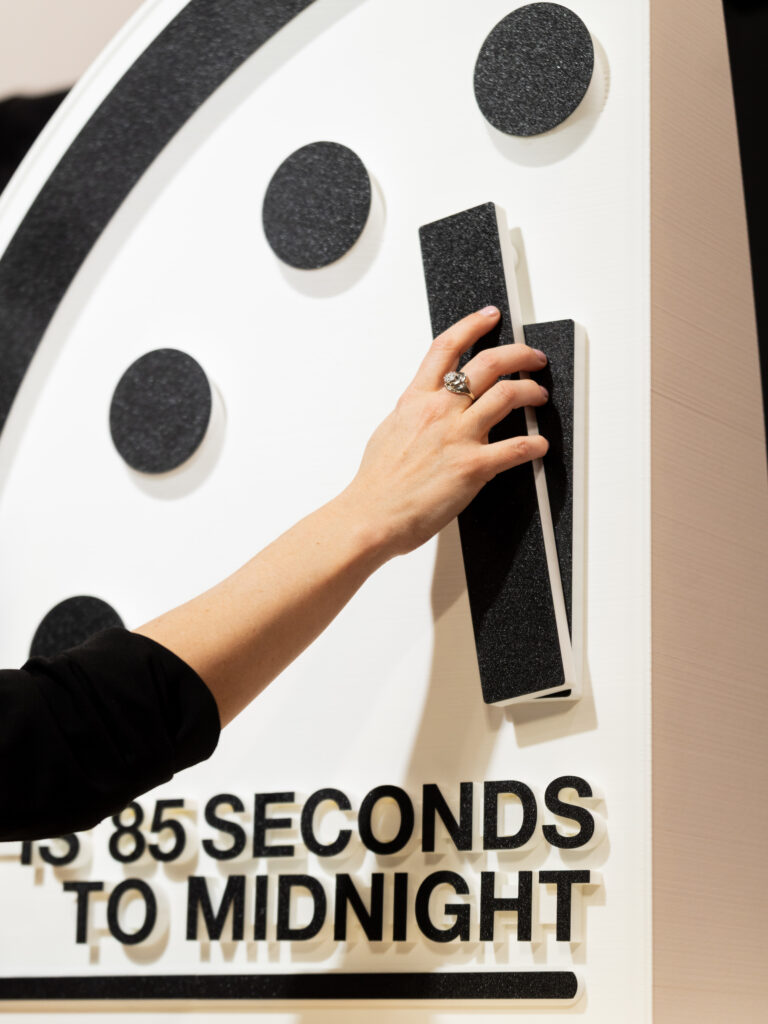
As mentioned there, the Bulletin of Atomic Scientists, through its Doomsday Clock, provides useful updates of a certain sort on the status of world efforts to buy time.1
(Still waiting for the hope, Bill…)
The good news is this. Although we can only buy time, we can potentially buy immense amounts of it. Innovation is well under way with regard to energy efficiency and renewable energy sources. More generally, so-called climate stabilization wedge strategies aggregate to addressing our greatest environmental challenges for centuries to come. Even better, they’re comprehensive in that they involve decisions and actions on the part of all eight billion of us. We have agency. We’re participants, not mere spectators, in shaping and extending our continuing survival and the quality of that survival on our planet. We get to help out. And new technologies, starting with artificial intelligence, offer the prospect of identifying and enabling additional approaches and improving the effectiveness of existing ones, and soon.
Why then, a doomsday clock, showing only a minute-to-midnight, versus a doomsday calendar, running out to millennia, with the day and the hour very distant and uncertain?
That has less to do with civilization than the root word civility. Eight billion of us are looking to each other to be our source of civility and peace of mind. We grow fearful and angry when we see signs this is being withheld. Only when we realize that the peace of mind we hunger for comes from within instead of from without can we ourselves be civil. Civility is less something we have a right to demand from others than it is a renewable resource within us that we can share. The needed change is something each of us can individually and unilaterally control.
This reality was wonderfully captured in song by the Millers, inspired (as the link explains) by their personal experiences and the pessimism of the post-World-War-II-post-nuclear mindset. They originally taught the song to an international choir of schoolkids. Here are the full lyrics (the link above points to a few slightly different versions of these):
Let there be peace on earth
And let it begin with me
Let there be peace on earth
The peace that was meant to be
With God as our father
Brothers all are we
Let me walk with my brother
In perfect harmony
Let peace begin with me
Let this be the moment now
With every step I take
Let this be my solemn vow
To take each moment
And live each moment
In peace eternally
Let there be peace on earth
And let it begin with me
Peace on earth? Beginning with you and me? Devoutly to be wished. You know you want to hear it sung. Here’s a version by the country music singer Vince Gill and his daughter Jenny.
- The Bulletin also made note of the a-whole-civilization-will-die-tonight forecast. ↩︎