By Desislava Petrova et al.1
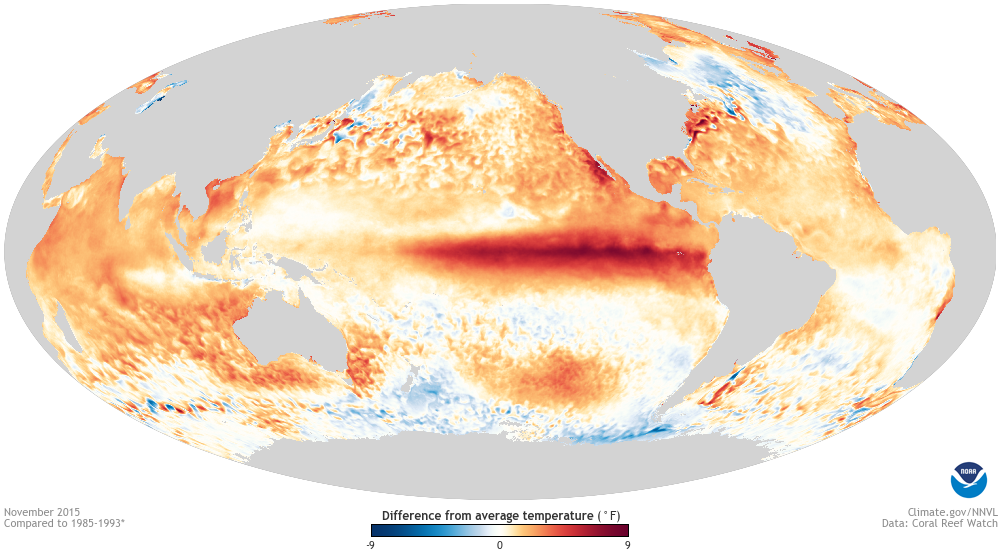
The El Niño-Southern Oscillation (ENSO) is one of the phenomena with the greatest capacity to alter the Earth’s climate conditions, and it is associated with numerous climate hazards and extreme weather events around the world. It is also the most significant source of seasonal and interannual climate predictability. Given the large impact this phenomenon has on much of the planet, early anticipation through operational long-lead forecasts could have huge economic, societal, and health benefits. The official forecasting framework currently used to issue warnings related to ENSO events is limited, as it only anticipates the events by 6 to 8 months. In our study, we have unveiled that our methodology made it possible to predict the 2023-24 El Niño in real time up to 19 months in advance.
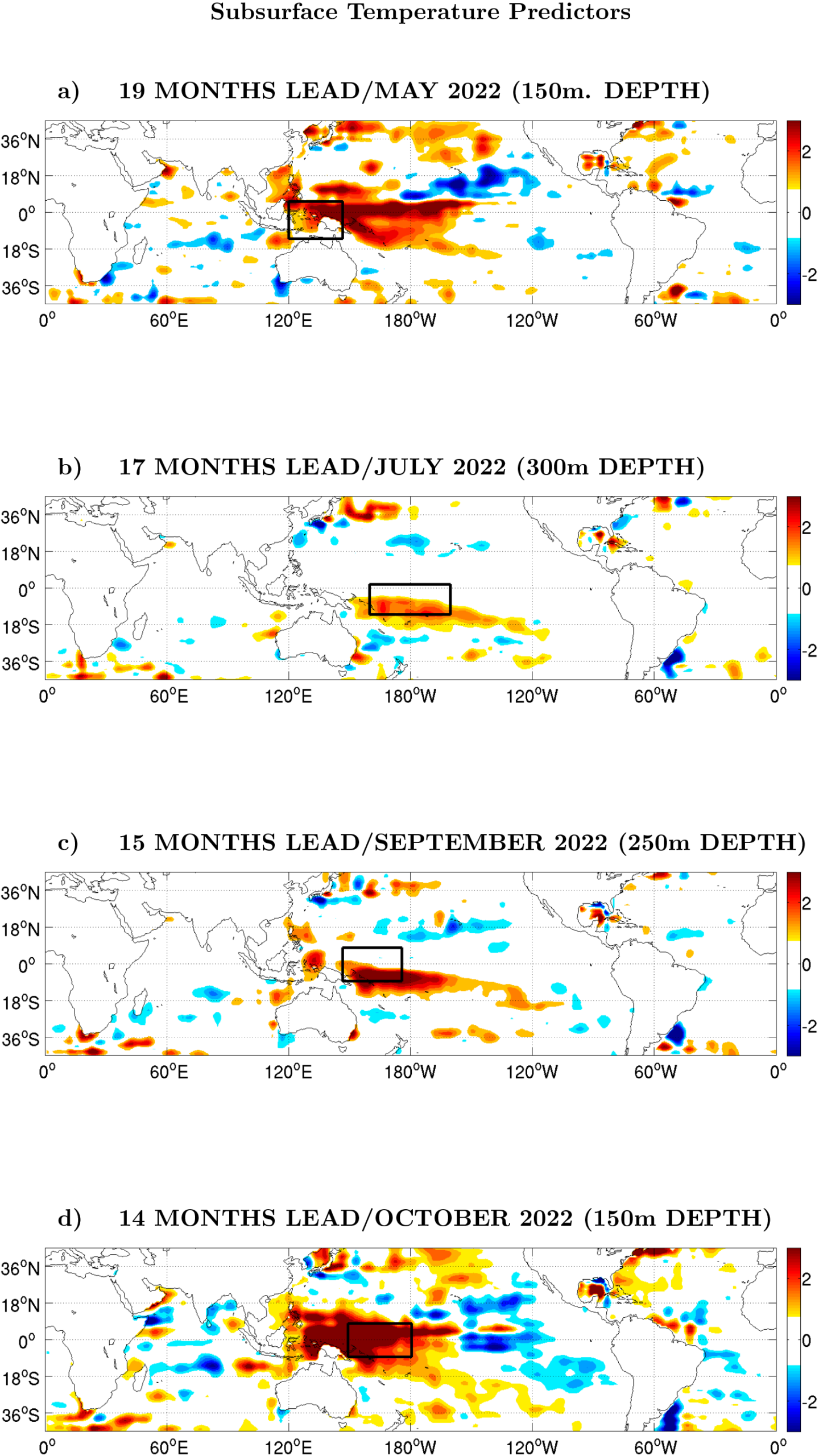
Over more than seven years, we developed, tested, and improved an ENSO statistical dynamic components prediction model (labeled EDCM). The model incorporates carefully selected predictor variables that include subsurface and surface ocean temperature and zonal wind stress over the western and central tropical Pacific, along with additional dynamic components that account for the quasi-cyclical ENSO physics. Intensification of the trade winds, a subsurface ocean heat buildup in the western equatorial Pacific and its slow subsurface migration toward the central equatorial Pacific, along with westerly wind bursts at a later stage, are well known to play pivotal roles in the onset of El Niño events. Therefore, EDCM is designed to capture these dynamics and make use of different predictors at different lead times, ranging from subsurface temperature at different depth levels and sea surface temperature to zonal wind stress. These predictor indices are based on the general progression of a typical El Niño event and are extracted from predefined regions.
Using historical datasets provided by the tropical ocean observing system, we have tested the model to prove that it was indeed able to predict major El Niño events since the 1970s, sometimes even more than two years in advance. We previously predicted the 2014-16 and the 2018-19 El Niño events in real time more than one year ahead. With our latest research, we went on to forecast in real time the development of El Niño in the equatorial areas of the Pacific in the winter of 2023-24. Climate conditions there between the spring and winter of 2022 were compatible with the early onset and evolution of a warm event. All the anomalous features discussed previously were present and captured by our predictor variables during the year-and-a-half preceding the boreal winter peak of the 2023-24 El Niño. The quasi-biennial and quasi-quadrennial modes of ENSO variability, corresponding to some of the EDCM dynamic cyclical components (along with a near-annual component), were also in their growing phases in 2023, signaling the high probability for an El Niño to occur. The forecasting system was able to predict this moderate-to-strong warm event up to 14 months in advance, while a borderline El Niño was foreseen 19 months in advance.
Having demonstrated the operational forecasting potential of EDCM, and considering results from other recent ENSO prediction studies, in our article we also call on authorities and relevant stakeholders to incorporate these early forecasting systems and increase the official lead time of operational ENSO forecasting. It is vital to take advantage of the tremendous potential that EDCM and other recently developed long-lead ENSO models have in fields as diverse as health impact studies, the epidemiology of vector-borne diseases such as dengue fever or malaria, agriculture, or energy production systems. Our prediction framework and results point to a potential for doubling the operational predictive lead time of ENSO to at least 12 months, with the possibility for even earlier anticipation of 19 months. Such longer-lead forecasts could be of high value, because decision-making and management in a number of key socioeconomic sectors could be substantially improved. For example, our long-lead El Niño forecasts were previously utilized within a dengue fever incidence model for the city of Machala in Ecuador, to assess the probability of a dengue outbreak up to 11 months in advance in 2016 and 2019. In this way, EDCM’s potential to extend the forecast lead time of a climate-sensitive disease was also illustrated.
In light of these considerations, we believe that it is now relevant to start establishing an operational structural framework for the issuing of such longer-lead ENSO forecasts that is also coordinated with local needs and demands. An additional forecasting plume could be released on a regular basis alongside the existing one for medium- and short-lead predictions, and it would include only models tailored for longer-lead forecasts. Hence, a consensus ENSO outlook at a lead time of at least one year ahead could be available for climate information users.
A Brief Conversation
with the Author
“I got thrilled by fluid dynamics and especially by atmosphere–ocean fluid interactions. As a mathematician by background, I was surprised that I hadn’t been introduced to this beautiful part of mathematics during my bachelor degree studies.”
—Desislava Petrova, Barcelona Institute for Global Health (ISGlobal)

AMS Headlines: What would you like readers to learn from this article?
Desislava Petrova [Barcelona Institute for Global Health (ISGlobal)]: Two things are important take-home messages from this article. First, that an ENSO or any other climate prediction system needs to be tested operationally over extended periods of time before it can be successfully deployed and used with confidence by stakeholders and decision-makers. And second, that the groundwork has been laid, including by a number of other recent studies, testifying as to the feasibility of extending the operational ENSO forecasting to at least one year in advance.
AMS Headlines: How did you become interested in the topic of this article?
DP: Years back, when I was doing my master’s degree at the University of Bristol, I randomly came across a book about El Niño in the city library. I finished it in two days, and ever since I have been fascinated by the enormity of this phenomenon. It happens over a vast swath of the Pacific Ocean, and then it has multiple ramifications, not just for climate, but for many socioeconomic sectors and activities all around the globe. Moreover, it has impacted humanity during all its history. I was lucky to pursue a PhD project on ENSO predictability, and I have been involved in ENSO research ever since.
AMS Headlines: Can your methodology predict an event’s intensity?
DP: The intensity of an ENSO event is very hard to predict at long lead times. The model mostly underestimates the amplitude, although there were instances when it could predict a strong El Niño early on (e.g. the 1997-98 event; see Figure 4 in same paper mentioned in the previous answer). However, in the case of the 2015-16 “super” El Niño, the model predicted a moderate event at leads of 21-29 months, and a strong event was foreseen only for lead times of less than 13 months. For this year, I have not run all lead times yet and I have run the model with data up to December 2025 (i.e., 12 months or longer lead times). Based on this preliminary information, the forecast points to an event similar in strength as the 2023-24 El Niño. This could be an underestimation. The impacts of the last warm event in 2023-24 were devastating in many regions—an exceptional drought in the Amazon and record-breaking floods in southern Brazil, just to name a few—so an even stronger El Niño this year could have more widespread and catastrophic consequences.
AMS Headlines: What surprised you the most about the work you document in this article?
DP: It was surprising that all of the anomalous processes typically accompanying the onset of El Niño based on my previous analysis of ocean temperature and wind variables actually occurred in a very consistent and timely manner. Every ENSO event has its own “flavor.” However, there are some processes that seem to inevitably occur prior to El Niño, such as the warm pool heat buildup and the ensuing westerly wind bursts. The diversity primarily comes from the exact timing and intensity of these processes.
AMS Headlines: What was the biggest challenge you encountered while doing this work?
DP: I was actually focused on a different project related to future precipitation changes in Mediterranean climate types at the time I ran the ENSO model and issued the forecasts for a forthcoming El Niño event. Therefore, I had to convince my supervisor at the time that it made sense to divert my attention to this study at least for a while, because testing and calibrating the ENSO model is an ongoing topic in my research career.
AMS Headlines: Does your new ENSO prediction methodology forecast La Niña with the same long-lead accuracy as El Niño?
DP: Yes, the model is theoretically able to predict La Niña at the same long leads as El Niño. In fact, last year’s La Niña was accurately predicted 24 months in advance. Currently, the same predictors are used in a reverse way, capturing cool anomalies in the subsurface and strengthened easterlies. However, since El Niño and La Niña are not exactly symmetric, one of the objectives I have for the future is to fine-tune and design specific predictor parameters to address this asymmetry. In that sense, perhaps the La Niña forecasts could be further improved.
AMS Headlines: Early spring in the Northern Hemisphere has reportedly long been a mostly low-skill time of year for ENSO forecasts – does your methodology wipe away this seasonal prediction gap?
DP: The so-called spring barrier in ENSO prediction is due to intrinsically low signal-to-noise ratio during this season, and while the model could potentially overcome it, the overall prediction skill slightly drops at lead times of 8-10 months with respect to the boreal winter peak (see Figure 3 in a January 2020 Journal of Climate paper).
“I want to extend the predictor variable pool to include specific covariates that target La Niña events. At the moment, the cold phase of the oscillation is treated by the model as purely symmetrical to El Niño, but the literature shows that this is not always the case, and there is in fact evidence for distinct dynamical processes during La Niña events. For example, El Niño is usually much quicker to decay than La Niña.”
—Desislava Petrova, Barcelona Institute for Global Health (ISGlobal)

- Key messages from “The 2023/24 El Niño and the Feasibility of Long-Lead ENSO Forecasting,” by Desislava Petrova (Barcelona Institute for Global Health (ISGlobal), Xavier Rodó, Siem Jan Koopman, Vassil Tzanov, and Ivana Cvijanovic. Published online in BAMS, October 2024. Right click on the link above for options to view the full article. ↩︎