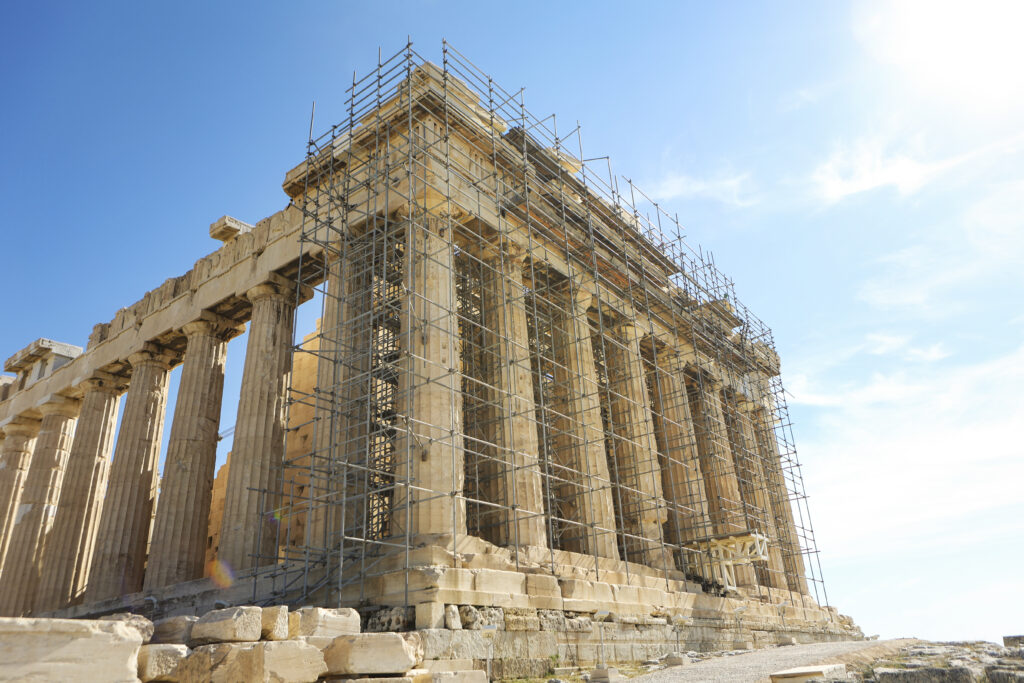
“In the end, more than they wanted freedom, they wanted security and they wanted a comfortable life. And they lost it all – security, comfort and freedom. The Athenians finally wanted not to give to society, but for society to give to them. When the freedom they wished for most was freedom from responsibility, then Athens ceased to be free.”—Edith Hamilton (a paraphrase from her book, The Ever-Present Past)
It’s been a challenging few years for American science. 2025 saw swingeing federal budget cuts and staff reductions to climate science and to the environmental sciences more broadly. NOAA and EPA were especially hard hit, as were their academic collaborators. 2026 has seen punitive measures at NCAR, dislocation of NSF headquarters, and threatened cuts to NSF and NASA budgets and programs. Medical and public-health research and services saw similar disruption. The USGS Ecosystems Mission Area and National Academies of Science, Engineering, and Medicine (NASEM) are also in the crosshairs. Most recently, OMB has signaled intent to politicize science grantmaking, terminate active grants, limit international collaboration, bypass peer review, and more.
The actions taken to date and proposed for future cuts and disruption threaten the dominant position the United States currently enjoys worldwide in virtually every science discipline. This across-the-board U.S. leadership has been an extraordinary accomplishment, especially considering that our population is only 4% of the world’s total. Because the research advances have been developed with step-by-step international partnerships, the U.S. success and leadership has led to American national security and economic prosperity, and contributed to global frameworks benefiting the entire world.
It was therefore not only natural but imperative that the U.S. science agencies, their research-university partners, and professional societies would produce counterarguments and, in some instances, take legal steps to minimize what promises to be catastrophic damage. This they have done and are doing. (An AMS statement was posted on Headlines on July 1.) Those efforts are to be applauded.
Since the intent to hobble science has been politically motivated, logic and evidence-based counterarguments are unlikely to change minds of those wielding the wrecking ball. Instead, the pushback and the rationale are aimed at a different audience: Congress and the wider American public. The hope is to generate the countervailing political support needed to walk back the past-and-proposed destruction. If recent experience is any judge, the effort will be at least partially successful. However, it will not likely be complete, nor will it be sustainable over the long haul.
In many ways, the attacks on science are comparable to a natural disaster. The current destruction and ensuing recovery efforts in the face of the Venezuelan earthquakes make this similarity easy to see.
One key similarity: Earth’s seismic activity is no respecter of human cost.
What can be learned from the disaster experience? Well, researchers speak in terms of the disaster cycle: mitigation, preparation, emergency response, and recovery. The rosy scenario—the goal, the ideal—is one in which society learns from experience through each run of the cycle. After a tragic event, society builds back stronger. In this event, for example, strengthening lateral braces in high-rise structures to reduce the risk of pancaking collapse. Sharpening the resolution of seismic maps and minimizing new construction and reconstruction on fault zones. Investing in planning and technology to improve emergency response – building increased capacity for search and rescue, and speeding the supply of emergency food, water, and shelter to survivors. However, in most such disasters worldwide the lessons learned are few, and even these only minimally augment future practice. That’s particularly true of the mitigation piece. After the earthquake, an impoverished nation rushes to resettle the homeless and return to some level of normalcy. The fastest, cheapest option is often rebuild-as-before.
This locks in a future of repetitive loss and decline. The root reason? The goal is a resilient society resilient to natural hazards. But hazardous events occur only infrequently relative to the time scale for rapid technological advance and social change. Thus, emergency response planning, however enhanced by the most recent experience, has usually become obsolete by the time natural hazard revisits the area (much like the Maginot Line of World War II).
The same reality challenges efforts to make science and its infrastructure more resilient to political attack. If the countermeasures are limited to appeals to Congress and the public, the scientific establishment will erode. Whether gradually or rapidly, the United States will yield its favored national security and economic position to another nation or nations.
Note that such a limited approach is equivalent to focusing only on the emergency response and recovery sectors of the cycle. Usually, in the natural disaster case, when emergency response and recovery come into play, the options for reducing damage and disruption have largely been lost. Attention should therefore focus on mitigation—on reducing the likelihood of politically driven interruption of vital research, and on limiting the consequences of such disruption.
At least four somewhat overlapping opportunities to protect science come to mind. (You can easily come up with more, or a better framing—please do!) Giving weight to each will at the same time accelerate the contributions to science toward building a better world, to everyone’s benefit. They are:
- Decouple science to the extent possible from partisan politics. Given the polarization of today’s world, this will not be easy, but scientists are guilty of remaining passive as this problem has surfaced over several decades.
- Focus on the essential connections linking the contentious branches of science to those receiving priority. The world’s natural hazards experience has shown that hazards enhance/exacerbate preexisting trends. Unified, vibrant societies shrug off natural disasters. Those with fraying social fabric find themselves in accelerated decline. In short, science needs to hitch its wagon to AI’s rising star.
- Strengthen K-12 public education, not just with respect to STEM education, but giving greater primacy to critical thinking and civics.
- Bring the private sector to the table.
Each of these needed steps requires scientists to shoulder some responsibility. None of these needed steps is easy. None is comfortable. None is without flaws or risk. But as Edith Hamilton noted from her decades-long study of the Athenians—if as scientists we want to continue to be free—then we need to move in these directions, or something like them.
My plan is to flesh out each of these in subsequent posts.