By Lourdes B. Avilés, Associate Provost, Plymouth State University
In my first semester as a doctoral student at the University of Illinois at Urbana-Champaign, a small snowfall, maybe three inches, fell while the autumn leaf colors in town were still vibrant. The convergence of seasons was an amazing sight that I eagerly waited to see again, but it did not repeat during my time there. I did not know how unique it was when I experienced it; I had little experience with the spectacles of fall color.
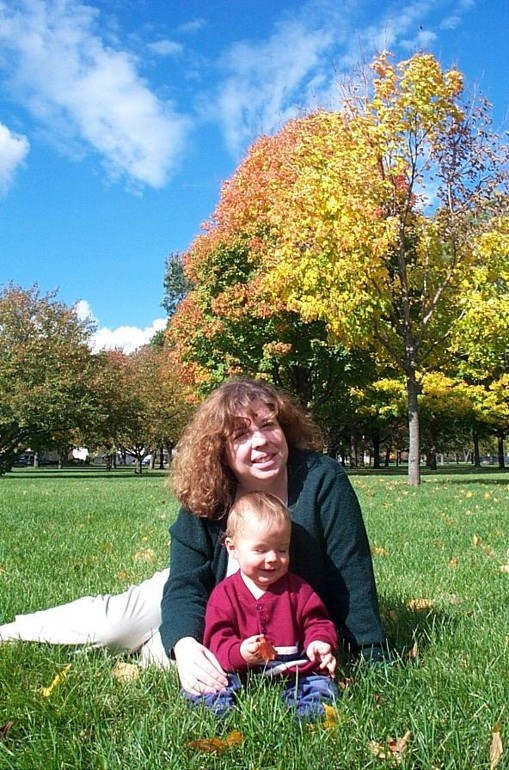
The seasons I experienced growing up in the southwestern coastal region of Puerto Rico had more to do with shifts in precipitation, accompanied by small temperature and humidity variations. Summer/fall was hotter and more humid with a higher chance of rain. Winters/springs saw less rain and were (somewhat) less hot and humid. Autumn’s orange, red, and yellow leaves were exotic, faraway sights to enjoy in pictures and movies. When I finally got to see them firsthand in Illinois, I was deeply fascinated by the show put on by shade trees around town.
When I came to live in New England in the early 2000s, I was blown away. It is not surprising that so many go out of their way and spend money to experience the awe-inspiring fall foliage here. My home institution, Plymouth State University in New Hampshire, is located between the White Mountains to the north and the Lakes Region to the south, with access to myriad fall color sights.While my experience in the Midwest helped me learn to appreciate the beauty of fall trees, I was not prepared for being surrounded by mountains and valleys covered in blankets of bright colors, or the variety of intermingling yellows, oranges, reds, and deep purples.
I quickly learned that you cannot know exactly when the colors will start and end or how bright they will be in any given year. I also learned how ephemeral the peak colors can be. What is a magnificent sight midweek might be gone by the weekend.
There is of course a climatological peak for foliage colors that depends on the location (as shown in the map below), but in practice, peak color can happen a week or so before or after the climatological peak. In addition, some trees start changing very early or stay colorful very late, and will be bare or fully green, respectively, while their neighbors show their colors.
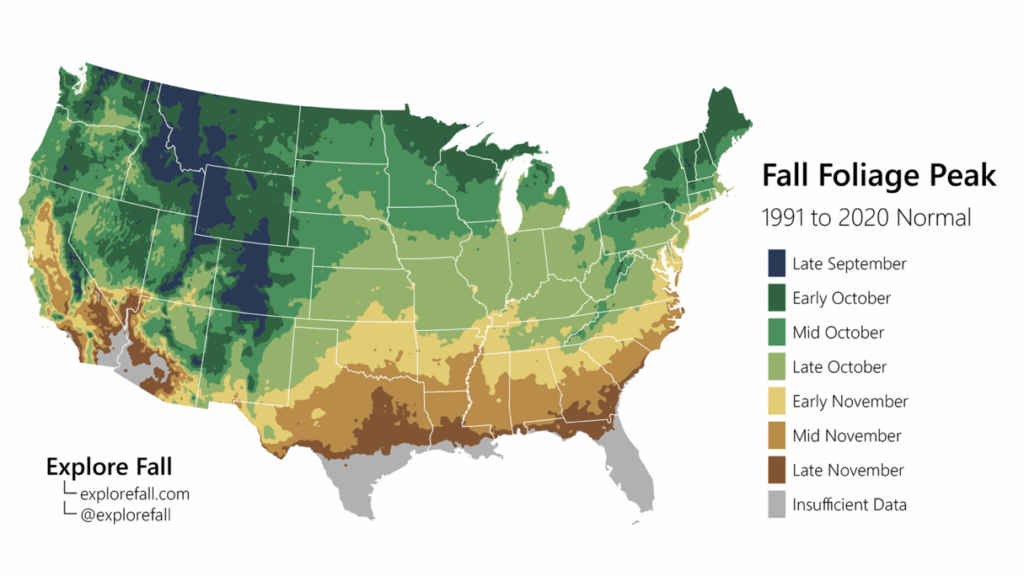
The website ExploreFall.com provides a wealth of information about fall colors. Created by a meteorologist, the site uses its own proprietary model based on satellite observations of vegetation cover and temperature, as well as other weather conditions, to predict the evolution of fall colors throughout the nation. Available online here, this map provides a climatology of Fall Foliage Peak corresponding to the thirty-year average for 1991 to 2020. Thirty-year averages are commonly used in determining the so-called “normal” conditions, in this case, the timing of the peak color, which ranges from late September to late November. Peak color is established when most trees in a particular area have full canopies of fall colors.
Given my then-new job as a meteorology professor, I was immediately interested in learning more about the role of weather in fall colors, information I wanted to share with my students. But the simple rule-of-thumb answers just led me to deeper questions, and over the years I learned more. My work on atmospheric optics during this past decade has provided an additional lens through which I could explore the autumnal show.

The highest peak in the Northeast U.S., home of the famed Mount Washington Observatory, stands out in the background covered in snow, while the surrounding mountains and valleys teem with colors. Photo by Lourdes Avilés.
Those are the topics on which we will focus below: weather and optics. We will also have to touch on some plant physiology and biochemistry here and there, but we will keep it accessible.
The Science of Fall Colors
Overview
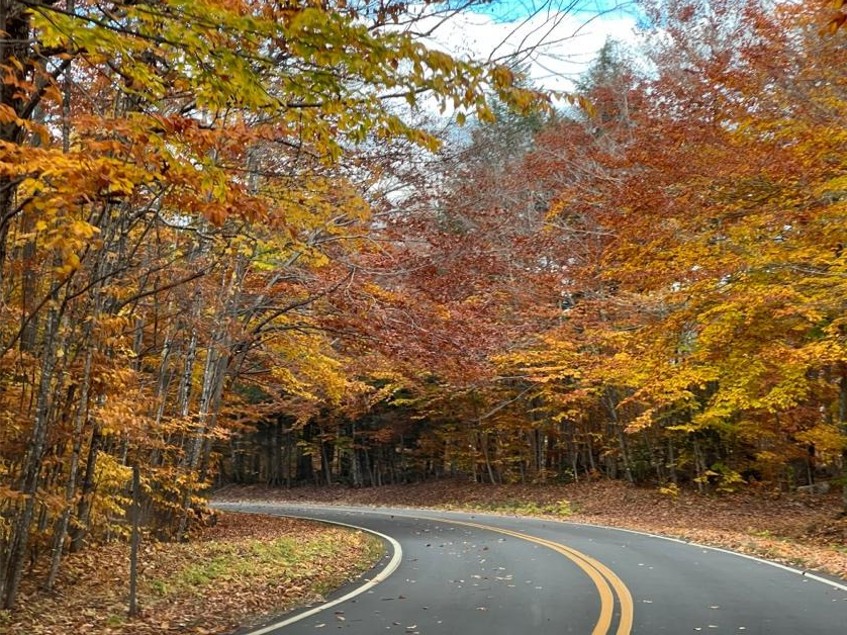
Every autumn, in some temperate regions and just for a short time, deciduous trees (those that shed their leaves as winter approaches) bring on a visual spectacle. The wide array of possible colors is the result of complex interplays between plant physiology and environmental factors that determine how trees react to shortening days and cooling temperatures. There are also normal variations among tree species and variations due to soil moisture and temperature.
<< Roads large and small at the right time and location can provide exciting fall color driving experiences. Photo by Lourdes Avilés.
Pigments
Leaves contain large amounts of chlorophyll pigments which absorb solar radiation, providing the energy necessary for the plant to make sustenance — carbohydrates — from carbon dioxide and water. Chlorophyll compounds are more efficient at absorbing reds and blues (on opposite sides of the visible spectrum of solar radiation) than they are at absorbing the wavelengths in between: the greens. Green light is least absorbed and thus reflected/diffusely scattered by the leaf surface, so that is what we see: green leaves.
Surprisingly, leaves do absorb a great deal of green light (up to 80–90% once you get to their deeper layers), but green is still the primary wavelength left over. As I explained in a recent AMS blog post, a similar but different phenomenon explains why some severe thunderstorms appear green.
The absorption of solar radiation breaks down chlorophyll molecules — we can say that they are spent by the needs of the tree. However, if temperatures are consistently warm enough and there is enough sunlight available, chlorophyll production easily continues and the mechanisms for absorption and energy conversion continue without interruption. In the fall, as the hemisphere tilts farther from the sun, solar radiation becomes less plentiful and temperatures tend to be colder, making the process of chlorophyll production less efficient and less worthwhile. The tree stops making as much chlorophyll, and other biochemical processes are set in motion to prepare the tree for winter.
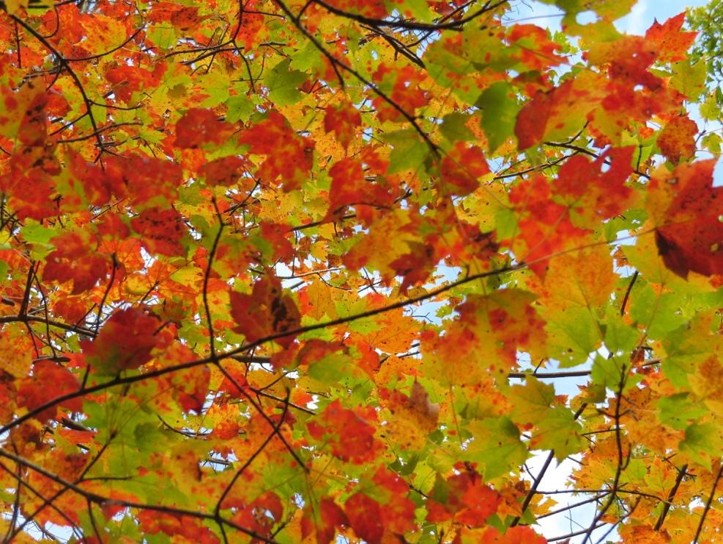
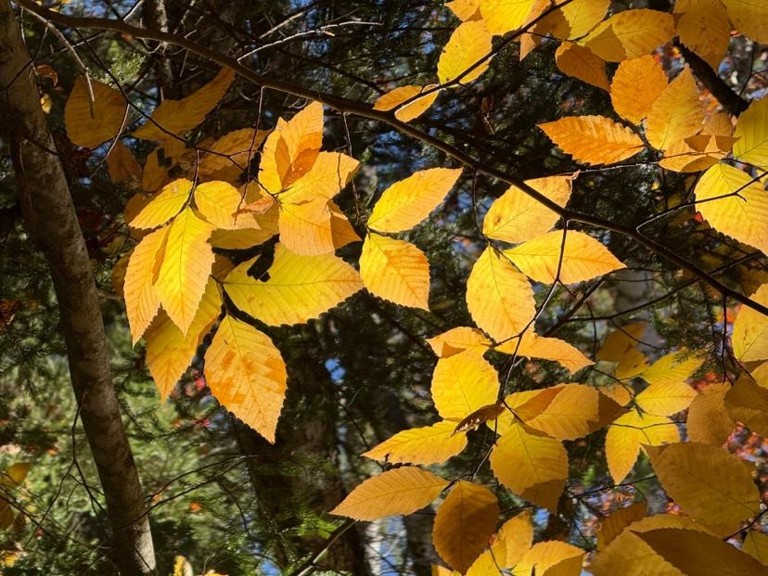
As chlorophyll breaks down into translucent, colorless molecules, the abundance of green diminishes. However, leaves contain other pigmented substances, which vary based on the tree species. Carotenoids, for example, exist at stable levels in the plant throughout the growing season and from year to year; these are the same pigments that make pumpkins and carrots orange and also color bright yellow flowers like sunflowers and fruit like bananas. As the dominating green pigment starts to diminish, the excess light reflected from the now dominating carotenoids can be seen. The yellows and oranges that some tree species produce thus tend to be similar from year to year.
When I first learned about the science of fall colors, it seemed suspicious that colors would be hiding until the green from the chlorophyll went away. One way to understand this is by thinking of a small cup of water with a small amount of yellow colorant. If there is no other color added, the water looks yellow (that’s what happens when the chlorophyll goes away and allows the other present colors to be seen). If one adds green colorant, then yellow and green will give a bright yellowish green (what might happen in the early spring when the leaves are first coming out and not enough chlorophyll has been produced yet, producing the brighter/yellowish spring green that blankets the mountains). If one continues to add additional green colorant, then it does not matter that there is any yellow present. All you see is green (this is what happens during the summer when chlorophyll production is at full swing).
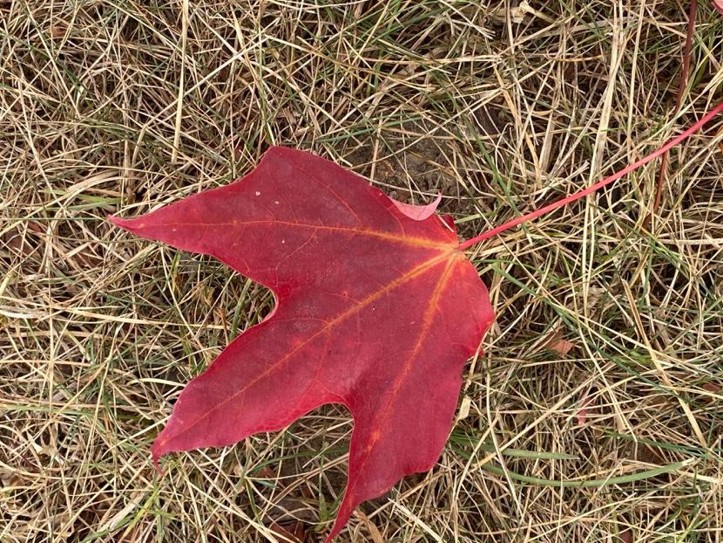
As the trees prepare for winter, a layer of cells forms at the base of the leaf where it connects to the branch. Slowly cutting off the exchange of sap and nutrients between the leaf and the branch, this process, known as abscission, will eventually cause the leaf to fall off the tree. Rather than an immediate cutoff (going from green to dead and off the tree), the process is gradual, although it does accelerate as the season progresses. During this time, nutrients still in the leaf can be reclaimed by the plant. Any remaining chlorophyll will continue to absorb solar radiation and the leaf will keep making sugars, but they will not flow out of the leaf as readily. Some plants (for example red maples and sugar maples) will at this point use those sugars to make new pigments: anthocyanins, which produce deep oranges, reds, and dark purples. Simplistically, we thus have three pigments: chlorophyll (green), carotenoids (yellow/orange), and anthocyanins (reds/purples), whose amounts are decreasing, staying steady, and increasing, respectively, as the fall colors appear and progress.
Environment
Fall colors are generally not the same from year to year either in exact timing, intensity, or even the shades of color that dominate. This is because, besides tree health (distressed trees, for example, tend to change colors early), weather conditions have an important effect on the processes described above. Anthocyanins, for example, form in the presence of sunlight, but only as the flow of nutrients out of the leaf is decreasing in the fall. This means that the best conditions for vibrant reds are sunny fall days, to aid with red pigment production, and chilly (but not freezing) nights that promote the abscission process. Freezing temperatures, on the other hand, can precipitate the leaf’s early demise, since the delicate liquid-filled tissues will likely not survive a deep freeze. It is a common misconception that the first frost of the season brings in the fall colors. In fact, an unluckily timed hard frost can ruin the upcoming colors.
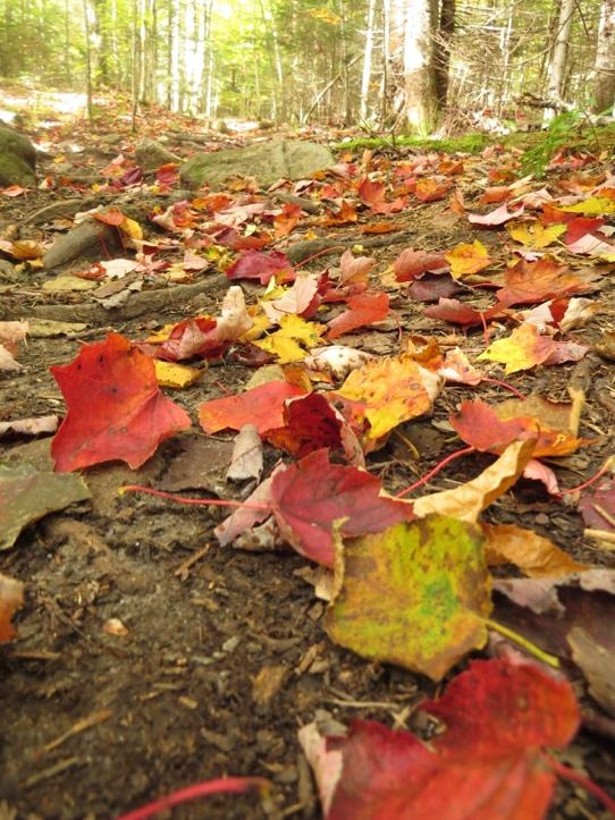
A strong storm can also prevent a foliage spectacle by blowing the leaves off the trees before they would have fallen naturally. Many observers noted that fall colors did not come after the Great New England Hurricane of 1938, as the surviving trees lost their leaves right before fall colors would have started showing in the region.
Adequate rain throughout the growing season maintains tree health and is best for good colors. On the other hand, too much rain or flood conditions could affect a sensitive tree species. In general:
- If the soil is dry, colors tend to happen earlier.
- If too wet, they tend to be delayed.
- If nighttime minimum temperatures are too high, colors are also delayed.
Combined, all these conditions can cause substantial variability. Additionally, different tree species can have different normal, earlier, or later timing of their colors showing. For those wanting to learn a little more, the USDA Forest Service’s The Science of the Fall Colors is a worthwhile resource. More advanced information can be found from Xie et al. (2018) and Kyne and Diver (2012).
Finally, we must return to the shorter days and longer nights that signal the tree that it is time to prepare for the winter. Changes in nighttime length, which in turn also depend on latitude, are the most reliable of all the triggers of the start of the processes. One can think of these changes in solar radiation as the factor that opens the door to all others.
The Last Tree
It was a beautiful early November day in 2015. Walking back from the grand opening of a new athletics facility, I approached the row of trees that lines the core of campus. Among the leafless brown was this yellow beacon that just could not be ignored.
This very large maple was full of leaves, all bright yellow. After the initial enthrallment, I noticed that there was also a thick carpet of yellow leaves underneath. It was just too irresistible of a sight, and caused me to veer from my initially intended path. As I approached, I started noticing the sound of leaves as they came down, hitting branches, other leaves, and finally the thick carpet of yellow that had survived the grounds crew cleanup. It was truly a heavy rain of leaves.
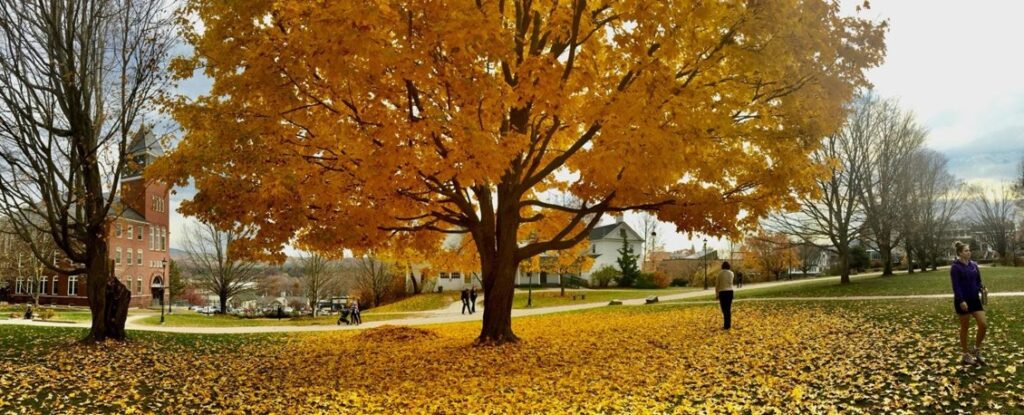
Standing under the tree and trudging through the yellow carpet, with leaves falling all around, was a surreal experience. I took many pictures and a few movies. One of my favorites was a slow-motion video of leaves swishing back and forth as they fell to the ground. I shared my experience on social media and quickly learned that others had also noticed the tree. As we discussed it, I started calling it “The Last Tree.” My colleague Liz Ahl was one of those who also found her way to the “burning and trembling, still-yellow maple,” and surprised me with an original poem, which she also read in her beautiful soothing voice. With ten-years-ago technology and my budding video editing skills, I combined her audio recording with the “slo-mo” movie and shared it. Every year since then, I am happy to reminisce when The Last Tree pops up in my “on this day” memories.
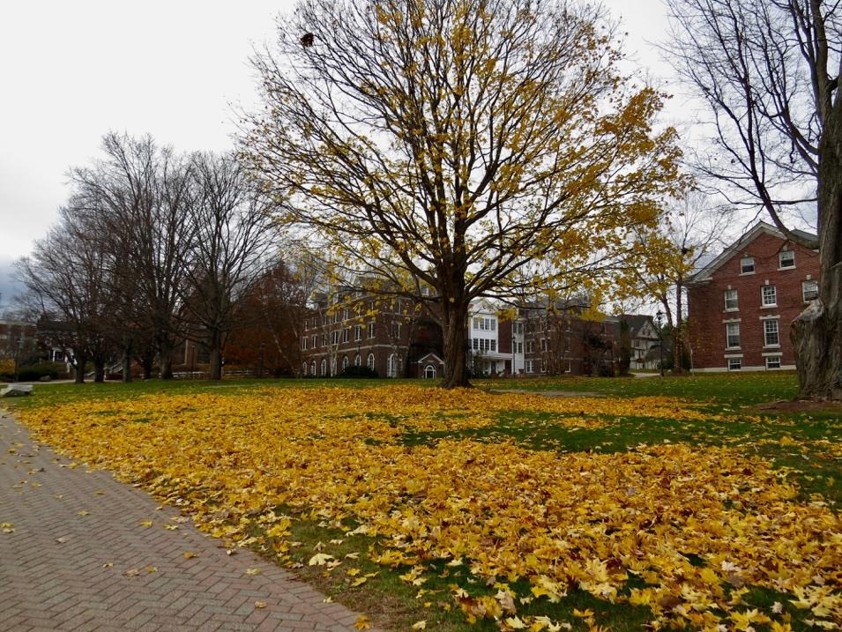
I came back the next day, a Saturday, but the tree was almost bare. The Last Tree was done for the year. Every year since then I try to catch that one day with the rain of leaves. Without fail The Last Tree continues to be so, but I always seem to be too early or too late to catch the magical experience with which I was gifted that year.
<< One day later, The Last Tree was almost done for the year. Photo by Lourdes Avilés.
The Last Tree
by Liz Ahl
for Lourdes
The other trees along this campus path
are stripped of leaves now, down to their black bones,
and the piles they shed long disappeared
by late October wind, by the whining army
of leaf blowers. But here, one still-yellow maple
burns and trembles at the peak of its powers, rising
from the center of a golden carpet it has shed,
is shedding still, like the molten birth
of an island breaking the ocean’s surface with fire.
And we sodden castaways find it – drawn
to the shocking glow, hoisting ourselves onto shore,
exhausted by work, by life, by hurts and worries
that were just now pulling us under – rescued for a moment,
to kick the leaves, to take a picture, or just to stare
and walk slow circles around the sun of it,
as if this were the last tree ever. Stopped
in our harried tracks by this last gasp.
Made still, for now, by this blazing, dying beauty.
Acknowledgements: This is one article for which I would be remiss if I did not give thanks. Thank you, Madelynn Smith, intern at Mount Washington Observatory, whose summer research about fall colors in Vermont provided me with excellent resources on how weather and environmental conditions affect fall colors (shared above). Thank you, Liz Ahl, for not only vibing with me ten years ago but also allowing me to share your poem in this article. Finally, thank you to my husband Dan Bramer for indulging my desire to brave going out among the many tourists, so many tourists… multiple times each year to experience the northern New England fall colors. It never gets old.
Photo at top: Near-peak fall foliage colors blanket the White Mountains region of New Hampshire, as seen from the Gallen Bridge viewing area at the Franconia Notch State Park. Photo by Lourdes Avilés.