A summary of “Global Land-Lake Thermal Contrast in a Warming World,” by Heng Lyu (Yale, and Nanjing University of Information Science and Technology), Wei Wang, Wei Xiao, Keer Zhang, and Xuhui Lee, published in the 1 August issue of Journal of Climate. Click the link for the full, citable article.
Land-lake thermal contrast strongly influences local weather, local climate and the hydrological cycle. With our research, we calculated this thermal contrast ΔTs (difference in the surface temperature between land and lake) with subgrid data generated by the Earth System model CESM2 under the SSP5-8.5 maximum greenhouse gas emissions scenario. Results show that climate warming amplifies the daytime ΔTs (making it more positive) and dampens the nighttime ΔTs (making it less negative) across all climate zones. The annual mean ΔTs in 2019–23 ranges from –1.75 K in tropical climates to +2.82 K in arid climates. All climate zones exhibit increasing trends in the annual ΔTs. The global mean annual ΔTs shows a regime shift from being negative (–0.61 K; land cooler than lakes) in 2019–23 to being positive (+0.37 K; land warmer than lakes) in 2096–2100. This implies that the lake breeze should intensify, and the land breeze should weaken in the future, impacting local weather.
The authors note that this regime shift differs sharply from the land-ocean thermal pattern. The global land surface is cooler than the global ocean surface in the current climate and will continue to be cooler at the end of the century according to the same model projection.
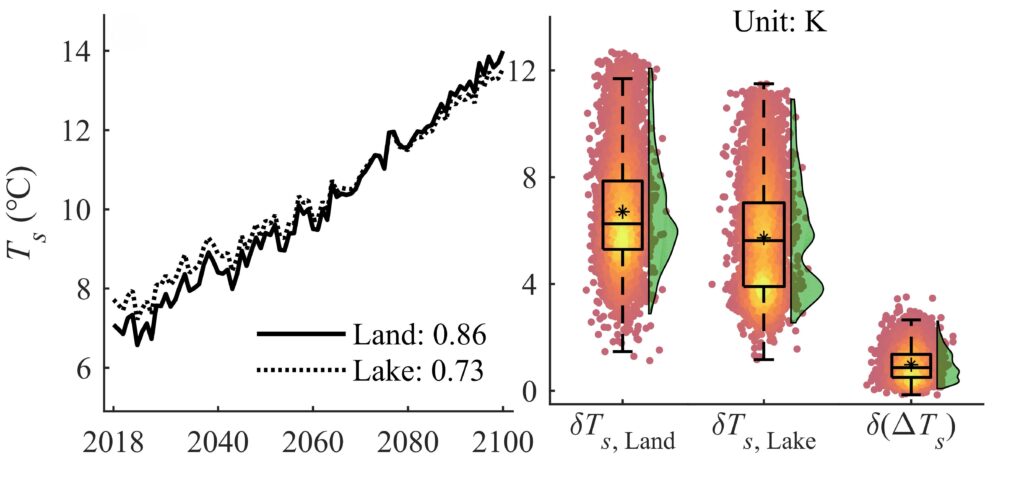
The validity of the model calculation was supported by good agreement between the modeled (0.57 ± 0.38 K decade-1) and observed lake warming trend (0.40 ± 0.30 K decade-1) and by reasonable agreement between the modeled and satellite-observed ΔTs.
We then used a surface energy balance framework to diagnose the contributions of long-term changes in lake and land biophysical properties (surface albedo, Bowen ratio, and convection efficiency) and in radiation energy to the long-term trends in ΔTs. A reduction in lake Bowen ratio, reduction in lake and land albedo, and an increase in downward longwave radiation are well-known consequences of climate warming. The reduction in lake Bowen ratio is the primary driver of the amplification of ΔTs across all climate zones. Albedo reduction has a relatively minor effect on the overall trend due to similar changes in land and lake albedo associated with shortened snow-cover periods on land and ice-cover periods on lakes. The role of the increase in downward longwave radiation is complex. In arid, temperate, and cold climates, the increase in downward longwave radiation warms the land but cools the lake surface at midday during the summer, contributing to the enhanced land-lake thermal contrast near the end of the century.