Key messages from "Development of an Integrated Modeling Framework for Visibility and Air Quality Forecasting in Delhi," by A. Jayakumar (Ministry of Earth Sciences), T. J. Anurose, Shweta Bhati, Margaret A. Hendry, Garry Hayman, Hamish Gordon, Paul Field, Saji Mohandas, Heather Rumbold, Prafull Yadav, Narendra Gokul Dhangar, Avinash Parde, Sandeep Wagh, Sachin Ghude, Andrew N. Ross, Daniel Smith, Stephen Dorling, John P. George, V. S. Prasad, and M. Ravichandran. Published online in BAMS, February 2025. For the full, citable article, see https://doi.org/10.1175/BAMS-D-24-0194.1.
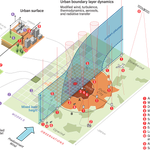
Cities around the world face complex urban challenges, including heat stress, visibility reduction, flooding, and air quality issues. Beyond its well-known health impacts, particulate pollution also affects local atmospheric processes, particularly shaping the formation, longevity, and clearance of fog. These unique characteristics underscore the necessity for specialized attention to urban atmospheric chemistry at city-scale resolutions. One such city in India is Delhi, which frequently reports high levels of particulate matter pollution, particularly in the winter, along with periods of intense fog. Air quality and visibility forecasting for an urban region is dependent upon many key inputs other than emissions and meteorology. Realistic representation of the (i) city’s local urban morphology, (ii) surface aerosols, and (iii) soil conditions impacted by irrigation activities has been found to significantly influence air quality and visibility prediction in Delhi and surrounding areas. Addressing these problems effectively needs an integrated modeling framework. Subsequently, we developed the Delhi Model with Chemistry and aerosol framework, DM-Chem, and set it up for Delhi operationally, especially for fog and air quality forecasting, which is crucial for minimizing both health and economic losses.
In 2013, the UK Met Office developed a high-resolution model centered on Heathrow Airport in London that significantly improved fog forecasting. The enhanced representation of orography in the Unified Model (UM) led to better simulation of turbulence within the stable boundary layer. Inspired by this success, we initiated a similar modeling setup over Delhi in 2017 to improve visibility forecasts for the Indira Gandhi International Airport. Unlike London’s relatively pristine environment, Delhi presents considerable challenges arising from intense urbanization and heterogeneous land-use characteristics, making tropical city modeling particularly demanding.

The evolution of the DM-Chem model reflects a series of systematic advancements implemented in the Delhi model since 2017. These include the transition from prescribed aerosols to an online chemistry scheme, the enhancement from a single urban tile to a detailed urban canopy representation, and the refinement of the visibility parameterization to incorporate aerosol effects. These developments are unique compared to prior modeling efforts, as few air quality models over tropical cities have addressed such challenges in an integrated manner. The advanced urban parameterization scheme was achieved through the incorporation of local urban morphological parameters such as the planar area index, frontal area index, and building height. A comprehensive, high-resolution database of air pollutant emissions—covering sources from transport, industry, and residential activities—has also been developed and incorporated into the model.
The combined use of CASIM, the cloud microphysics scheme, and UKCA, the UK chemistry and aerosol scheme, provides a robust framework to represent aerosol–cloud interactions realistically over metropolitan regions. Additionally, the extensive irrigated areas surrounding Delhi act as a significant local moisture source, while aerosol transport, stubble burning, and other regional activities contribute to elevated aerosol mass levels during the winter season. All these developments have been thoroughly documented and their versions updated in the model repositories to ensure traceability and reproducibility.
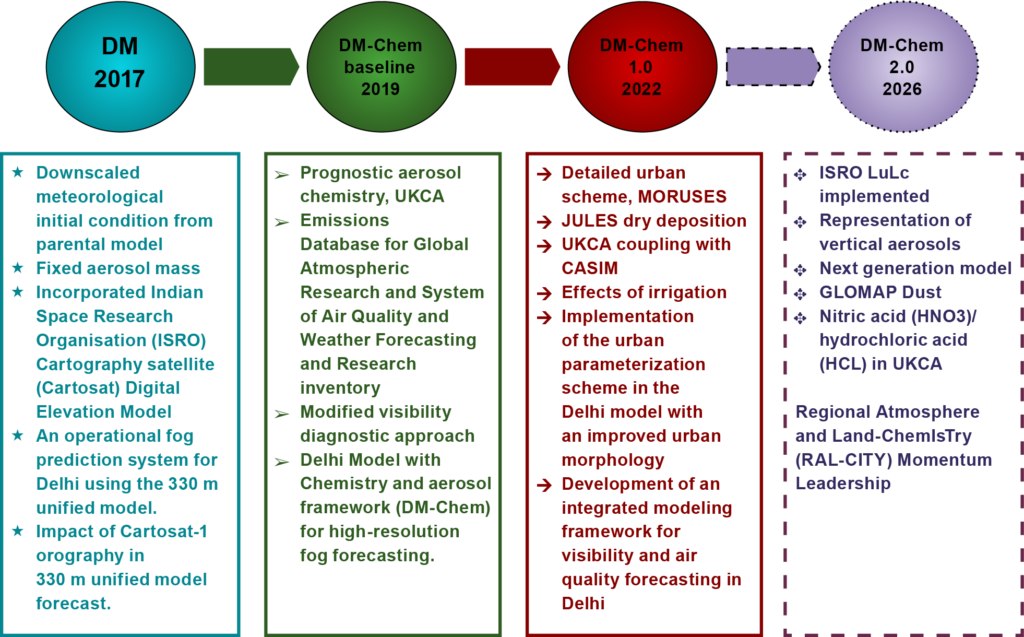
The Sixth Assessment Cycle (AR6) of the Intergovernmental Panel on Climate Change in 2023 indicates that urbanization has exacerbated the effects of global warming in cities, which is reflected in the intensification of the urban heat island (UHI) effect. Hence the aforementioned work in development of DM-Chem encouraged us to propose the Urban and Chemistry Modeling leadership activity to other operational NWP centers under the Momentum partnership of the UK Met Office. In its future scope, this activity aims to implement and release an advanced modeling framework for other tropical cities by incorporating a detailed urban parameterization and prognostic aerosol chemistry scheme, and to provide a uniform platform to address urban-specific challenges. This framework offers a comprehensive approach to study urban-aerosol interactions and feedback mechanisms and its effects on near-surface weather, particularly during severe weather events such as heatwaves, heavy rainfall, poor visibility, and air quality degradation.
METADATA
BAMS: What would you like readers to learn from this article?
A. Jayakumar (Ministry of Earth Sciences): Many cities around the world are susceptible to urban stress in the context of global warming, demanding specific attention to urban atmospheric chemistry at city-scale resolutions. This article highlights the development of an integrated modeling framework to address urban-specific challenges, by generation of reliable air quality and other hazardous weather prediction at city-scale range, to minimize both health and economic losses.
BAMS: How did you become interested in the topic of this article?
AJ: Since I currently work with the National Centre for Medium Range Weather Forecasting in Noida, a suburb of Delhi, I am directly affected by the problems caused by pollution and fog. While working at operational NWP centers, the difficulties in predicting different types of fog under varying meteorological and environmental conditions have been observed on many occasions. The city has frequently faced hazards due to the weather, which have resulted in aircraft cancellations and accidents on expressways because of poor visibility. These incidents frequently make newspaper headlines. This high susceptibility has motivated our group to develop models specifically designed for continental cities.
BAMS: What got you initially interested in meteorology or the related field you are in?
AJ: I have always enjoyed traveling and exploring diverse landscapes, including different land use patterns, river bodies, forests, and mountains, and much more. Meteorology offered a unique platform to blend this interest and passion with scientific inquiry, allowing me to study and understand the natural world in a structured and meaningful way.
BAMS: What surprised you the most about the work you document in this article?
AJ: The inclusion of the aerosol scheme in the model introduced a dry bias, which often resulted in the underprediction of fog events. In contrast, the representation of moisture sources through the irrigation scheme enhanced fog formation and played a crucial role in its simulation—an unexpected and noteworthy outcome of the present study.
BAMS: What was the biggest challenge you encountered while doing this work?
AJ: The unavailability of vertically resolved microphysical and aerosol distributions limited the quantitative interpretation of many model variables, subsequently impacting results in the skill score for the prediction of mixed fog types. Aerosol assimilation in the Global Model of Aerosol Processes (GLOMAP) chemistry scheme, whether through satellite data or chemistry reanalysis, is currently a constraint. However, it is expected to evolve into this model in the future.
BAMS: What’s next? How will you follow up?
AJ: The application and positive outcomes of our urban model DM-Chem in operational scenarios, especially for fog and air quality forecasting, form the foundation for expanding into a more advanced modeling framework employed for many other cities, through the activities of India’s National Centre for Medium Range Weather Forecasting, in collaboration with other operational NWP centers in a collaborative initiative withthe UK Met Office. This activity will be supported both operationally and with research to accurately simulate city-scale weather.