Key messages from “The Role of the Weather in the Fate of Shackleton’s Endurance,” by Ryan L. Fogt (Ohio University), Ashlee N. Ziegler, John King, and Julie M. Jones. Published online in BAMS, September 2025. For the full, citable article, see http://doi.org/10.1175/BAMS-D-24-0208.1.
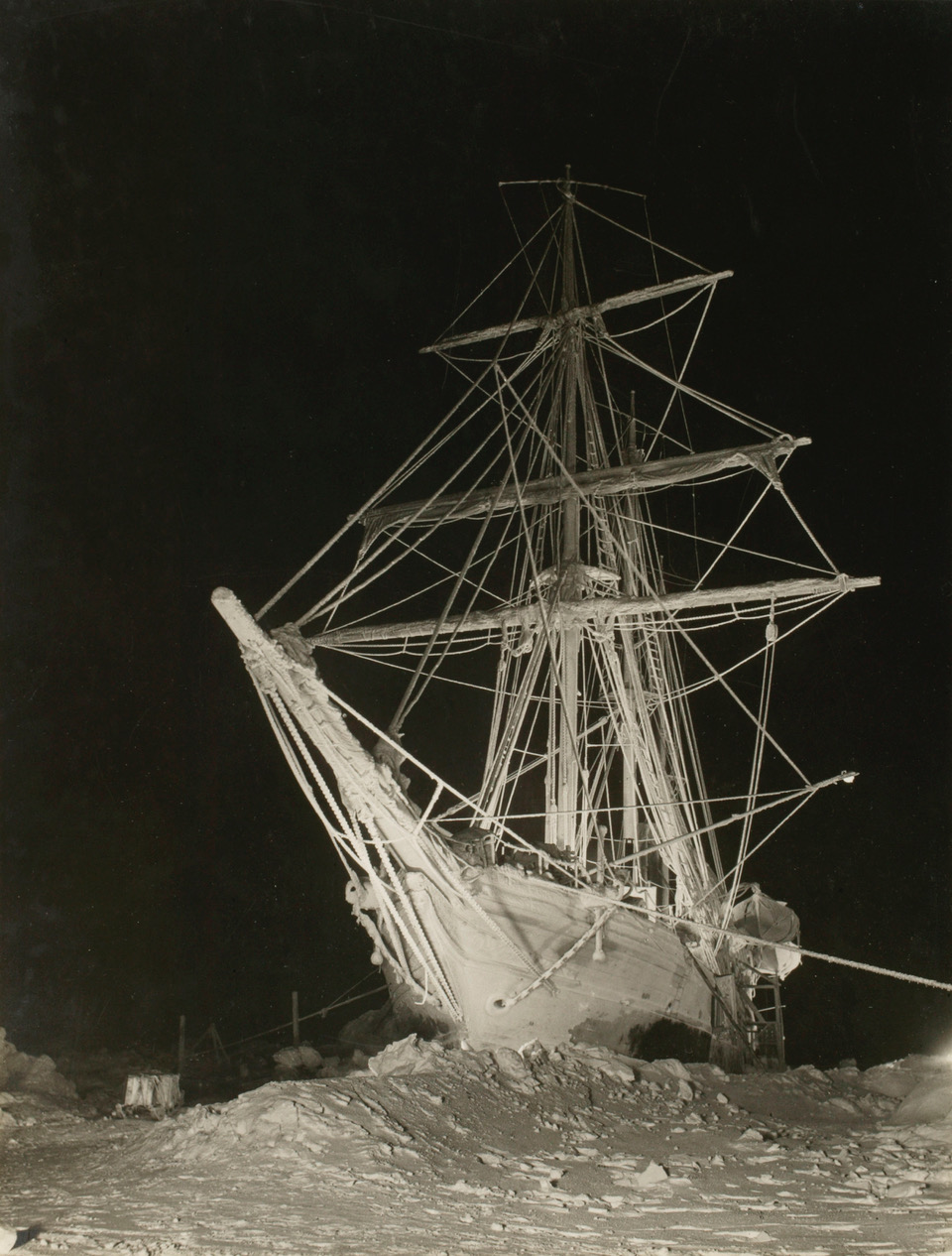
The Imperial Trans-Antarctic Expedition of 1914–17 is perhaps one of the greatest stories ever of survival, heroism, and perseverance in all Antarctic history. It was led by Sir Ernest Shackleton, who had previous experience on other British expeditions to Antarctica, including a failed attempt to reach the South Pole. The goal was ambitious: to have two separate parties, one led by Shackleton, landing on the Antarctic in the southern Weddell Sea (the farthest southern portions of the South Atlantic Ocean), crossing the Antarctic continent on foot, and eventually meeting up with the other party. The other separate party sailed into the Ross Sea (the portion of the deep southern Pacific Ocean south of New Zealand near Antarctica) and made landfall where many previous Antarctic expeditions had gone before. While both parties had setbacks and faced obstacles, the events that unfolded for the Weddell party (led by Shackleton) caused the need for a heroic rescue.
![Sir Ernest Shackleton, leader of the Imperial
Trans-Antarctic Expedition of 1914–17 and captain of
the ship Endurance. [Image courtesy of The Scott Polar
Research Institute, University of Cambridge]](https://headlines.ametsoc.org/wp-content/uploads/2026/01/Ernest_Shackleton-web-764x1024.jpg)
Shackleton commanded the ship Endurance, and when it sailed into the Weddell Sea, it encountered sea ice much quicker than anticipated and soon after became stuck within thick pack ice. The crew then hoped for an early breakup of the sea ice in austral spring, but unfortunately this did not happen, and eventually the ship was crushed by the pressure of the ice surrounding it and sank to the bottom of the Weddell Sea. Without a ship, the crew used its lifeboats to make landfall on a small island (Elephant Island) at the northern edge of the Antarctic Peninsula. Realizing they could not survive at this location indefinitely, Shackleton and four other crew members modified a lifeboat, called the James Caird, and made for the nearest island where a whaling station could provide assistance. Using only primitive navigation tools (primarily a sextant and chronometer), but with an expert navigator, Frank Worsley, the ship sailed across the stormy, rough waters of the Drake Passage and made landfall on a small island, South Georgia. They then crossed over the island on foot to a whaling station and were soon able to get a rescue ship back to Elephant Island and reach the abandoned crew. Miraculously, no one from the Weddell party perished, and despite not fulfilling its original mission, this story remains one of the most iconic in all of Antarctic history.
While no one can doubt the leadership of Shackleton to see the expedition through to its positive outcome, with our research we investigate this story asking a different question: Was the fate of the ship Endurance sealed before it left on its journey south into the Weddell Sea? In other words, was the weather of this expedition in 1914–15 exceptional, enough so that it likely played a role in the ship getting stuck in the ice and eventually crushed? To analyze this question, we used multiple lines of data—including measurements taken directly from the crew until they boarded the lifeboats, reconstructions of both the atmosphere and sea ice in the region, nearby long-term measurements from stations on sub-Antarctic islands, and reanalysis data to put the point measurements into a broader spatial and temporal perspective. In analyzing these sources of data, we find two unique aspects of the weather during this voyage that were not present in neighboring years and likely played a role in the outcome.
First, the austral summer of 1914–15 was marked with more extensive sea ice in the Weddell Sea, both in the context of satellite observations and estimates from the twentieth century, consistent with an ongoing El Niño event. Indeed, the ship encountered sea ice within one week of sailing into the Weddell Sea, where satellite observations since 1979 rarely indicate the presence of ice; regional sea ice extent reconstructions and observational measurements of ice at the nearby South Orkney islands indicate that the 1914–15 ice season was one of the longest and most extensive since the beginning of the twentieth century. Once the ship became beset in the ice, observations from the Endurance compared to the same locations over a longer climatology from the ERA5 reanalysis indicate persistent near-record minimum daily mean temperatures, which lasted through the remainder of the summer of 1914–15, offering little opportunity before winter to become dislodged.
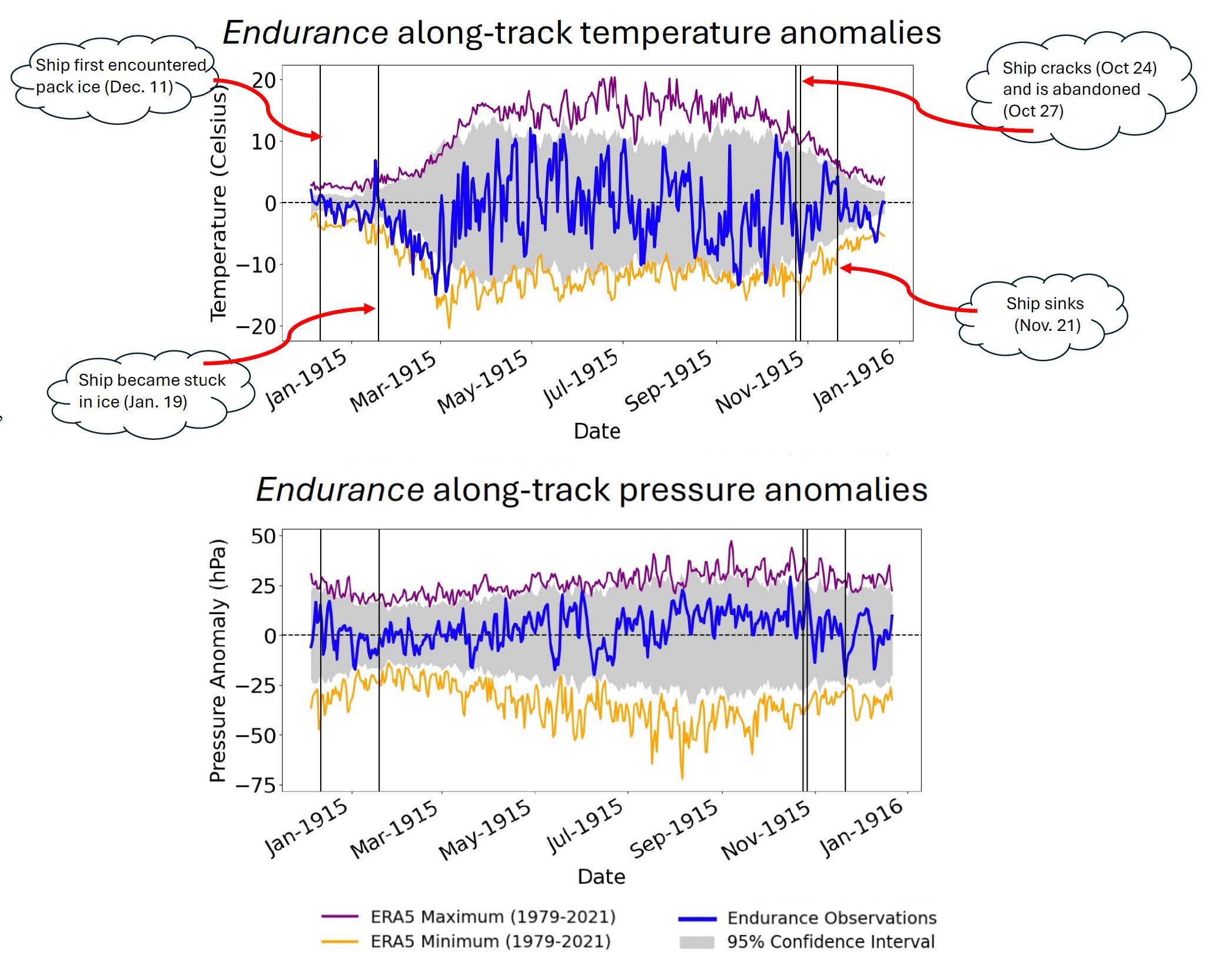
Second, the austral spring season of 1915 was marked by persistent high pressure anomalies in the Weddell Sea, confirmed by nearby observations and reconstructions. These extensive, persistent high pressure conditions delayed ice breakup in the Weddell Sea and (with the underlying ocean current) moved the ship into heavier multiyear ice, ultimately limiting opportunities for an early escape. As such, the pressure from the sea ice was allowed to persist and likely intensify around the ship, eventually crushing it, causing it to become water-logged and ultimately sink to the bottom of the Weddell Sea. Notably, the ship was found in 2022 on the Weddell Sea floor, very close to its last known position.
While it is impossible to conclude that the weather was the driving force in the outcome of the Endurance, the fact that both the cold and extensive ice cover at the journey’s start and the strong high pressure during normal ice breakup in austral spring coincided in a rare occurrence in 1914–15, it likely played a role in the outcome of this expedition, forcing it into its historical narrative of survival and heroism. However, it is important to note that a study published just recently in the journal Polar Record also found that the Endurance was not structurally sound, perhaps also making it more susceptible to the ice pressure than other ships before it that survived winter-long stresses from being beset in sea ice in other portions of Antarctica. Nonetheless, investigating historical cases in a new climatological perspective provides a different lens to view their impressive stories, in this case ultimately making one question if Shackleton emerged as a legendary leader from bad luck with the weather.
METADATA
BAMS: What would you like readers to learn from this article?
Ryan Fogt (Ohio University): First, I hope that readers can learn about an incredible piece of Antarctic history that they may have never heard and be inspired to want to read more about it. Second, I hope that the article provides a new perspective to this narrative: Although the ship may have had its own issues, the weather during this particular year in the Weddell Sea may have doomed the ship from its start, and only an experienced, effective leader (along with the help of an expert navigator) could have saved every individual from peril. Had the expedition happened even a year earlier or a year later, the story likely would have been very different.
BAMS: How did you become interested in the topic of this article?
RF: I had previously worked on investigating another story in Antarctic history—the so-called race for the South Pole in the summer of 1911–12 between the British and Norwegians—and found a similar storyline where the weather helped fuel the success of the Norwegians in many aspects and hindered the British polar party, all of whom perished. When the news was spread of the discovery of the Endurance at the bottom of the Weddell Sea in 2022, I was curious to investigate if the weather may have played a role in this popular legend, as well.
BAMS: What got you initially interested in meteorology or the related field you are in?
RF: When I was a graduate student at Ohio State just starting my career in Antarctic research, I had the wonderful opportunity to go to the Antarctic continent three times. Although my work there (operational meteorology and numerical weather prediction) was not related directly to my research, it gave me the ability to see the Antarctic continent firsthand. I was even able to make a trip to the South Pole. This experience set my passion in motion for my life: The beauty, power, and mystery of Antarctica that I saw before my eyes made me always want to learn more about it, and I have been fortunate to spend my entire career studying this frozen continent and its connection to the rest of the world.
BAMS: What surprised you the most about the work you document in this article?
RF: I started the work with just a curiosity, combined with my love of Antarctic history and scientific discovery. I was really surprised as we started the work to see signs emerge that the weather in the Weddell Sea was unique in this year, too. As we collected more sources of information, they agreed on the signals we found from the ship’s observations, converging on the story we tell in the article. I never really expected anything to emerge from my initial interest, but I suspect many interesting scientific advances are quite similar.
BAMS: What was the biggest challenge you encountered while doing this work?
RF: Antarctica is one of the world’s greatest weather data voids—especially true during the time of this expedition, but still true today (especially compared to the Northern Hemisphere). As such, researchers must use a variety of data and approaches to place any event in a longer climatological perspective. While this always presents challenges, fortunately the Antarctic Peninsula near where the Endurance sailed is situated relatively close to many long-term observations from islands and the tip of South America. These rich data sources enabled us to use multiple lines of evidence to reach our conclusions.
BAMS: What’s next? How will you follow up?
RF: My team at Ohio University, in collaboration with coauthor Julie Jones from the University of Sheffield, aims to digitize over one million newly discovered observations from prior to 1960 around Antarctica from whaling, sealing, and commercial ships. The hard work of finding these archives and scanning them into images has already been completed by other individuals (to whom we are incredibly appreciative), and we now have the task of transforming these data points into a new database, which will provide new evidence for the possibility of long-term change in and around Antarctica since the beginning of the twentieth century.