by Alexander B. Rabinovich1
Ed. Note: With the first nor’easter of the autumn season delivering high surf and coastal flooding to New England and the Mid-Atlantic through the weekend, the following BAMS article highlight recalls a rare compounding flood event along much of the same coastline four years ago. The difference? Its flooding was enhanced by a tsunami triggered by a volcanic eruption on the other side of the world.
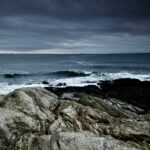
Photo: Yuval Zukerman on Unsplash
The violent underwater eruption of the Hunga Tonga–Hunga Haapai volcano in the South Pacific on January 15, 2022, generated a near-field tsunami that reached heights of several tens of meters. The eruption also sent massive amounts of water vapor into the atmosphere, creating a huge cloud that dominated the regional weather and was clearly visible in daytime satellite imagery. The eruption also generated atmospheric pressure waves that propagated around the globe several times at roughly the speed of sound (~310 m s–1). Although they were readily detected by a multitude of sensitive air pressure sensors around the world, the waves were imperceptible to human senses. Characterized by air pressure changes of a few hectopascals over a few tens of minutes, these atmospheric waves triggered regional-scale tsunamis through air–sea resonance mechanisms as they traveled across the ocean.
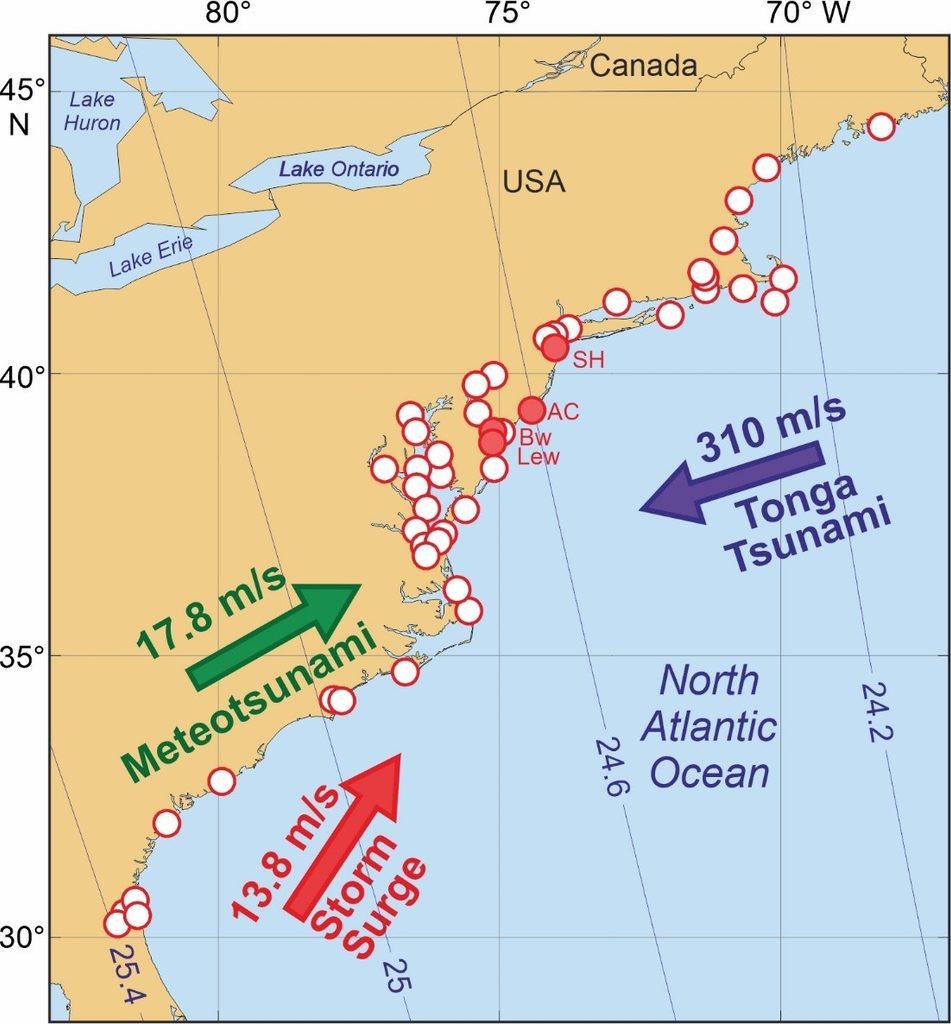
Tsunami waves generated by Hunga Tonga air pressure waves impacted all coasts of the World Ocean, including the Atlantic Coast of the United States, more than 13,000 km from the source region. The Hunga Tonga tsunami arrived at this coast in the morning hours of January 16. Almost simultaneously, a deep extratropical cyclone formed over the northern Gulf of Mexico and propagated northeastward along the eastern coast of the United States as a “bomb cyclone” having a rapid pressure change of 36 hPa
The 2022 event strongly resembled a double jeopardy event of December 26–27, 2004 in the same region. At that time, a major tsunami, generated by a megathrust earthquake off Sumatra Island, had reached the Atlantic Coast of the United States. Arrival of the Sumatra tsunami coincided with a storm-generated meteotsunami, resulting in a hazardous double-jeopardy oceanic event, with wave heights of up to 1 m on top of a storm-generated surge.
We examined the individual properties of the three atmospherically generated processes that gave rise to the cumulatively high sea level response along the U.S. East Coast on January 16–17, 2022. The storm surge was produced by the combined effect of an air pressure drop and strong onshore winds associated with a slow northward-moving cyclone. The surge affected the entire East Coast, from Florida to Massachusetts, with maximum observed height of more than 1.1 m at several stations in Delaware and New Jersey.
The meteotsunami of January 16–17 was a small-scale, short-period event formed by a mesoscale air pressure disturbance that was moving to the northeast at a speed of ~18 m s–1, typical of atmospheric gravity waves. Characterized by a very fast pressure change of ~4.5 hPa (30 min)–1, this “bomb cyclone” disturbance resulted in Proudman resonance (resonant transfer of energy from propagating atmospheric disturbances to long ocean waves) over the northwestern Atlantic shelf. This, in turn led to a strong sea level response on the coasts of New Jersey and North Carolina up to about a half-meter. The meteotsunami was augmented by other storm-generated high-frequency oscillations, including significant seiches and infragravity waves.
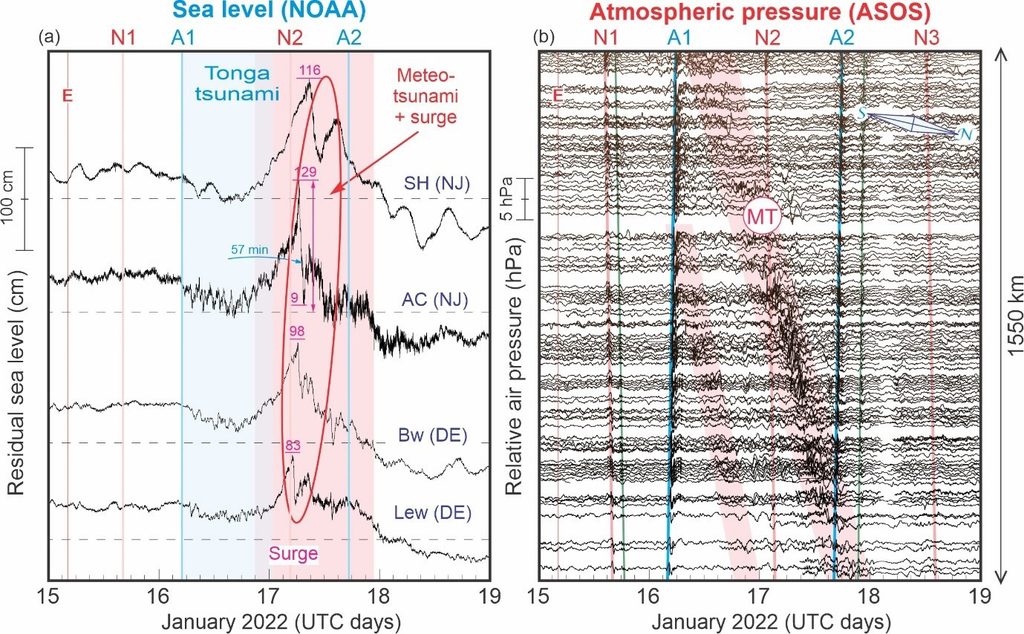
The Tonga tsunami waves recorded on the East Coast were produced by explosion-forced Lamb waves in the atmosphere that traveled with the speed of sound (roughly 17 times faster than the atmospheric disturbance responsible for the meteotsunami) and completed several circumventions of the globe, each time initiating a sea level response along the U.S. East Coast. The strongest sea level response was due to wave A1, the first onshore propagating Lamb wave arriving from the east, with sea level rise of a quarter to a third of a meter.
Events like this one, in which multiple hazards combine to generate one exceptional hazard, clearly need to be taken into account in marine warning and mitigation planning.
A Brief Conversation
with the Authors
BAMS: What would you like readers to learn from this article?
Alexander Rabinovich (Fisheries and Oceans Canada, and Russian Academy of Sciences), Jadranka Šepić (Russian Academy of Sciences), Igor Medvedev (Russian Academy of Sciences), and Richard Thomson (Fisheries and Oceans Canada): Marine hazards associated with extreme sea levels are an ongoing threat to coastal communities around the world. On the East Coast of the United States, the main threat is from extratropical and tropical cyclones, which can result in hurricane-force winds and pronounced drops in air pressure. These two factors, accompanied by high wind-driven waves and swell, pile up the water in coastal areas and often lead to hazardous flood conditions. However, dangerous long sea waves can also appear suddenly in calm weather or a few hours after a major weather event has passed over a coastal area. Such waves have periods of minutes to a couple of hours and are usually triggered by relatively small-scale atmospheric pressure disturbances. Because of their atmospheric origin, they are termed meteotsunamis. More commonly, extreme sea levels are also caused by seismically generated tsunamis. Before 2022, the only tsunami recorded on the East Coast of the United States was the December 26, 2004 Boxing Day tsunami, which struck Indonesia and countries bordering the Indian Ocean the hardest, but propagated to other oceans as well. On the U.S. East Coast, the Boxing Day tsunami combined with a hurricane-generated meteotsunami to create a double-jeopardy event.
Our new research goes one step further by describing a January 2022 triple-jeopardy event on the U.S. East Coast arising from the combination of two local processes (a storm surge generated by an extratropical cyclone and a meteotsunami forced by a mesoscale atmospheric disturbance) and a tsunami initiated by atmospheric acoustic gravity waves from a distant (~13,000 km) volcano eruption. Our study highlights the fact that extreme sea level events do not always arise from a single factor but can be caused by a combination of marine and atmospheric processes that strongly amplify the cumulative effect, leading to potentially highly dangerous sea levels. To paraphrase Heraclitus, an ancient Greek philosopher, “expect the unexpected.“
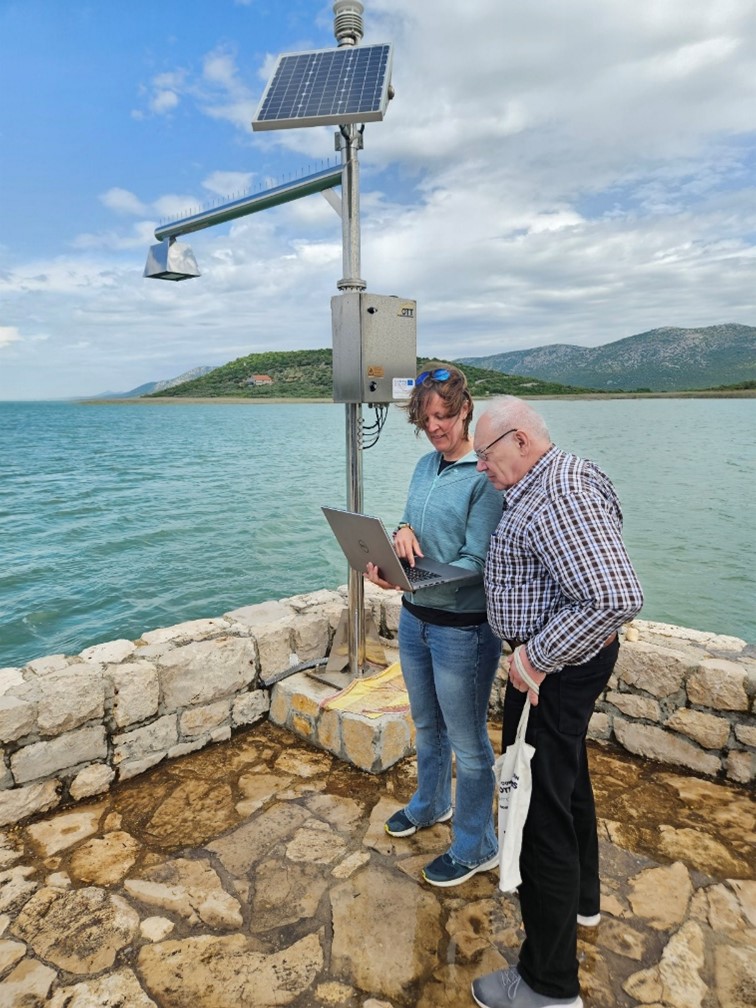
In May 2025, Jadranka Šepić (left), Alexander Rabinovich, and a group of Ukrainian scientists (not pictured) visited tide gauges along the eastern coast of the Adriatic Sea (northern Mediterranean), standing here next to a gauge located on Vransko Lake and discussing measured sea level data. The tide gauges are operated by the Insitute of Oceanography and Fisheries in Split, Croatia.
BAMS: How did you become interested in the topic of this article?
AR, JŠ, IM, RT: Eruption of the Hunga Tonga-Hunga Ha’apai volcano sparked our interest in tsunamis generated by atmospheric Lamb waves. These acoustic waves can circle the Earth several times, triggering atmospherically forced tsunamis along the way. For this study, we collected and analyzed air pressure and sea level data from hundreds of stations around the globe. The data from U.S. stations are of particularly high quality and have impressive temporal and spatial resolutions. A careful examination of these data by us and several colleagues revealed that three atmospheric processes were contributing to anomalous sea levels on the U.S. East Coast, raising the hazard level from a single-jeopardy to a triple-jeopardy event.
BAMS: What got you initially interested in meteorology or the related field you are in?
AR, JŠ, IM, RT: We all work in the fields of physical oceanography, meteorology, and geophysics. Jadranka Šepić became interested in oceanography when growing up by the sea and watching water rush in and out of a bay where her grandmother was born. Little did she know at the time that this was due to a meteorological tsunami, and that years later this phenomenon would become the main topic of her interest and research. During his school years, Alexander Rabinovich became a fan of documentary sea movies about Jacques-Yves Cousteau and Folco Quilici, which led him to take up scuba diving and later to the Oceanology Department of Moscow State University. As a research scientist in physical oceanography, he worked for 20 years in Sakhalin Island, in the Russian Far East, and then in many countries, including Spain, Italy, South Korea, the United States, Australia, New Zealand, and several others, but mostly in Canada. Since 1993, he has been working closely with Richard Thomson. Together, they have coauthored more than 50 primary scientific papers. RT became interested in oceanography after taking an undergraduate course in fluid dynamics at the University of British Columbia. Going to sea as a graduate student clinched it! At the time, working on the ocean was much better than the alternative—conducting research in a windowless laboratory housed deep in the basement of the physics building. Igor Medvedev became interested in oceanography when he was studying at school and read several popular scientific books about flooded cities and countries. This led him to enter the Oceanology Department of Moscow State University, as with AR but 40 years later. His first student term paper was written in the Tsunami Laboratory of the Shirshov Institute of Oceanology and was related to long waves and tides. After being awarded his PhD, he became the head of the laboratory.
Igor Medvedev giving a lecture at the Scientists Against Myths science festival in May 2025.

BAMS: What surprised you the most about the work you document in this article?
AR, JŠ, IM, RT: What surprised us most was how several marine hazards could come together in such a timely manner to cause sea levels to rise at one particular coastal location. Two of these hazards—a storm surge due to an extratropical cyclone and a meteotsunami due to a mesoscale atmospheric disturbance—were locally triggered, while the third was associated with a volcanic eruption almost half the Earth away. All of these processes together led to extreme sea levels on the East Coast of the United States, with particularly high sea levels in the Atlantic City, New Jersey, region. The extreme sea levels recorded in this region were due to the specific pathways of the three atmospheric systems and the unique bathymetric characteristics of the area. Although we have accounted for much of the event, it still remains a wonder of nature that all three types of waves could occur at the same time at this one location.
BAMS: What was the biggest challenge you encountered while doing this work?
AR, JŠ, IM, RT: The biggest challenge was analyzing huge amounts of different types of data, including NOAA sea level, air pressure, and Deep-Ocean Assessment and Reporting of Tsunamis (DART) bottom pressure data, as well as Automated Surface Observing System (ASOS) atmospheric data. A particular challenge was to separate two high-frequency processes, both in the air pressure and sea level time series. At any particular station, the time series of mesoscale atmospheric disturbances and acoustic gravity waves have very similar characteristics, and so are very difficult to separate analytically. The same applies to sea level time series generated by meteotsunamis and volcano-induced tsunamis! We also found that it was necessary to increasingly expand coverage of the study domain and to take into account the very different speeds and propagation directions of each contributing factor to distinguish one from the other.
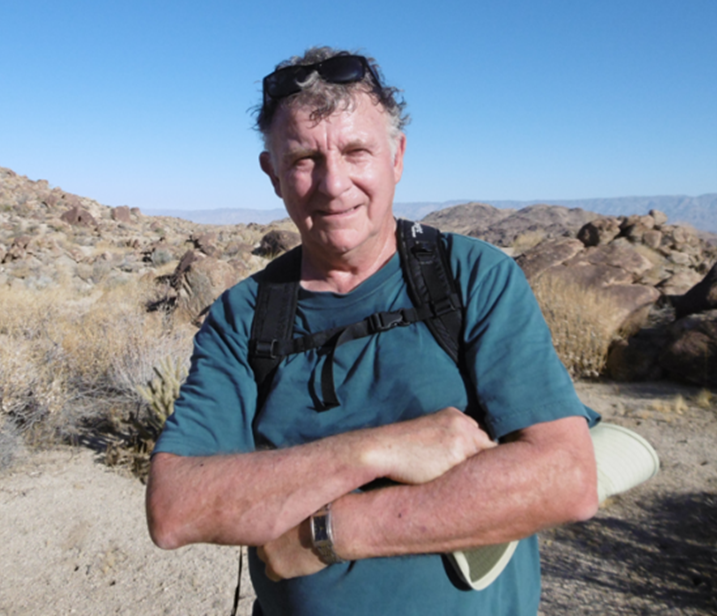
Richard Thomson and his wife typically spend part of the winter in Southern California to avoid the rain and cold weather where they reside in Victoria, British Columbia, Canada. This photo of Thomson was taken in the winter of 2024–25 in the Palm Springs area, part of the Sonoran Desert, which has warm winter temperatures and very little rain, with high local hills and mountains (some mountain peaks nearby are more than 3,000 meters). “We hike in the early morning when it is cool and I do science in the afternoon when it gets hotter. I look “bedraggled” in the photo because every trail goes up, up, up for about an hour before you get to the plateau region. I don’t look much better going down, down, down!”
BAMS: What’s next? How will you follow up?
AR, JŠ, IM, RT: Our triple-jeopardy study focuses on the far-field analysis of the Hunga Tonga event, on which were superimposed two local processes (a meteotsunami and a storm surge). In the future, we plan to focus our analysis on the near-field waves arising from the Tonga event, in order to determine the effects created by this event in the vicinity of the eruption. We will likely concentrate on data from Australia and New Zealand. We are also interested in observations of the event on the coasts of Antarctica. In addition, the air pressure data from U.S. stations revealed the presence of slower atmospheric waves associated with the eruption, which we also want to investigate further. Finally, the superposition of sea level extremes associated with different forcing mechanisms remains at the heart of our interest.
- Key messages from “A Triple Jeopardy Flood Event: Coincident Arrival of the 2022 Tonga Tsunami with a Storm Surge and Meteotsunami on the East Coast of the United States,” by Alexander B. Rabinovich (Fisheries and Oceans Canada, and Russian Academy of Sciences), Jadranka Šepić, Igor P. Medvedev, and Richard E. Thomson. Published online in BAMS, February 2025. ↩︎