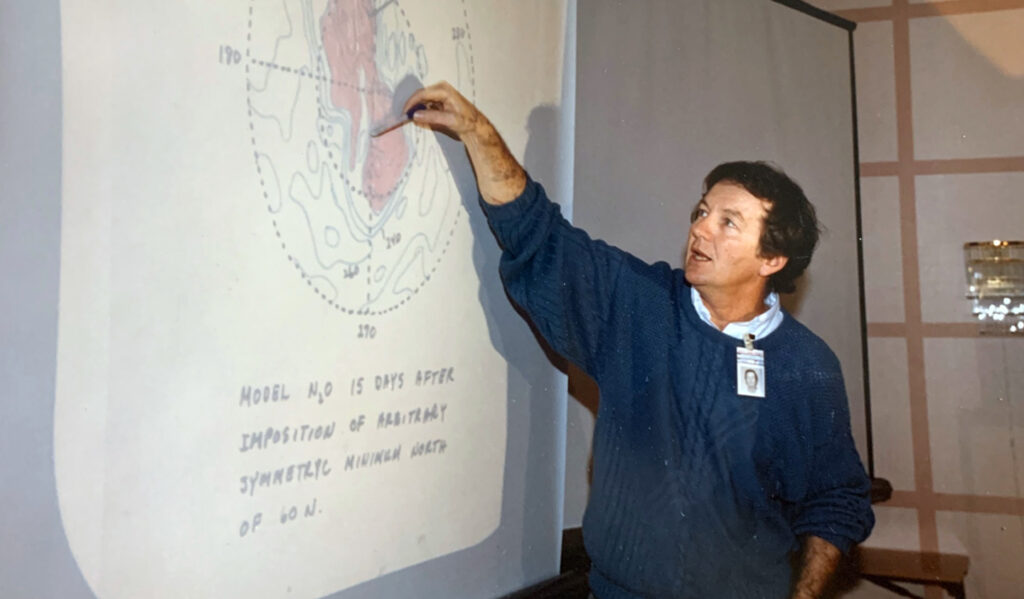
The Richard Stolarski Symposium at the 106th AMS Annual Meeting will honor the contributions of Richard (Rich) Stolarski (1941–2024), whose research has been vital to efforts to protect the ozone layer. Through decades of work at NASA, Stolarski’s models and analysis of ozone distribution and transport underpinned understanding of the stratosphere’s response to anthropogenic changes and encouraged international efforts to combat ozone layer depletion.
The Stolarski Symposium will be held Tuesday, 27 January, at AMS 2026 in Houston and online. View the program here.
We spoke with symposium co-chairs Qing Liang and Paul Newman to learn more about what attendees can expect.
“[Stolarski’s] ability to separate human-driven trends from natural variability helped provide unambiguous proof that ozone depletion was real — and reversible.”
-Symposium Co-Chair Paul Newman
Why is now an important time to honor Richard Stolarski’s work?
Newman: Dr. Richard (Rich) Stolarski’s career is a clear example of how science directly helped to solve a global environmental ozone depletion crisis. In 1974, Rich and Ralph Cicerone published a ground-breaking paper that showed how chlorine in the stratosphere could damage our protective ozone layer. His subsequent work played a key role in developing written, international scientific assessments of ozone depletion. When scientists in the 1980s discovered that ozone levels over Antarctica had plummeted, Rich analyzed NASA satellite data and helped show that the problem was consistent with the ground observations and continental size, findings that helped spur worldwide cooperation to reduce ozone-depleting chemicals. Rich worked on increasingly sophisticated computer models of the atmosphere — tools used to predict how the ozone layer and climate respond to natural and human changes. Thanks in part to Rich’s work, the ozone layer is healing.
Liang: While Rich’s career was centered on basic scientific research, his work — and that of his colleagues — had a profound impact on ozone science, ultimately providing the scientific foundation for the landmark Montreal Protocol to regulate ozone-depleting substances. Signed by every nation in the world, the Montreal Protocol has delivered extraordinary benefits for both ozone recovery and climate protection. Rich’s legacy is a compelling example of how sustained investment in fundamental research can yield monumental environmental and societal benefits.
At a time when support for basic research in the United States is being significantly undermined by government policies, this symposium was convened to highlight Rich’s contributions and to reaffirm the critical role of academic research in advancing science and moving society forward.
What can attendees expect from the Symposium? What issues will be discussed?
Newman: Rich’s career is an example of how science can both be fascinating and lead to real policy changes that impact life — the dialogue between science and environmental policy. The Symposium will cover both specific aspects of Rich’s career and elements of the evolution of global policy on ozone depletion.
The stratosphere is recovering from the effects of ozone depleting substances’ (CFCs’) impacts on our protective ozone layer because of the Montreal Protocol international agreement. However, the recovery is slow because of the long lifetimes of these CFCs. It is further confounded by year-to-year variations of the meteorology, effects from new man-made substances, potential satellite and rocket debris, and natural phenomena such as the Hunga volcanic eruption.
| Presentations of Note in the Stolarski Symposium |
| J7.1 David Considine: Development and Support of Atmospheric Composition Modeling and Forecasting by the NASA Modeling, Analysis and Prediction Program |
| J7.3 Darryn Waugh: Stratospheric Transport in Models: Has there been improvement over the last 25 years? |
| J7.5 Steven Wofsy: New Challenges for the Stratosphere |
| J8.1 William Randel: Updates on Observed Stratospheric Temperature Variability and Trends |
| J8.2 Sir Robert Tony Watson: Lessons Learnt from Studying Stratospheric Ozone Depletion |
What makes Richard Stolarski’s career so noteworthy?
Newman: For researchers and members of the public who may not have known him, Rich’s work is noteworthy because he helped transform ozone depletion from a theoretical concern into one of the clearest, best-documented examples of science directly protecting the planet.
At a time when the idea that human activity could alter the global atmosphere was still controversial, Stolarski was among the first to show — using rigorous chemistry and physics — that reactive chlorine could destroy stratospheric ozone, the thin shield that protects life from harmful ultraviolet radiation. His and Ralph Cicerone’s early work helped establish the chemical mechanisms later linked to chlorofluorocarbons (CFCs), laying crucial groundwork for discoveries that ultimately reshaped environmental policy worldwide.
Stolarski’s impact deepened when satellite data revealed dramatic ozone losses over Antarctica. He and colleagues demonstrated that these losses were continental in scale, helping establish the reality of the Antarctic ozone hole — a discovery widely regarded as one of the most important in late-twentieth-century atmospheric science. This evidence played a pivotal role in galvanizing international action, supporting negotiations that led to the Montreal Protocol, now considered the most successful global environmental treaty ever enacted.
Beyond individual discoveries, Stolarski was central to building the scientific infrastructure behind policy decisions. He led and contributed to major international ozone assessments for more than three decades, ensuring that policymakers received clear, carefully vetted conclusions grounded in observational data and models. His ability to separate human-driven trends from natural variability helped provide unambiguous proof that ozone depletion was real — and reversible.
Equally important was how he worked: Stolarski was known for intellectual rigor, calm judgment, and generosity with younger scientists. He advanced increasingly sophisticated atmospheric models, helped couple chemistry and climate science, and had an important impact on early-career scientists, mentoring generations of researchers who now lead the field. In short, his legacy is not only foundational discoveries about ozone, but also a template for how careful science, sustained collaboration, and patience can lead to global environmental repair.