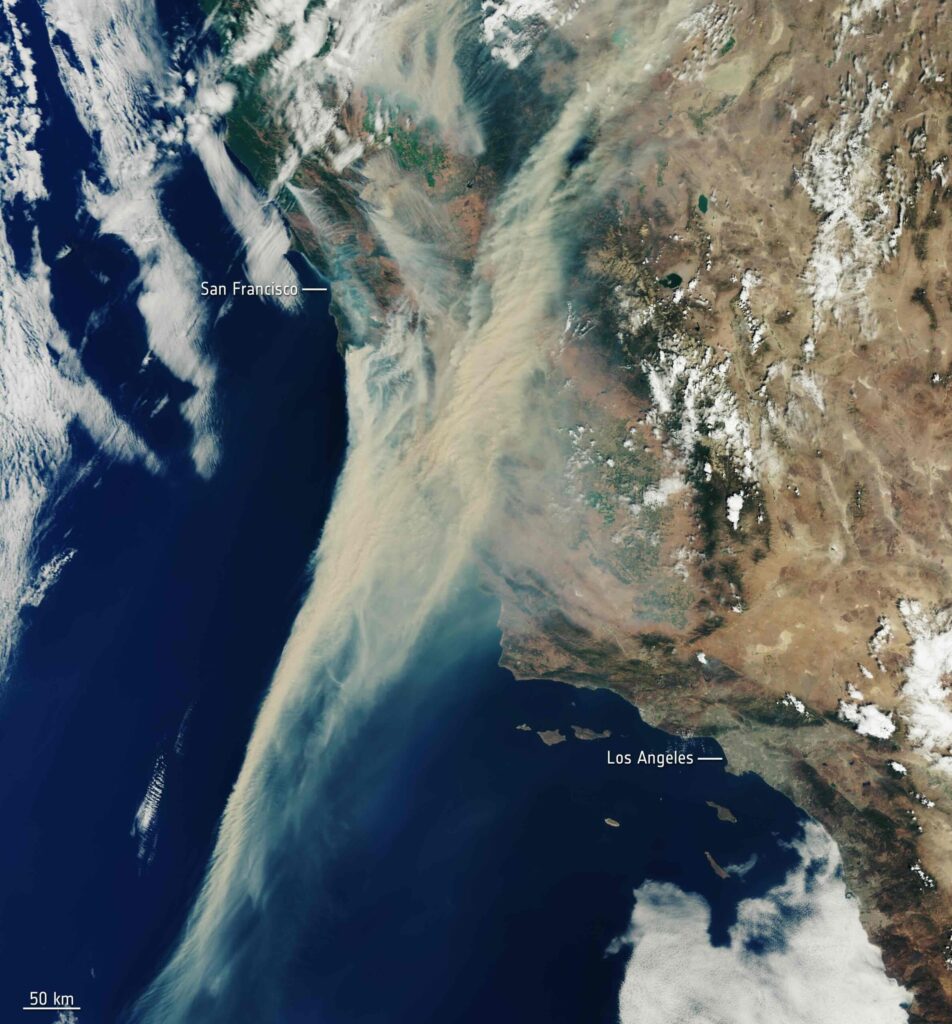
20%–30%—The amount that wildfire smoke increased ozone levels during the record-breaking 2020 wildfire season in the western United States, according to a recent study published in Atmospheric Environment. Researchers utilized a coupled fire–atmosphere model to reproduce the evolution of a regional smoke plume that occurred in August 2020. A number of significant fires in the West contributed to the plume, including California’s August Complex fire, Utah’s East Fork fire, and Oregon’s Lionshead and Beachie Creek fires. The research determined that the smoke increased ozone levels by 21 parts per billion, on average, which in some cases caused concentrations to exceed federal health standards—even in remote locations with few human sources of pollutants. The main drivers of ozone formation are nitric oxides (which primarily come from anthropogenic sources) and volatile organic compounds, which are a significant component of wildfire smoke. “The question I wanted to ask was, if we don’t have urban emissions—let’s say that we zero out all emissions—will we still have an ozone problem?” says lead author Derek Mallia of the University of Utah. “This study suggests that we could remove all of the regional emissions from anthropogenic sources of [nitric oxides], but fires can still produce a large amount of ozone.” The research also used a coupled fire–atmosphere–chemistry model to examine the effects of smoke shading, which occurs when the smoke absorbs and scatters incoming rays of sunlight, cooling the atmosphere and surface below the smoke. The new research revealed that shading hindered ozone formation within the plume by up to 10 parts per billion, as particulate matter in the plume can limit the amount of sunlight for ozone photochemistry. “It can be substantial in some cases,” Mallia notes. “If you’re right over the fire, there’s usually enough smoke shading where it limits the amount of ozone. But if you get far enough away and the plume becomes relatively diffuse, it’s usually not thick enough to really limit ozone.” The study found that in comparison to smoke, regional anthropogenic emissions increased ozone levels by only 11 parts per billion. “We are talking about twice as high a contribution to ozone formation [from wildfire smoke] than from anthropogenic emissions,” says study coauthor Adam Kochanski of San Jose State University. “For us, it was absolutely surprising.” [Source: University of Utah, Boise State Public Radio]