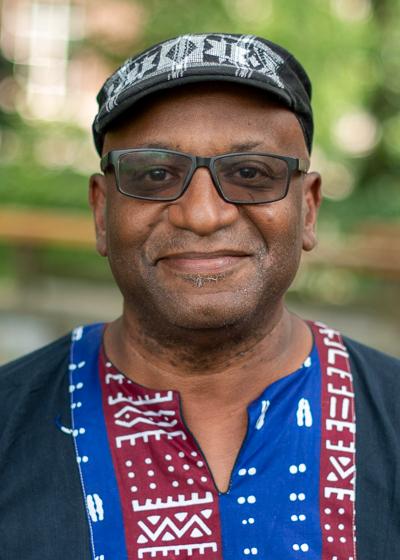
February is Black History Month. In this post, we spotlight the exceptional career of Greg Jenkins.
Jenkins is a professor in the Department of Meteorology and Atmospheric Sciences at Penn State, with courtesy appointments in African Studies and the Department of Geography. His research focuses on weather, climate change, and air quality in West Africa, utilizing regional models to complement the sparse observational network across Africa. He is the director of the Alliance for Education, Science, Engineering, and Design with Africa (AESEDA) and has held former administrative appointments at Howard University. Jenkins is an AMS fellow who has received The Charles E. Anderson Award and has been featured by The HistoryMakers. He is also a proud native of West Philadelphia.
Can you tell us a few highlights from your career?
Modeling the Archean and Proterozoic Climate Paradoxes, playing a leadership role in the NAMMA field campaign in 2006, understanding the Tropical Atlantic Paradox, modeling future changes in Saharan dust, understanding research problems related to the African continent and its people, receiving The Charles E. Anderson Award, and being nominated to be an AMS Fellow.
What are you most proud of in your professional life?
Being the first person in my family to get a PhD and seeing the value in education as my parents envisioned for me, in spite of them never living to see me graduate from high school, college, graduate school, and work as a professor and researcher at Penn State and Howard University.
Working at the Howard University Program in Atmospheric Sciences (HUPAS) for a decade or so to increase the number of PhDs in the discipline.
Watching a diverse set of young scholars that I have worked with and mentored blossom into career scientists and observing how they and their peers have accomplished so much in their careers.
Making slow (sometimes over more than a decade or two) and steady progress on relevant research problems.
Have things changed for Black meteorologists or scientists over the years? What still needs to change?
Our field made so much progress in terms of the scope and number of Black meteorologists and scientists in the discipline. These young people are at universities, in government, and in private industry. This needs to continue.
Given recent policy changes and attacks on diversity, we need more Black scientists and meteorologists to consider owning their own companies, thereby promoting innovation in the discipline and related fields (data science, engineering, communication). These companies are needed to address current and future challenges facing communities of color and society as a whole. They also provide new career pathways for present and future scientists.
Are there other Black meteorologists/atmospheric scientists who have particularly influenced or inspired you?
I might say that Warren Washington made me the scientist that I am today, first serving as my PhD co-advisor with the late William Kuhn at the University of Michigan and then as an ASP Postdoc advisor at NCAR. He mentored and advised me throughout my entire career.
The late Warren Washington and Charles Anderson, along with June Bacon-Bercey, inspired me to go beyond the boundaries set by the larger society and to persist in serving others despite prevailing stereotypes. I was always impressed by John Jones Jr. of the National Weather Service for his leadership and for pushing to increase the number of Black and Brown meteorologists in the weather service. I am also inspired by the young Black meteorologists/scientists, and broadcasters who support the weather and climate enterprise.