Two AMS Fellows on Extreme Events, Atmospheric Science, and Global Survival
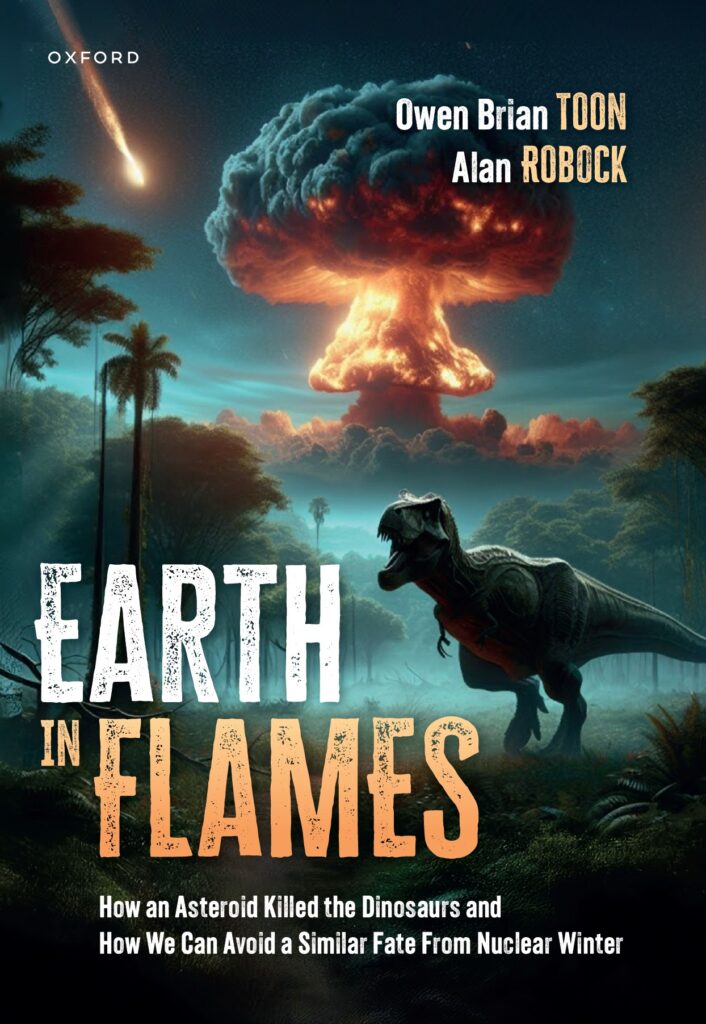
As longtime AMS Fellows, Brian Toon and Alan Robock have spent their careers studying how Earth’s atmosphere responds to extreme events—from asteroid impacts to nuclear war. Their 2025 book, Earth in Flames, brings decades of atmospheric science into sharp focus, drawing urgent parallels between past mass extinctions and risks humanity faces today.
AMS spoke with them about their scientific journeys, their decision to write the book, and what they hope readers—especially fellow AMS members—take away from it.
You are both AMS Fellows with long, distinguished careers in atmospheric science. How did your individual research paths lead you to the questions at the center of Earth in Flames?
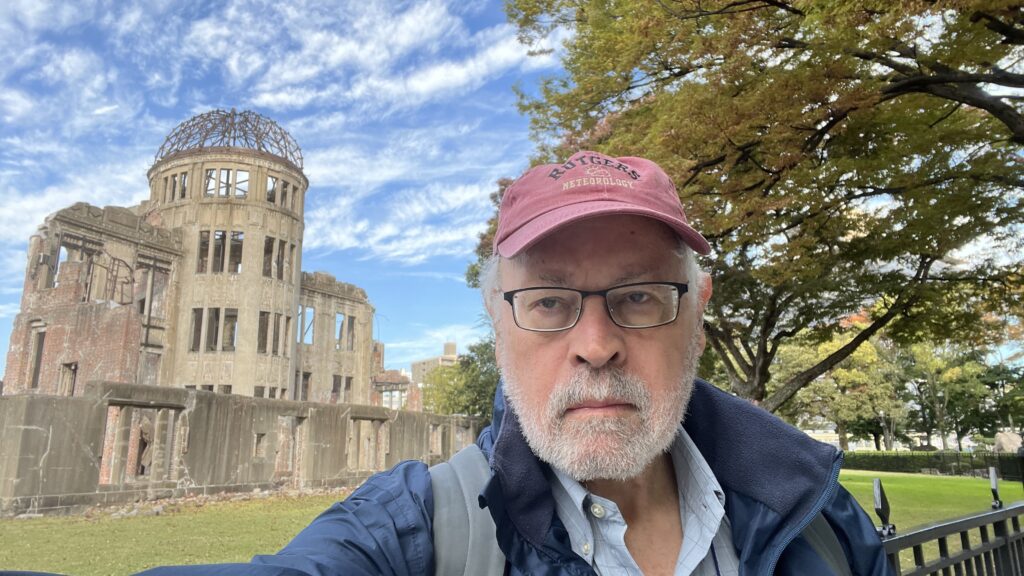
ALAN:
My Ph.D. dissertation, which I began in 1974, focused on understanding the causes of climate change over the past century. Shortly after graduating, I published those results in 1978 in the Journal of the Atmospheric Sciences, where I showed that volcanic eruptions were the largest natural drivers of climate change on that time scale. I’ve studied their impacts ever since.
Over time, it became clear that humans could also inject particles into the stratosphere—through climate intervention or nuclear war—producing similar effects. That realization shifted my focus.
In 1982, at the AGU Fall Meeting, I noticed a scheduled talk on the “Climatic Effects of Nuclear War.” The talk was canceled, but I later learned that its authors—Brian Toon, Tom Ackerman, and Jim Pollack—had been discouraged from using the term “nuclear war” and instead reframed their work as “nuclear winter.” I attended the first nuclear winter conference in 1983, where U.S. and Russian scientists presented matching results. That meeting inspired me to apply the energy-balance climate model I had been using for volcanic eruptions to the long-term effects of nuclear war.
When Ronald Reagan and Mikhail Gorbachev later ended the nuclear arms race, both cited nuclear winter research—produced independently by American and Russian scientists—as influential. That outcome motivated me to continue studying how fires affect climate.
BRIAN:
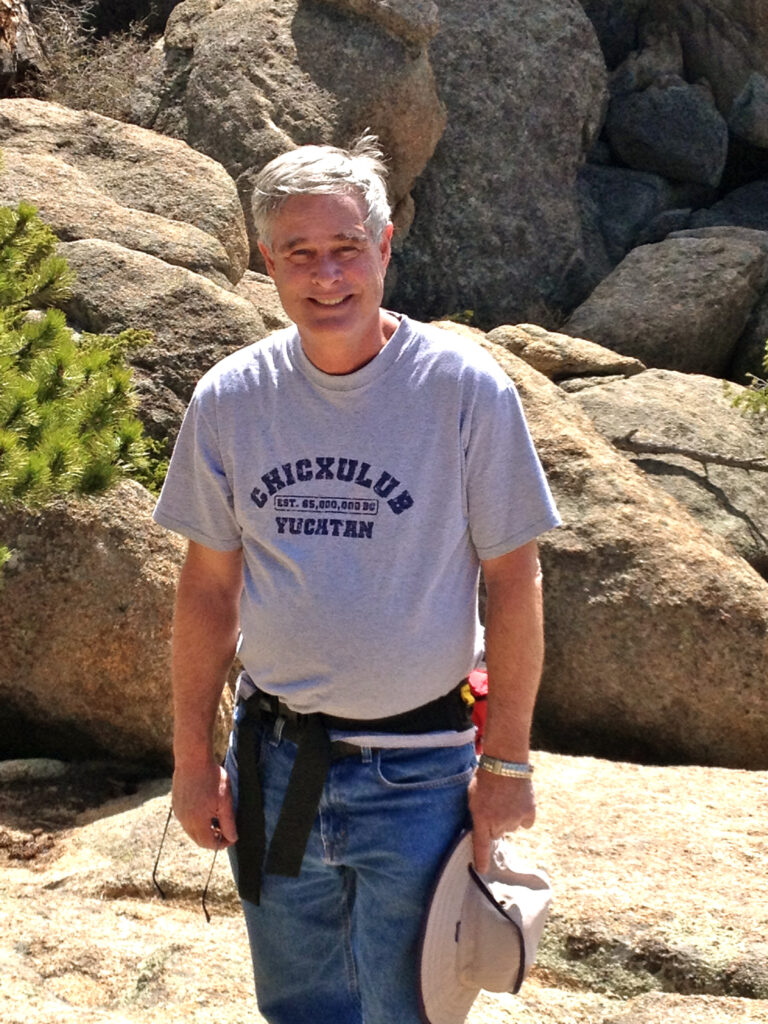
My work began in the early 1980s, following the discovery by the Alvarez group that an asteroid impact caused the extinction of the dinosaurs and about 75% of life on Earth 66 million years ago. This challenged the geological principle of uniformity. I gave a talk at an early interdisciplinary meeting showing how such an extinction could occur, and an organizer from the National Academy of Sciences suggested I look into nuclear war.
That suggestion led a group of us—including Rich Turco and Carl Sagan—to discover nuclear winter. Smoke from massive urban fires would rise into the stratosphere, absorb sunlight, heat the upper atmosphere, destroy the ozone layer, and block light at the surface. Photosynthesis would stop, and global temperatures would drop to near-freezing for years.
Recent work by Lili Xia and colleagues shows that even a limited conflict between India and Pakistan could cause famine killing more than a billion people. A full-scale war involving the United States, Russia, NATO, and China could kill most people on Earth through starvation, including more than 90% of populations in Russia, China, the United States, Canada, and much of Europe.
What made this the right moment to write this book—and why was it important to collaborate on it together?
ALAN:
Brian and I have worked together for more than 20 years and published many papers in journals like Science, Nature, and PNAS, as well as outlets accessible to the public, including Scientific American and the Bulletin of the Atomic Scientists. Despite this, nuclear winter is still not widely recognized, and some people believe it has been disproven.
In 2017, Brian gave a TED Talk on what killed the dinosaurs and how humanity could meet the same fate. It now has over nine million views. We realized that dinosaurs could be an entry point to educate a broad audience about nuclear weapons. So we decided to write a book for the public.
BRIAN:
We’re living in a perilous time. Nearly all treaties controlling nuclear weapons have expired. China is rapidly expanding its arsenal, while Russia has developed new weapons, including nuclear-powered cruise missiles, drone submarines, and hypersonic missiles. Accidents in the past nearly triggered nuclear war, and current threats related to the war in Ukraine increase the risk of an accidental conflict.
Around 2003, during rising tensions between India and Pakistan, Rich Turco and I realized that urban fires could generate enormous amounts of smoke. We asked Alan to apply his volcanic eruption models to a regional nuclear conflict. That collaboration has continued for more than two decades and led directly to this book.
Was there a turning point in your careers when the societal implications of your science became impossible to ignore?
ALAN:
For me, it was the end of the arms race in the 1980s—when world leaders listened to scientists and acted. I had been aware of the dangers of war since being drafted during the Vietnam era, but nuclear war would be orders of magnitude worse. It must be avoided.
BRIAN:
When nuclear winter was discovered, there were about 70,000 nuclear weapons. The U.S. and Russia together had roughly 500 cities with populations over 100,000—meaning about 140 weapons per city. Hiroshima showed that one is enough.
After Reagan and Gorbachev learned of our work and similar research in Russia, they agreed to reduce arsenals. Today there are about 12,000 weapons left, with roughly 4,000 deployed and ready to launch—still about eight per city. Politicians learned from scientists and acted.
How did your experience communicating science within AMS shape your approach to writing for a broader audience?
ALAN:
I’ve been a professor my entire career and have spent decades explaining climate science to students and the public. I’ve also helped revise AMS climate policy statements, participated in international meetings on the humanitarian impacts of nuclear war, and contributed to efforts that led to the 2017 Treaty on the Prohibition of Nuclear Weapons and the Nobel Peace Prize awarded to the International Campaign to Abolish Nuclear Weapons (ICAN).
I’ve given many public lectures, including a TED Talk and distinguished lectureships, and continue to speak widely about global famine after nuclear war. Communicating these ideas clearly has been central to my work.
BRIAN:
Writing, teaching, and public speaking force you to focus on your audience. It’s hard to avoid scientific jargon, but learning to explain your work simply—like in an “elevator talk”—is invaluable. It helps students, funders, and policymakers understand why the work matters.
What do you hope atmospheric scientists take away from the book’s comparison between asteroid impacts and nuclear war?
ALAN:
Both involve global stratospheric smoke clouds that drive climate change. While the causes of the fires differ, the atmospheric impacts are similar. I hope this work motivates more scientists to study wildfire behavior, urban fire modeling, and global processes so we better understand the consequences of nuclear war.
BRIAN:
Big problems require seeing the big picture. Earth system models link atmospheric, oceanic, chemical, and biological processes. Nuclear winter can’t be tested experimentally, so we validate models using observations of wildfires, volcanic eruptions, the ozone hole, pyrocumulus clouds, and the asteroid impact itself. Geological records show a global smoke layer coinciding with the dinosaur extinction—enough to reduce sunlight below 1% for years and halt photosynthesis.
How has AMS influenced your thinking about scientists’ roles in public communication and global risk awareness?
ALAN:
“If you see something, say something” guides my work. I’ve received substantial public funding, and I believe scientists have a duty to warn society about dangers they uncover. I’m inspired by Sherry Rowland’s insistence that publishing papers isn’t enough—and by Bob Dylan’s question: “What good am I if I know and don’t do?”
BRIAN:
AMS tackles difficult issues—air pollution, climate change, ozone loss, severe weather—that require courage to confront. Scientists helped phase out ozone-depleting chemicals and will help transition us away from fossil fuels. Nuclear winter is harder to discuss, but dinosaurs capture attention. Linking their extinction to nuclear war helps people understand how stratospheric smoke works and why the danger is real.
What were the biggest challenges in translating decades of modeling into an accessible narrative?
ALAN:
If you block sunlight, it gets cold and dark. Crops don’t grow. Using familiar analogies—nighttime, winter, volcanic eruptions—makes the science understandable.
BRIAN:
The biggest challenge was doing the research without support. For decades, no government agency would fund studies of nuclear war consequences. Philanthropic groups eventually stepped in, and only recently did the National Academy of Sciences call for renewed research. Too few scientists are working on this global threat.
Why was it important to end the book by focusing on prevention and agency?
ALAN:
The story is depressing, and denial is a natural response. Giving people agency helps. As of February 6, 2026, the New START treaty expires—the last remaining limit on nuclear weapons. There is still much to do, and we need public engagement.
BRIAN:
We hope readers understand both asteroid threats and the reality that nuclear war could happen suddenly. If you live in the United States, Europe, Russia, or parts of China, there is likely a nuclear weapon aimed at you right now. People need to act.
How do you hope Earth in Flames fits into your legacy as AMS Fellows?
ALAN:
I hope it inspires action. Being an AMS Fellow is an honor, but it also carries responsibility—to our profession and to society.
BRIAN:
Atmospheric and oceanic sciences are central to daily life and humanity’s future. I hope students and the public are drawn to the book to learn about one of Earth’s most important past events—and one of our greatest present dangers.
For more information, please visit their website on nuclear winter.