by Natalie A. Umphlett et al.
Key Messages From
The Regional Climate Center Program—Past, Present, and Future: Reflections from 40 Years of Regional Climate Services
by Natalie A. Umphlett (Cornell University), Timothy J. Brown, Charles E. Konrad, Tamara U. Wall, Beth L. Hall, Arthur T. DeGaetano, John W. Nielsen-Gammon, Rezaul Mahmood, and Tamara G. Houston. Published online in BAMS, October 2024. For the full, citable article, right click on the title above for options.
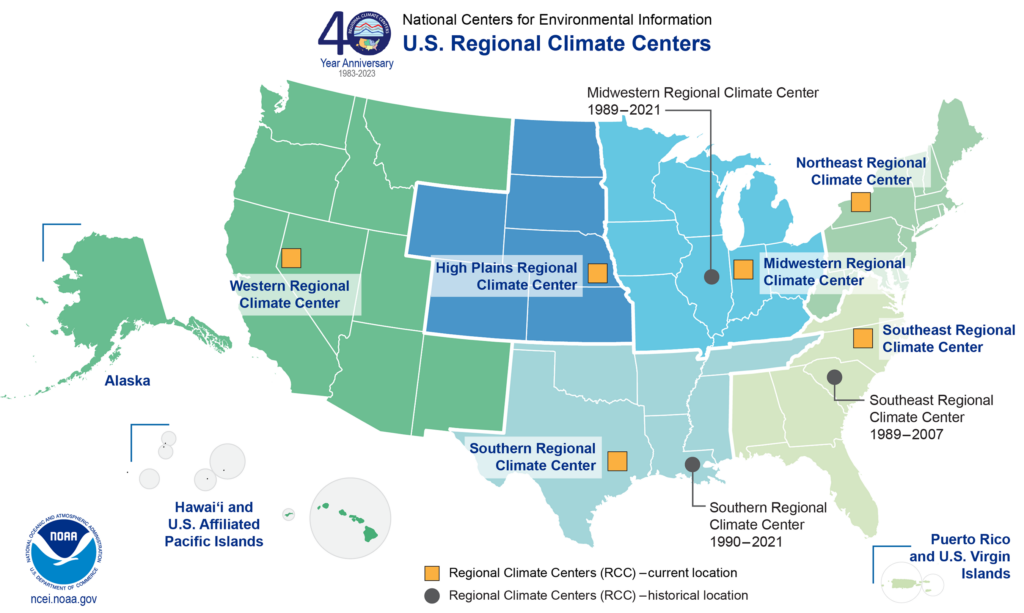
Just over 40 years ago, at the start of the Regional Climate Center (RCC) Program, regional climate services were a novel concept. Today, there is a public, private, and government expectation of these services in support of all sectors of the economy.
In 2023, the RCC Program celebrated its 40th anniversary, marking four decades of dedicated service to the nation. Over the years, the RCC Program has played an active role in the evolution of climate services from the days of climate data libraries—where books of data were consulted to fulfill simple data requests—to coproduced tools that can calculate sectoral-specific, on-the-fly climate analyses in a matter of seconds. With new technologies emerging, the RCC Program is poised to build on its reputation as a trusted climate service provider by incorporating advanced methods for climate service delivery to continue to meet the needs of the nation. In our recent article in BAMS , we provide a look back at the evolution of regional climate services over the past 40 years, as well as a vision for the future.
The RCC Program is rooted in the National Climate Program Act of 1978, which recognized the need for expanding access to regional climate information in support of a range of stakeholders. At the time, there was a growing interest in applied climatology, and there was a gap between local and national climate services. A new concept—a regional climate service program—was tested through pilot projects in the early 1980s, and, after a short demonstration period, the RCC Program began to be formally established with the creation of the Northeast RCC at Cornell University. Over the next few years, the Program grew to collectively serve the entire nation.
Through time, the Program has come to fill three main niches: 1) provision and development of sector-specific and value-added data products and services, 2) establishment of robust and efficient computer-based infrastructure for providing climate information, and 3) seamless integration and storage of non-National Oceanic and Atmospheric Administration (NOAA) climate data with traditional NOAA data sources. But these technological advancements were not achieved in isolation, and the collaborative nature of the RCCs work is exemplified in its close working relationships with public and private partners and stakeholders, as well as other state, regional, and national climate services providers. With a range of products and services that the RCCs provide, there are numerous examples of collaborations and partnerships that have driven applied climate research projects and decision-support tools through the years.
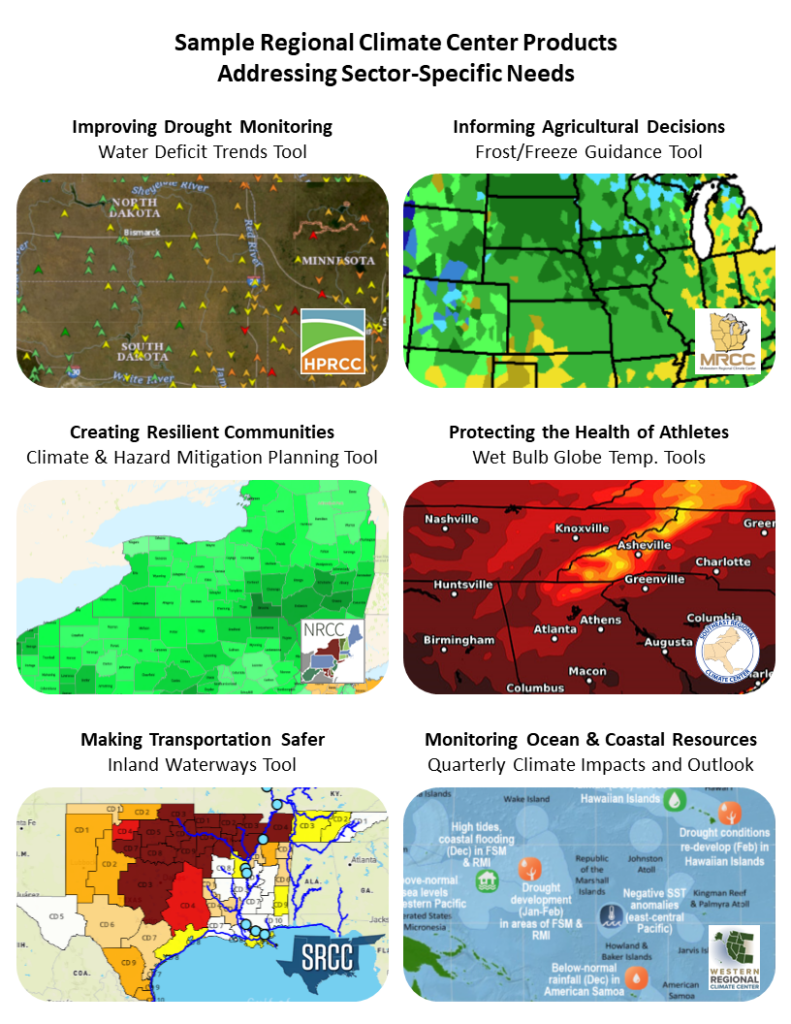
Looking toward the future, we expect that established RCC activities will continue, and, just as they have in the past, evolve to meet changing needs. In fact, climate services are expected to be a growth area, especially in the face of increasing extreme weather events. Because the RCCs have experience in every aspect of climate services, from the collection and quality control of individual observations to the integration of that data into products and services to community and practitioner engagement, the RCCs are poised to tackle—and help other climate service providers tackle—the climate-related challenges of today and tomorrow.
Predicting what regional climate services will look like well into the future comes with much uncertainty. At the beginning of the RCC Program, it would have been difficult to predict what computing capabilities would exist 40 years later, especially those in support of climate services. Nonetheless, we present four technological areas by which we imagine the future: mega-data, quantum computing, artificial intelligence and machine learning, and integrated models and decision-making.
Although there will be challenges along the way, we offer an optimistic view of how technology might positively influence regional climate services over the coming decades. We encourage the next generation of applied climate scientists and service providers to embrace the challenges that lie ahead and create new ways to bridge the ever-growing gap between raw data and actionable climate information, much like the RCCs have done over the last 40 years.
Note that our article was one of several activities marking the 40th anniversary of the RCC Program. For more information, we invite you to also check out these news articles (https://www.ncei.noaa.gov/taxonomy/tags/regional-climate-centers-40th-anniversary) and this interactive timeline of important events in the history of the RCCs (https://www.srcc.tamu.edu/about_us/regional_climate_centers/).
METADATA
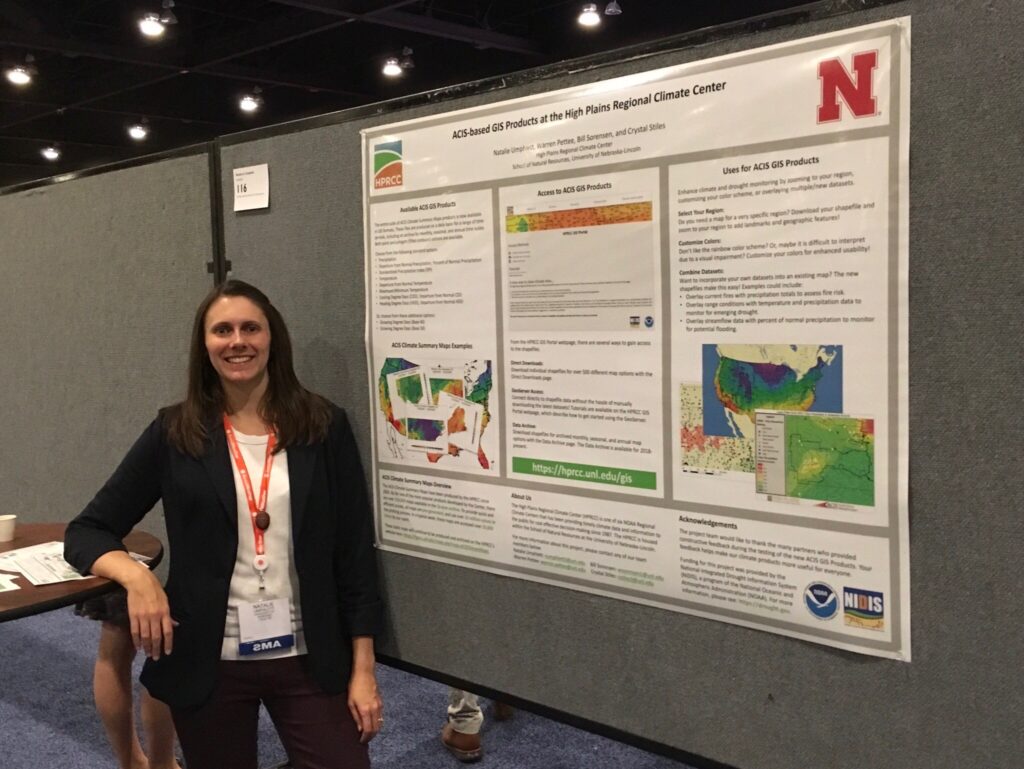
“Although I was interested in the weather growing up, it wasn’t until a couple of years into college that I decided to major in meteorology/climatology. At the start of grad school, I figured my education would lead me to a career in forecasting or research. But participating in the NSF GK–12 program really opened my eyes to the importance—and fun—of science communication. It now seems serendipitous that a service climatologist position opened up around the time I was finishing my master’s program. I knew very little about applied climatology at the time, but the position would allow me to combine my knowledge of weather and climate with my passion for education and outreach. I got the job and never looked back.”
—Natalie Umphlett, Cornell University
A Brief Conversation
with the Authors
BAMS: What would you like readers to learn from this article?
Natalie Umphlett (Cornell University): I would like our readers to feel inspired. Technology may be changing how we provide climate services, but these advances are only expanding the ways that we can help serve the people in our regions. One of the best things about working within the realm of climate services is that no two days are alike. RCC staff work on a broad range of topics with people from all walks of life. It’s fulfilling work, and I hope that our reflection on climate services—especially how we envision the future—is inspiring to the next generation of scientists.
BAMS: How did you become interested in the topic of this article?
Tamara Houston (NOAA/National Centers for Environmental Information): The director of the National Centers for Environmental Information (NCEI), Deke Arndt, said it best: “The RCCs make NCEI and NOAA better by extending the reach of NOAA data and information into communities they know and serve so well.” The 40th anniversary of the program was the perfect opportunity to highlight and celebrate the unique RCC history and partnership with NCEI.
BAMS: What surprised you the most about the work you document in this article?
Art DeGaetano (Cornell University): Certainly what has surprised me is the friendships I have developed through the years working with our partners and stakeholders. I do a lot of work with the turf grass industry, and one day I mentioned a problem that my father was having with his lawn. The next day a person that I have worked with for years (entirely virtually) showed up to diagnose the problem. Climate services are all about building trusted relationships!
BAMS: What was the biggest challenge you encountered while doing this work?
NU: Deciding on how to frame the article may have been the hardest part. We chose to reflect on the program through a technological lens, but there were other ways we could have approached the article. The RCC Program would not be what it is today without the pioneering work of applied climatologists who had a vision for regional climate services. Equally important are the stories of the people we serve. Maybe one day someone like Ken Burns will help tell the people part of the RCC story.
“Perhaps when the RCC Program celebrates another milestone anniversary, we, along with our AI assistants, will check back in to see if any parts of our vision have come true.”
—Natalie Umphlett, Cornell University
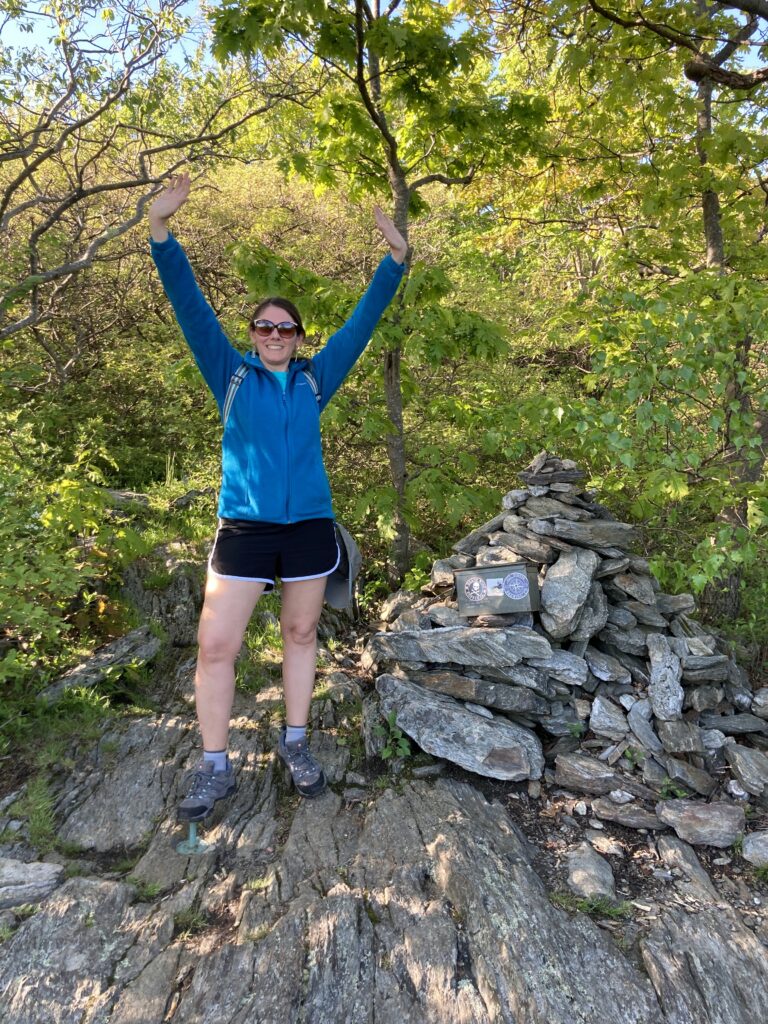
Standing on the south slope of Mount Frissell in Connecticut in May of 2022, Natalie Umphlett completes her 31st state highpoint.