Harold E. Brooks is the 2026 recipient of the Robert H. and Joanne Simpson Mentorship Award. recognized “For steadfast mentorship of generations of atmospheric scientists.”
The American Meteorological Society’s Robert H. and Joanne Simpson Mentorship Award recognizes individuals who have demonstrated an exceptional commitment to mentoring and supporting the next generation of scientists in the weather, water, and climate enterprise. Named in honor of pioneering meteorologists Robert and Joanne Simpson, the award celebrates those whose guidance has had a lasting impact on students, colleagues, and the broader community.
This year’s recipient, Harold E. Brooks of the NOAA National Severe Storms Laboratory, is recognized for both his scientific contributions and his deep dedication to mentorship. Over the course of his career, Brooks has influenced generations of atmospheric scientists through his teaching, collaboration, and commitment to helping others think critically and grow.
AMS Headlines spoke with Brooks about his journey, the work behind the recognition, and what lies ahead.
What first sparked your interest in your field?
I grew up in St. Louis and went to college in the Kansas City area, so thunderstorms were just part of life. I’d see evidence of the damage from the 1959 tornado every week, especially at the old Arena, which had lost a quarter of its roof.
Academically, I kind of stumbled into the field. An undergraduate professor recommended I attend a summer program on planets and climate at NASA GISS. I ended up modeling the last ice age climate, and they invited me back for graduate school. I chose that path instead of physics. After my master’s, I needed a change, and some friends suggested Illinois for my PhD, where I began modeling thunderstorms. I never had a clear long-term plan but instead followed the opportunities.
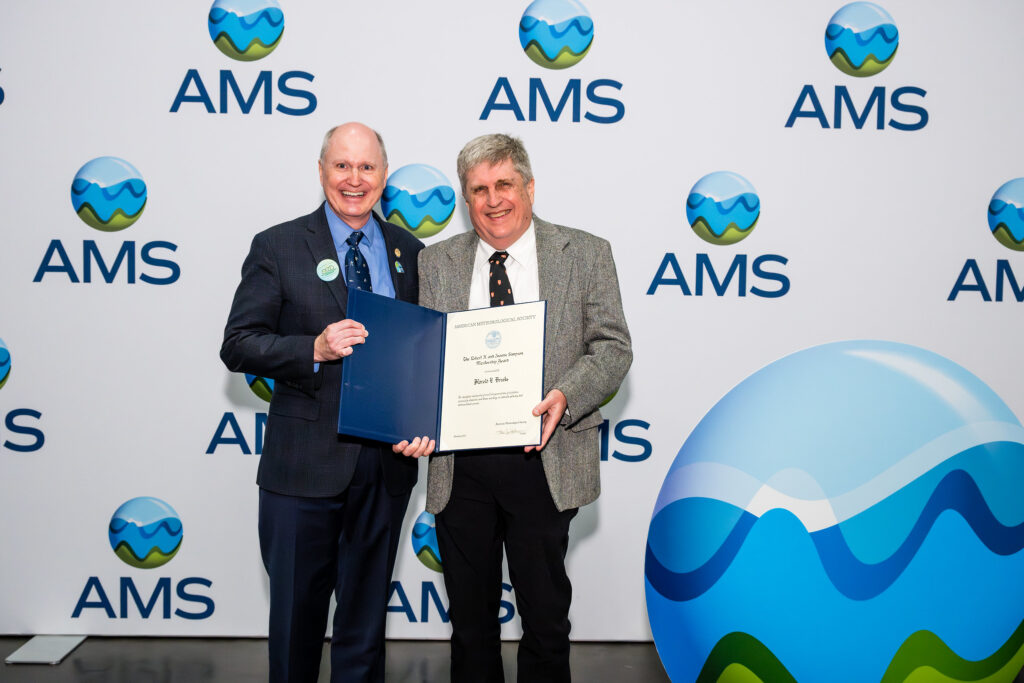
What does receiving this AMS award mean to you?
It’s hard to describe. I remember reading an interview with Jerry Seinfeld where he said awards are what happen when you focus on “the thing,” not the recognition. That resonated with me.
I’ve always just tried to do what I thought was worthwhile, so it was really meaningful to hear from people—especially some I didn’t realize I’d influenced—that I’d made a difference. It was also special to celebrate alongside others this year, including Kim Klockow-McClain and Renee McPherson, who I’ve had the privilege of mentoring.
For readers outside your specialty, how would you describe your work?
My work has focused on two main areas: the climatology of severe convection—understanding where and when it happens, what it looks like, and its impacts—and the evaluation of forecasts, especially in terms of value. That includes how information is created, communicated, and ultimately used in decision- making.
Was there a defining project or moment that shaped your career?
Not really. I’ve tended to move from one “target of opportunity” to another. Something catches my attention, and I explore it until the next interesting problem comes along. I often circle back to earlier work with new ideas. A lot of it has been shaped by conversations with colleagues and by specific weather events that raise new questions.
What problem or question has driven your work the most?
Two questions: What is the true distribution of severe thunderstorms and tornadoes around the world? And how do we get real value from forecasts?
Can you share an example of how your work has made a real-world impact?
I’m not the best judge of that, but early in my career I taught part of a National Weather Service training course on flash flood forecasting. Later, one of the students reached out and said they had issued a warning for a major flash flood using ideas from that course and didn’t think they would have done so otherwise. That stuck with me.
What are the biggest challenges currently facing your area of research?
In forecast evaluation, one of the biggest challenges is understanding how people use information to make decisions, especially in complex situations like tornadoes. You’re dealing with uncertainty, time pressure, and high stakes, which makes decision- making incredibly difficult.
What excites you most about the future of the field?
There are a lot of bright people coming into the field with expertise I never developed. They’re going to tackle problems I haven’t even thought of, and that’s exciting.
What advice would you give to early-career scientists?
Be aware of the opportunities around you. Learn broadly and make connections across different areas.
My first peer-reviewed paper, as a graduate student, was actually about evaluating a metric for identifying clutch hitters in baseball. From that, I learned Monte Carlo modeling, base rates, and other concepts that didn’t show up in my atmospheric science work until a decade later. You never know what will prove useful.
How do you approach mentoring the next generation?
I try to challenge people to think. Richard Hamming said, “The purpose of computing is insight, not numbers,” and that idea has always stuck with me.
I also believe in pushing people outside their comfort zones. I tell students I want to throw them in the deep end and see if they can swim. I’ll pull them out before they drown, but just before. Trying something new is how you learn what you’re capable of, or what you might want to pursue next.
What motivates you to keep pushing forward?
I like to feel useful, and I want to understand things I don’t yet understand.
Is there anything you wish more people understood about atmospheric science?
We’re pretty good at forecasting the weather. And chances are, we’ve already thought about that “new” explanation for climate change.
What legacy do you hope your work leaves behind?
I don’t spend much time thinking about legacy. I’m just trying to better understand the world around us. It’s up to others to decide whether anything I’ve done has been useful.