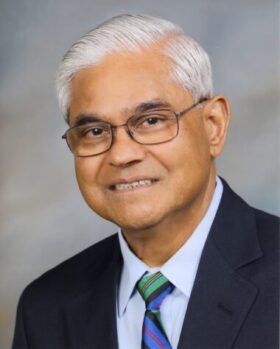
May is Asian American and Pacific Islander Heritage Month. In this post, we spotlight the exceptional career of one of our community members: Jagadish Shukla.
Shukla is a Distinguished University Professor Emeritus at George Mason University (GMU), where he founded the Department of Atmospheric, Oceanic, and Earth Sciences and the Climate Dynamics PhD program. His scientific contributions include studies of climate change, reanalysis, atmosphere–land interactions, deforestation, monsoon dynamics and predictability of weather and climate. He was the lead author of an IPCC report that shared the Nobel Peace Prize in 2007. He has received multiple honors and awards, including the Padma Shri Award from the president of India, the Sir Gilbert Walker Gold Medal from the India Meteorological Society, the NASA Exceptional Scientific Achievement Medal, the AMS Carl-Gustaf Rossby Research Medal, and the WMO International Meteorological Organization Prize. He is a Fellow of the Virginia Academy of Science, an Associate Fellow of The World Academy of Sciences, and a member of the Indian Prime Minister’s Council on Climate Change.
He and his wife founded Gandhi College in the village of his birth in India for the education and empowerment of women.
What are a few highlights from your career?
I was born in a poor backward village in India. My village had no electricity and no roads. My primary education was under a banyan tree, but with constant encouragement from my parents, I obtained a PhD in geophysics from Banaras Hindu University and then an ScD from the Massachusetts Institute of Technology. Since then I have been a professor in the University of Maryland and George Mason University (GMU). At GMU, I founded a new Department of Atmospheric, Oceanic, and Earth Sciences, and I established a new PhD program in climate dynamics that has now produced 70 PhDs. I have published more than 250 scientific papers and have supervised 25 students for their PhD work. I am now a Distinguished University Professor Emeritus at GMU. I have also helped established a college for girls in the village of my birth in the Ballia District of Uttar Pradesh, India.
What are you most proud of in your professional life?
The scientific community used to think that because of the butterfly effect, weather cannot be predicted beyond 10 days. I demonstrated that there are major exceptions to the butterfly effect and it is indeed possible to predict seasonal average climate variations due to the influence of oceans and land surface properties. This provided a basis for making seasonal prediction of monsoon rainfall, which turned out to be extremely important for the Asian countries. I also proposed and demonstrated that the past observations can be reanalyzed using a sophisticated global weather model, and this will create a consistent 4-dimensional dataset for weather and climate variables. This dataset has become essential for AI models to predict weather up to 10 days. I also showed that in addition to oceans, land is also very important in influencing climate. The conventional wisdom was that climate determines the vegetation, I showed that vegetation also determines climate.
Have things changed for AAPI meteorologists or scientists over the years? What still needs to change?
I have been a member of multiple national and international committees which were formed to advance the science of monsoon prediction. This has made an important contribution to the careers of AAPI weather and climate scientists. For example, I helped India get its first supercomputer for weather prediction. Now, most of the Asian countries use modern methods of weather prediction. I have given hundreds of lectures in Asian countries. I have also organized international training programs in Trieste, Italy, where I invite scientists from Asian and African countries for advanced training, and experts from the advanced economy to give lectures. There is still a lot to be done for AAPI scientists. They do not have sufficient national funding to advance science and to improve the prediction of local weather and climate. There is also need for state-of-the-art facilities and modern institutions in AAPI countries to help scientists.
Are there other AAPI meteorologists/atmospheric scientists who have particularly influenced or inspired you?
Yes, Dr. K. Gambo and T. Nitta from Japan helped me at the early stage of my career when the Indian government sent me to Japan for training supported by the United Nations Development Program. Dr. P. R. Pisharoty also inspired me at the very early stage of my research at the Indian Institute of Tropical Meteorology in Pune, India.
As a leader of international climate initiatives, why is it important to work across languages and cultures in the pursuit of scientific goals?
I can answer this question from my limited but direct experience of working with monsoon scientists from seven countries (India, China, Nepal, Bhutan, Pakistan, Myanmar, Sri Lanka). For 10 years, I invited these scientists to come to Trieste, Italy, and study and discuss the vagaries of the Asian monsoon, which affects these countries in a significant way. Since weather does not recognize any boundaries, collaboration amongst scientists with different languages and cultures is very important for all of them.