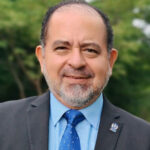
June is LGBTQ+ Pride Month. In this post, we spotlight the career of one of our LGBTQ+ community members, Matthew C. Brown.
Matthew C. Brown (he/him) is an incoming assistant professor at the University of North Dakota, specializing in severe convective dynamics and predictability. He previously received his BS in meteorology from Penn State University and his MS/PhD in atmospheric science from Texas A&M University. Matthew is currently the vice chair of the AMS STAC Committee on Mesoscale Processes, and also is an involved member of both AMS BRAID and its LGBTQ+ affinity group—Coriolis.
What are a few highlights from your career?
My time at Texas A&M, where I completed both my MS and PhD degrees, definitely helped me grow as a researcher and begin to develop my scientific voice. In the past four years, I’ve had the opportunity to complete both an NRC and NSF AGS postdoctoral fellowship at the National Severe Storms Laboratory (NSSL), which greatly expanded my collaborative network and further sharpened my research acumen. This fall I am thrilled to be starting a tenure-track assistant professor position at the University of North Dakota.
What are you most proud of in your professional life?
While I am proud of the research I’ve accomplished, I am most proud getting to witness the growth and success of the students I’ve had the chance to mentor (both formally and informally)—from undergraduate and REU students, to graduate students and new postdocs. I stand on the shoulders of all the dedicated mentors I had (and continue to learn from) throughout my career. There’s nothing like seeing young scientists with so much raw potential begin to “put the pieces together” as they gain confidence in their research, coding, writing, and communication skills.
Have things changed for LGBTQ+ meteorologists or scientists over the years? What still needs to change?
While there is still plenty of room for improvement, I think there has been considerable progress when it comes to the visibility and acceptance of LGBTQ+ scientists. When I was in school, I don’t recall having any professors who talked openly about being LGBTQ+ or about their partners/spouses. As a young LGBTQ+ scientist, this gave the impression that I needed to keep my identity quiet if I wanted to succeed in the field. However, LGBTQ+ meteorologists have become much more vocal and visible in the last 10 years across academia, broadcasting, and elsewhere. This, paired with organizations like AMS BRAID and Coriolis, have shown that the scientific community thrives when we bring our full, authentic selves to the table. I hope that in the coming years, we can continue to build and maintain these inclusive spaces, especially as certain parts of the LGBTQ+ community remain under attack.
Are there other LGBTQ+ meteorologists/atmospheric scientists who have particularly influenced or inspired you?
There are too many to name, but I will say that every LGBTQ+ scientist I’ve interacted with who has openly talked about a spouse or partner (or broadly about their identity) has had a more profound impact on young LGBTQ+ scientists than they may even realize. Without them and their courage, the next generation of LGBTQ+ science leaders that I’ve have the pleasure of working with on AMS BRAID/Coriolis—including Declan Crowe, Bruce Pollock, Gaige Kerr, Joseph Trujillo-Falcón, Tevin Wooten, and many others—wouldn’t have the same opportunities we do today.