By Chris Vagasky

Lightning Safety Awareness Week is observed the last full week of June each year, around the time that summer starts and both lightning activity and lightning fatalities increase. Luckily, the risk posed by lightning is an avoidable one, so before you head out for your next hike, barbecue, soccer game, or trip to the lake, refresh your lightning safety bona fides with these lightning-fast facts.
What is lightning and why is it a hazard?
Lightning is a massive electrical spark that occurs within clouds, between the clouds and the air, or between the clouds and the ground. Think about all those times you walked across a carpeted floor and got a shock after touching a doorknob. Now multiply that by 100,000 or more. That’s lightning. And it strikes the United States millions of times each year.
A lightning stroke (the bright flicker of light we see when lightning flashes outside) is only as big around as a golfball, but is thousands of times more powerful than the electricity that runs through your walls and heats up the air around it to hotter than the surface of the sun. If you’re unlucky enough to be impacted by it, that amount of electricity can stop your heart and damage your nerves, causing lifelong injury or death.
How are people struck by lightning?
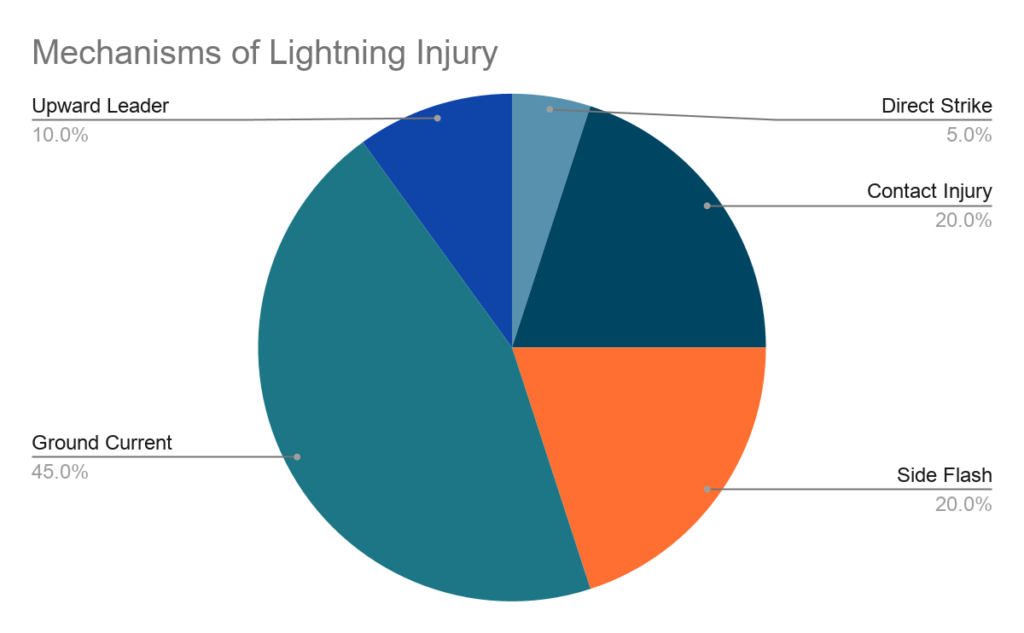
When people hear the term “struck by lightning” they tend to think of the direct strike, where lightning comes out of the sky and hits you. This happens occasionally, but is actually the least common way for someone to be impacted by lightning. There are five ways that people are impacted by lightning, including the direct strike, but other ways include:
- Contact Injury: When a person is touching something like a faucet or computer that is plugged into a wall and lightning strikes nearby, sending electricity through the pipes and wiring. This doesn’t happen often, but we hear stories every year of people who receive shocks through their computers, charging cell phones, and even video game systems.
- Side Flash: When an object is struck by lightning and the electricity jumps from that object into a person standing nearby. This is the cause of roughly one-third of lightning injuries and frequently happens when someone is standing under a tree that gets struck by lightning.
- Ground Current: Most lightning injuries occur when lightning strikes nearby and the electricity travels through the ground and into a person. There have been cases where large groups of people are injured while hiking or playing soccer when lightning strikes nearby and the ground current comes into contact with them.
- Upward Leaders: Lightning connects a charge from the clouds with charge from the ground. As the charge from the cloud gets closer to the ground, an opposite charge begins to rise from objects on the ground, including people. This flow of electricity across a person’s body can cause injury.
How can I stay safe from lightning?
Remember these phrases: No place outside is safe during a thunderstorm. When thunder roars, go indoors! See a flash, dash inside!
In the last 20 years, more than 500 people in the United States have been killed by lightning. Only three of those fatalities occurred when people were in a safe place, like a fully-enclosed metal vehicle or a substantial building. A substantial building is one that is fully-enclosed with wiring and plumbing in the walls.
If you hear thunder or see lightning nearby, it’s time to end your outdoor activities and head to a lightning-safe place as quickly as you can. Any time you can hear thunder, that means that lightning is close enough to strike. Avoid touching plumbing like faucets and things plugged into the wall and stay in your safe place for 30 minutes after the last thunder that you hear.
Can I get notifications of when lightning is too close?
Yes! Lightning Warning Systems that use data from lightning detection networks can send notifications to email, text message, or outdoor warning sirens to notify people when lightning is at an unsafe distance. Encourage the outdoor venues that you visit to invest in lightning warning systems to keep everybody safe.
Avoid systems that claim to predict or prevent lightning. Our current understanding of lightning does not allow us to predict precisely when and where lightning will strike. Data show that lightning prevention systems don’t reduce the frequency of lightning.
What if I’m hiking or on a boat and far away from a safe place?
One of the most important ways to stay safe from lightning is to be prepared. Know what the weather forecast is and consider changing your plans to finish your outdoor activities before thunderstorms arrive.
If you do get caught outside during a storm and far from a safe place, it’s important that you keep moving in the direction of a safe place. Remaining outside and exposed only keeps you at greater risk of being struck by lightning. Even before you hear thunder or see lightning nearby, start wrapping up your outdoor activities if you start seeing clouds building up and getting taller. Then when you hear thunder or see lightning nearby, move in the direction of a safe place as quickly as you can.
And don’t stop to crouch down! The “lightning crouch” has not been a recommended safety action in nearly 20 years. Crouching down only keeps you in the storm for longer and doesn’t reduce your risk of being struck by lightning.
What do I do if I see someone get struck by lightning?
Call 9-1-1 immediately and get emergency medical help on the way.
A person who is struck by lightning does not carry an electric charge, so you don’t have to be afraid to touch them. If the person is not breathing or has no pulse, start CPR. Hands-only CPR helps keep blood flowing through a person’s body and brain and can help save their life.
Where can I learn more about lightning and lightning safety?
The National Lightning Safety Council website shares a lot of resources about lightning, lightning fatalities, and lightning safety.
The American Meteorological Society has a Lightning Safety Statement that shares more information about lightning safety.

About Chris Vagasky
Chris Vagasky is a meteorologist and lightning data/safety specialist with the National Lightning Safety Council. He is also the research program manager of the Wisconsin Environmental Mesonet (Wisconet), a network of weather and soil monitoring stations across Wisconsin. Vagasky is a member of the AMS.