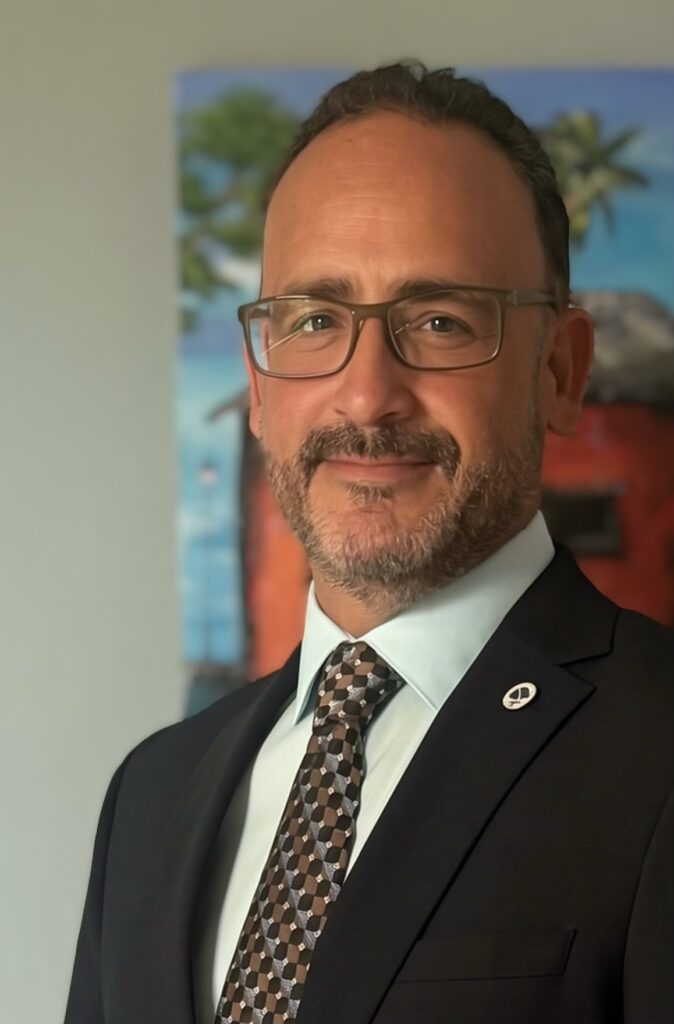
For more than two decades, Ernesto Morales has helped communities across Puerto Rico and the U.S. Virgin Islands prepare for hazardous weather. As warning coordination meteorologist at the National Weather Service Forecast Office in San Juan, Morales serves as a bridge between meteorological science and the people who rely on it to make critical decisions.
Whether he is briefing emergency managers, speaking with the media, visiting schools, or helping coordinate preparedness events, Morales believes that effective weather communication begins long before a storm appears on the horizon.
“Service has always been the key for me,” he says. “Knowing that our work can help communities become better prepared for hazardous weather is my biggest motivation.”
Growing up in Puerto Rico, Morales developed an early appreciation for weather while sailing with his family among the islands of Puerto Rico and the U.S. Virgin Islands. Later, as an avid surfer, he became fascinated by the atmospheric and oceanic conditions that shaped wave forecasts. What began as a personal curiosity eventually became a career.
After starting as a student volunteer at the National Weather Service office in San Juan, Morales joined the agency through the Student Career Experience Program. When no positions were available in Puerto Rico after graduation, he accepted a role in Key West, Florida. Less than a year later, the opportunity arose to return home.
“Between my family and the call of the waves, Puerto Rico kept calling me back,” Morales recalls.
Today, Morales oversees outreach and partner engagement across a region that presents unique forecasting and communication challenges. Although Puerto Rico and the U.S. Virgin Islands are geographically close, they differ significantly in language, culture, and communication preferences.
“Forecasting is only part of the job,” he explains. “Equally important is making sure the message is delivered in a way that people understand and can act on.”
That commitment to accessibility has made bilingual communication a cornerstone of the San Juan office’s mission. While official National Weather Service products originate in English, Morales and his team work to ensure Spanish-speaking communities receive timely, understandable weather information.
“During hazardous weather, people should not have to translate risk in order to understand it,” he says.
Morales credits much of his success as warning coordination meteorologist (WCM) to lessons learned from former San Juan WCM Rafael Mojica, whom he succeeded in 2012. While initially attempting to follow Mojica’s example closely, Morales gradually developed his own leadership style centered on clarity, empathy, and relationship-building.
“I’m not trying to impress anyone,” he says. “My goal is to communicate hazards and impacts clearly and effectively.”
That philosophy extends to his extensive outreach efforts. Morales is widely known throughout the region for engaging directly with emergency managers, educators, media partners, and community groups. He views outreach not as a one-way educational exercise, but as an opportunity to listen and learn.
“Outreach creates trust, and trust creates action,” he says. “The more relationships we build before a weather event, the more effective our communication becomes during the event.”
Among his favorite outreach activities is the annual visit of the U.S. Air Force Hurricane Hunters to Puerto Rico. The event draws more than 20,000 visitors each year and has become one of the Caribbean’s largest preparedness fairs, bringing together federal, territorial, and local agencies to promote weather awareness and safety.
For Morales, these interactions reinforce an important lesson: forecasting alone is not enough.
“A forecast only has value if it leads to action,” he says. “We can issue the most accurate warning possible, but if people do not respond or understand the risk, then we still have work to do.”
That focus on human behavior and decision-making aligns closely with the evolving future of weather services. Morales points to significant advances in forecasting technology, satellite observations, communication platforms, and artificial intelligence, but believes the human element remains irreplaceable.
“A forecast can be generated by an application,” he says, “but explaining uncertainty, discussing impacts, and helping people understand what those impacts mean for them requires human connection.”
As the 2026 Atlantic hurricane season unfolds, Morales hopes communities will remain vigilant regardless of seasonal outlooks.
“I always emphasize that it only takes one,” he says. “Do not prepare based on whether a season is forecast to be above or below average. Prepare because it only takes one storm to impact your family, your home, or your community.”
Beyond hurricanes, Morales is particularly passionate about raising awareness of rip current dangers, which continue to claim lives throughout Puerto Rico each year. He has helped spearhead collaborative efforts involving government agencies, tourism partners, and coastal safety advocates to improve public education and reduce fatalities.
He also takes pride in the success of the TsunamiReady program, noting that the San Juan Weather Forecast Office has earned more TsunamiReady recognitions than any other Weather Forecast Office in the nation.
Looking back on his career, Morales hopes his legacy will be measured not only by forecasts issued or storms tracked, but by the relationships he has built along the way.
“One of the biggest lessons I’ve learned is that effective warning coordination is built long before the weather event begins,” he says. “During an emergency is not the moment to introduce yourself or establish credibility.”
For Morales, trust is not a byproduct of weather communication, it is the foundation of it. And after decades of service, that belief continues to guide his work every day across Puerto Rico and the U.S. Virgin Islands.