“I rob banks because that’s where the money is.”—attributed to Willie Sutton, but…1

A recent cover story in The Economist featured the semiconductor manufacturer Nvidia and its founder and CEO, Jensen Huang. The article is behind a paywall but is worth the read in its entirety if you are able to access it. Meanwhile, here are the basic elements: Nvidia is currently worth over $5T. The current year’s revenues stand at some $250B, are expected to double next year, and are on track to reach $1T/year by 2029. At that point Nvidia would rank as the 16th-18th largest economy in the world—comparable to, say, the Netherlands, or Switzerland, or Turkey. Profitable, awash with cash, and accumulating more at a rapid rate, Nvidia has begun to back loans and to lend outright to its customers, from startups to the very largest, even to those who aspire to become chipmaking rivals, even to some financial firms. The nature and scale of these investments is helping to fuel a national—even global—buildout of AI infrastructure, most visibly but not limited to data farms. The Economist has done a masterful job of detailing the interconnections of this complex web of competition and collaboration and explaining how it allows Nvidia to hedge against the inevitable day when it will face some real competition. Apparently, a few other big IT firms are also offering, though on a smaller scale, similar “financial instruments to lubricate consumer demand.” The article concludes by noting the modest but very real risks that Nvidia and indeed the entire sector might overextend itself, leading to an economic bust.
Bottom line? Nvidia the chipmaker now functions in many ways like a bank.
Did someone say bank? Willie Sutton would know what to do.
I’m not suggesting that meteorologists and others facing hard economic times should take to robbing chipmakers, AI firms, and their ilk. Putting morality and risk aside, there’s the little matter of training. Willie Sutton achieved his reputation only from a lifetime dedication to a rhythm of practice and jail time. He was as disciplined in approaching his profession as we are to ours.
Instead, in light of Sutton’s Law2 (yes, that’s a thing, with its own Wikipedia entry), individuals and groups in our field might consider reaching out to the AI private sector for funding.
Why not simply focus on federal funding for AI (as suggested in an earlier LOTRW post)? Certainly federal outlays in this arena are themselves large. But the problem is that over 90% of this year’s federal spending has been for entitlements (such as Social Security, Medicare, and Medicaid), interest on the national debt, and defense. All three of these are on the rise, putting the squeeze on the very limited amount of discretionary federal spending. For example, the Committee for a Responsible Federal Budget estimates this year’s federal deficit was $2T. That eye-watering figure will carry forward into higher interest costs in next year’s budget. In addition, what funding is allocated for AI is largely concentrated in the DoD budget. Most federal funding is, in effect, mortgaged.
At this moment, early in the twenty-first century, the discretionary resources in the hands of AI’s corporations are comparable to those in the federal government.
But it’s not just the money that matters to today’s meteorologists and other geoscientists, any more than the money mattered to Willie Sutton. He robbed banks for the pure joy of it. And what geoscientists want, or should want, as much as the funding, are the AI tokens. As Nvidia’s blog explains,
Under the hood of every AI application are algorithms that churn through data in their own language, one based on a vocabulary of tokens.
AI tokens are tiny units of data that come from breaking down bigger chunks of information. AI models process tokens to learn the relationships between them and unlock capabilities including prediction, generation and reasoning. The faster tokens can be processed, the faster models can learn and respond. The goal is to achieve the fastest processing time and lowest cost per token to optimize AI infrastructure and maximize revenue generation.
AI factories—a new class of data centers designed to accelerate AI workloads—efficiently crunch through tokens, converting them from the language of AI to the currency of AI, which is intelligence.
With AI factories, enterprises can take advantage of the latest full-stack computing solutions to process more tokens at lower computational cost, creating additional value for customers. In one case, integrating software optimizations and adopting the latest generation NVIDIA GPUs reduced cost per token by 20x compared to unoptimized processes on previous-generation GPUs—delivering 25x more revenue in just four weeks.
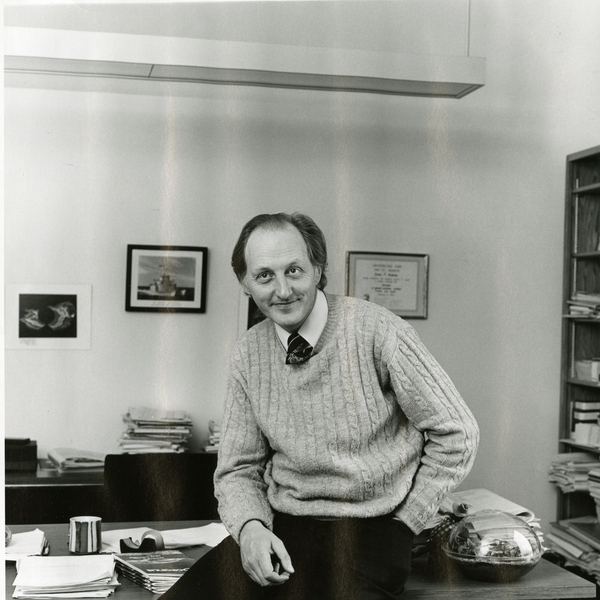
Why should the geosciences want the tokens? One answer can be seen in the life and work of another larger-than-life figure, this one from our community—Francis Bretherton. A few words about this extraordinary man (excerpted from a 2021 LOTRW post I wrote on the occasion of his passing):
In 1983, he chaired an interdisciplinary committee of scientists to advise the U. S. government on Earth-related research priorities. Two seminal reports by this “Earth System Science” Committee (1986 and 1988) presented a multidisciplinary vision of the Earth’s environment and climate as a set of interlinked components. The Committee’s recommendations led to a presidential initiative in 1989 to establish a still ongoing U.S. Global Change Research Program. It also facilitated NASA’s development of an Earth Observing System from space.
As the LOTRW post laid out in fuller detail, Francis was a man of extraordinary intellect. Exhibit A, in my opinion, is this so-called “conceptual” flow diagram capturing the workings of that Earth system:
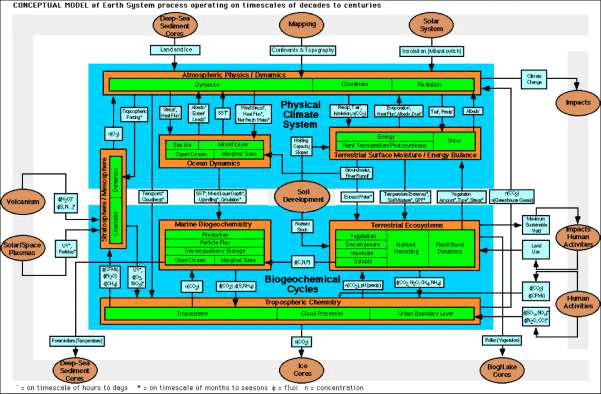
I noted at the time: “Conceptual? Really? To most of us at the time it looked like an unfathomable rats’ nest. The diagram was definitely an acquired taste.”
The diagram certainly understates the complexity, so is conceptual in that sense. The Earth system comprises some 200 million square miles of surface area, The block diagram is therefore really a fractal; each displayed element if unpacked would reveal a similar intricacy, and those myriad subcomponents would contain further frameworks…
AI provides a tool that just might allow meteorologists and other natural scientists to comprehend the Earth system’s workings as a coherent whole, instead of clumsily connected bits and pieces.
Okay! Easy to see why geoscientists might hunger for a bit of AI’s attention and resources, “time on the machine,” much in the way that graduate students of my 1960s generation did, when computers filled huge rooms, programmers submitted massive card decks, and programs were queued up for hours before they could be run.
But what’s in it for the AI community?
That’s the subject of the next post.
- …he never said it. Quoting from the Wikipedia link:
“In his autobiography, Sutton denied originating the pithy rejoinder: ‘The irony of using a bank robber’s maxim as an instrument for teaching medicine is compounded, I will now confess, by the fact that I never said it. The credit belongs to some enterprising reporter who apparently felt a need to fill out his copy. I can’t even remember where I first read it. It just seemed to appear one day, and then it was everywhere. If anybody had asked me, I’d have probably said it. That’s what almost anybody would say. . . it couldn’t be more obvious.'”
However, Sutton also said:
“Why did I rob banks? Because I enjoyed it. I loved it. I was more alive when I was inside a bank, robbing it, than at any other time in my life. I enjoyed everything about it so much that one or two weeks later I’d be out looking for the next job. But to me the money was the chips, that’s all.”
Points to ponder. This (from an unusual source) has notes of “do what you enjoy and you’ll never work a day in your life.” ↩︎ - Again, quoting from Wikipedia, Sutton’s law states that when diagnosing, one should first consider the obvious. It suggests that one should first conduct those tests that could confirm (or rule out) the most likely diagnosis. It is taught in medical schools to suggest to medical students that they might best order tests in that sequence which is most likely to result in a quick diagnosis, hence treatment, while minimizing unnecessary costs. As one doctor put it, “When you hear hoofbeats, think horses, not zebras.” ↩︎