Q: While the effects of volcanic eruptions on Earth’s temperature are well known, their impacts on flooding have not been widely studied. “Usually, when we think about volcanoes, we think of them through the lens of changes in temperature,” says Gabriele Villarini of Princeton University. “The question I had was, ‘How about volcanoes and their impact on flooding at the global scale?'”
A: Villarini coauthored a recent study in Nature Geoscience that determined major eruptions in one hemisphere can trigger significant flooding in the opposite hemisphere, particularly in tropical regions.
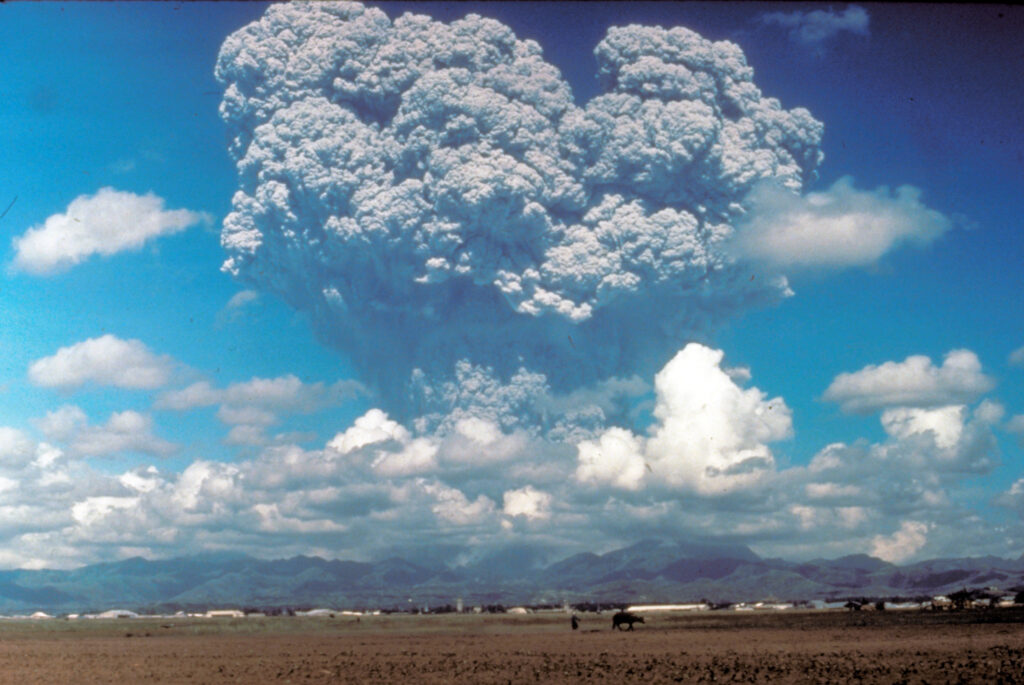
The research focused on three powerful volcanic events: the 1902 Santa Maria eruption in Guatemala, Indonesia’s Mount Agung eruption in 1963, and the eruption of Mount Pinatubo in the Philippines in 1991. Using past simulations of Earth’s climate system, researchers looked at precipitation and temperature data for the five years after each of the three events and also simulated conditions if the eruptions never occurred. They then applied the data to a model to determine how flooding patterns might be affected, and discovered that a volcanic plume in one hemisphere caused an increase in peak stream gauge readings—an indicator of seasonal flooding—in the opposite hemisphere. For example, in the year after Mount Agung’s eruption in the Southern Hemisphere, about 40% of Northern Hemisphere gauges showed an increase in peak flow, and Santa Maria’s eruption in the Northern Hemisphere led to a 25% increase in the Southern Hemisphere. Mount Pinatubo’s plume was more evenly distributed across both hemispheres and showed a different flooding pattern, with tropical areas getting drier but arid regions experiencing an increase in peak streamflows. The study found that the increased rainfall and flooding generally peaks in the first year after an eruption, and suggests that the connection between volcanic events and floods is related to the Intertropical Convergence Zone (ITCZ), a band of enhanced clouds and storms encircling the Earth near the equator. Eruptions spew gases like sulfur dioxide that push the ITCZ out of its regular position and into the opposite hemisphere from the plume, bringing with it increased precipitation. [Source: Eos]