“False facts are highly injurious to the progress of science, for they often endure long; but false views, if supported by some evidence, do little harm, for everyone takes a salutary pleasure in proving their falseness; and when this is done, one path towards error is closed and the road to truth is often at the same time opened.”—Charles Darwin (The Descent of Man, 1871)
AMS Headlines is a new platform for LOTRW. Perhaps, then, it won’t hurt in the early posts here to insert a few reminders of the past. Start with this Darwin quote; I first came across it in the front-matter to Palmen and Newton’s 1969 book entitled Atmospheric Circulation Systems.
In 2010, the quote would become my north star for the blog. Initially, it was displayed on the home page (but at some point, years later, it mysteriously disappeared1). I put it there to remind myself and readers that LOTRW offers mere views. Whenever you continue to find fault or dissatisfaction, please help us all by going that extra step of setting us on the road to truth—sharing your own better insights by sending me a note: [email protected].
With that preamble, here is a view—actually, a special kind of view, one that meteorologists call a forecast (or better yet an outlook, since it’s longer-term, extending beyond a deterministic forecast horizon )—for the coming year:
2026 will be a better year than 2025.
Rather vague. Questions arise: Really? Better for whom? And better in what respects? How much better? Is there room for doubt? What is the rational basis for this prediction?
To answer the questions in order: Better for most (maybe not all) of us—most Americans, and even most of the world’s population. Better with respect to dimensions that matter generally, regardless of individual political preference, or job, or even personal circumstances. How much better? Some. Any uncertainty, room for doubt? Heck, yeah.
Does all this seem a bit fuzzy? Compare with NWS seasonal outlooks, such as this one for Feb-Mar-April 2026, that show the trends of temperature and precipitation for the 90-day period ahead. They’re similarly vague; at one and the same time they’re both intriguing, brimming with possibility—and unsatisfying, leaving us wanting more. A typical feature of the maps is that in addition to areas marked “above” and “below,” there are broad swaths of white labeled “equal chances.”
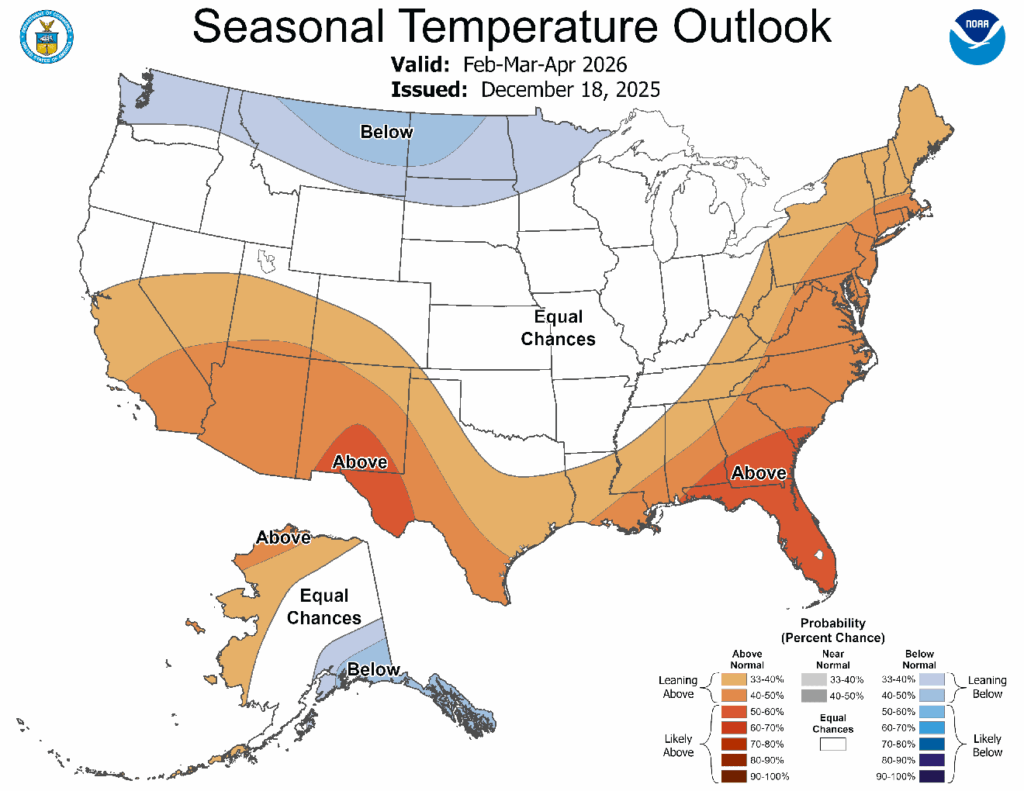
Which brings us to the rationale. The Climate Prediction Center producing the seasonal outlooks describes its forecast process here. It’s a blend of ensemble forecasts from a coupled ocean–atmospheric dynamical model and inputs from a variety of correlation analyses and persistence approaches.
This LOTRW outlook for the year ahead lacks even that much in the way of logic, or past statistical data. I can’t justify my thinking; best I can do is share it.
Start with persistence.
2026 will be about the same as 2025 (probability 35%).
For years, temperate-latitude meteorologists would note that “persistence is the best forecast.” Predict that tomorrow’s weather will be like today’s, and you will be about right something like 2/3 of the time. For dynamical models, claims for forecast skill must be based on statistical comparison against that yardstick.2
In the same way, global economic and social trends show multiyear persistence. They don’t change on a dime. National production of goods and services, GDP and employment figures, trade balances, inflation, etc., show correlation year-to-year. The same is true of social trends: demographics, education, public health, politics, armed conflicts, immigration pressures, and more.
What is certain is that persistence is never 100% (no change at all) or 0% (no influence whatever). For any given year, persistence lies somewhere in between. Let’s put persistence at about 1/3; say 35%. Chances that 2026 will be better or worse than 2025 therefore depend upon which of those two remaining possibilities has the larger share of whatever probability remains—in this case, 65%.
2026 will be worse than 2025 (probability 25%).
“Worse” is certainly a possibility. 2026 is only a few days old. Already we’ve seen America take extraordinary action in Venezuela. Vaccination standards for U.S. children have just been substantially relaxed. More such news will punctuate 2026. Why, then, assign such a low probability? The problem with pessimism is that 2026 starts from a lower-than average bar. The past few years have already seen a lot of war, from the Ukraine, to Gaza, to India and Pakistan, to Cambodia and Thailand, to the Sahel, and elsewhere; and cringeworthy saber-rattling from Venezuela to Taiwan and the Philippines, extending to the Koreas. Poverty is rampant; what affluence there is worldwide feels fragile. Nations are closing in on themselves. Tariffs have risen sharply. Asylum-seekers and job-chasers have found their access denied. The world has also seen the emergence and spread of autocratic leaders. But politicians bent on putting a wrecking ball to society have done most of the quick, easy damage; the institutions remaining are proving more obdurate. The populations surprised by prior disruption have toughened up, grown calloused, become more vigilant over the past year or so. They are less likely to be dismayed and more likely to be angry; less likely to be caught wrong-footed and more likely to push back. Easier to put the probability of “worse than 2025” as smaller than a tendency to return to some better norm (greater peace, less volatility in global commerce, stronger democracy, etc.). Hence a figure of 25%.
That leaves us with. . .
2026 will be better than 2025 (probability 40 percent).
History is crowded with examples of “reversion to the norm” following periods of extreme. Can we see or expect that this year? Certainly. Here in the United States, some bipartisan legislative proposals are beginning to appear. Centrist political candidates are popping up. In Russia, Putin may be enthusiastic for war, but the Russian people, eying their fragile economy and the continually rising death tolls, are growing restive. Xi Jinping and the Chinese leadership have growing concerns about their aging demographic, their continuing dependence on an export-driven economy in the absence of domestic demand, and the sorry state of housing markets. It is not just democratic governments who derive their just powers from the consent of the governed. The Putin’s and Xi’s of the world also find themselves constrained by public opinion, despite vigorous efforts to impose control.
So much for the big picture. How about. . .
the outlook for the weather, water, and climate enterprise?
2025 has been a tough year; NOAA, NASA, and NSF-funded personnel and research in these areas have been abruptly downsized. Is more to come? Probably. But likely only intermittently, with less vigor, and ameliorated by partial restorations of previous cuts. A forecast by analogy (the kind of thing Francis Crick might have admired, or that today’s AI might identify):
Many years ago, I was in NOAA during a similar season of political attack. A new administration was taking the reins in Washington. The incoming deputy secretary of commerce convened a meeting of DoC career-level leadership. During this meeting he opined, and I’m quoting, “I don’t see why NOAA is in the Department of Commerce,” followed by this, for emphasis: “I wish we could go back to woolly caterpillars for forecasting the weather.”
The future looked bleak. But a short time later, he was promoted/reassigned to a new position as deputy director of OMB. With his much broader, more demanding portfolio, he could no longer provide NOAA any personal negative attention, and at NOAA we were all able to get back to doing our jobs.
Something like that may be happening now. The administration has cracked down on funding for climate science and implementation of renewable energy, with funding for FEMA natural disaster response, and recovery, and more. But wars in Ukraine and tensions in the Middle East remain unresolved. The administration’s current moves in Venezuela, thinly veiled threats to Cuba and Columbia, and even Greenland will require follow-up. Attention to environmental issues will inevitably be diverted to more urgent, weightier matters. Beginning as early as 2026, perhaps the environmental issues that had once been so polarizing can be addressed in background.
In closing, take a moment to reflect on any resolutions you may have made entering this new year. Chances are good that they bin well into one or more of the most popular categories nation- and worldwide, as determined from surveys: exercise more; eat better/get more rest; save more money/spend less; personal growth; more time with friends and family. Look closely. These tend to emphasize self-improvement. They emphasize virtue. They emphasize growing deeper, supportive relationships. They focus on love itself.
That’s where eight billion people are heading.3 A cynic might argue that here is a perfect example of persistence being the best forecast: we make the same vows at the beginning of each year and then fail to follow through; this year will be no different. But the reality is that most of us are indeed making that better world we want, however frustratingly slow our progress may seem. We’re accomplishing that even as technological change and the quickening pace of life sweep us along and redefine what “making a better world” means in practice. Each day/year, we’re one day/year closer to this elusive goal.
That’s why the 2,000-plus year trendline finds most years better than the year before.
- Don’t even know the exact date; I only remember looking for it one day to find it gone. ↩︎
- In a way, the straight AI/MLL techniques currently used and under development are persistence models on steroids. They are currently achieving skill by teasing out correlative details of forecasts that hitherto had either escaped notice or were too complex to be incorporated by former means. They’re showing us daily and in multiple contexts that our understanding and use of persistence to date has been rudimentary. ↩︎
- As opposed to the trivial handful who are obsessed with making more money, preferably in fabulous amounts; exploiting others for such personal enrichment; spending more time at the office; becoming king of the hill politically. ↩︎