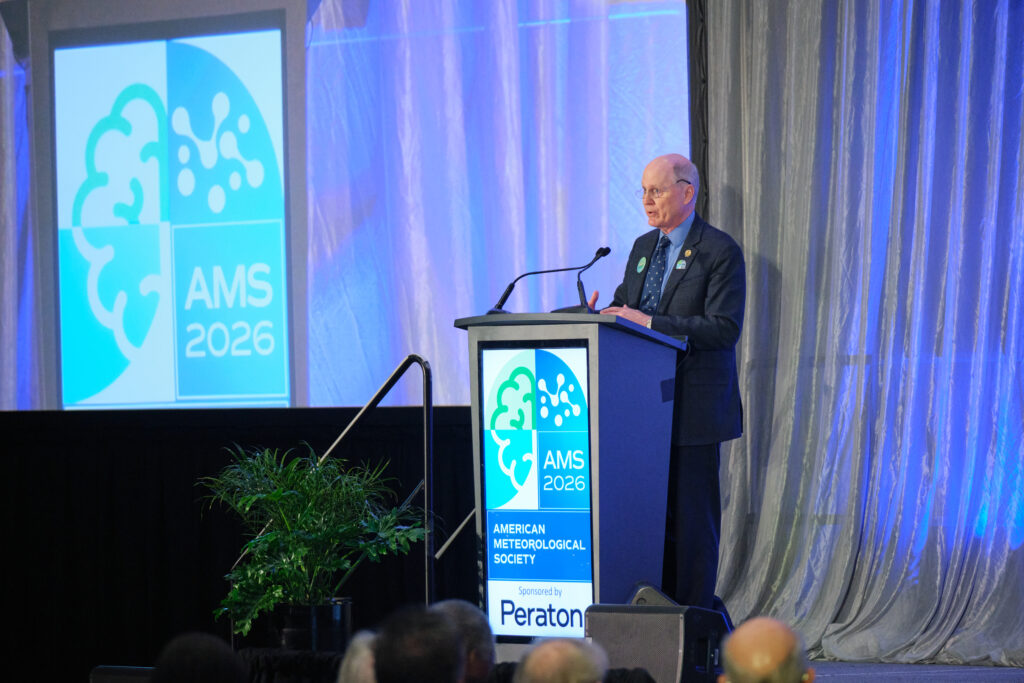
Whether attending AMS 2026 in person or virtually, you won’t want to miss this year’s Presidential Conference. Eleven hours of panel discussion, spread over the full five days of the meeting in nine sessions, and unpacking the Meeting’s central theme: Fast and Slow Thinking: The Human Factor in a Rapidly Changing World.
A quick background: Each year, the AMS presidency brings both honor and responsibility. The honor is significant; moreover, it’s relatively stable year-to-year. By contrast, the presidential responsibility in a given term can vary, even by orders of magnitude. Some presidents have a relatively easy ride; they come into office finding AMS finances relatively secure, stable organizational staffing, and a supportive national and international policy setting. It stays that way throughout their tenure. Other presidents take the reins when the world is tumultuous and the stakes are existential.
President Dave Stensrud has drawn one of the tougher assignments. The year 2025 has seen a perfect storm—bringing together weather and climate extremes, AI-driven paradigm shifts in meteorological services and research, and national and geopolitical rupture. This confluence has triggered uncertainty and upheaval in the professional and personal lives of every AMS member. And that’s before we come to open-access publication, travel restrictions limiting in-person participation in meetings, and other changes transforming the traditional business model for science-and-professional societies like the AMS and the corresponding value proposition for the members. Or before hiring a new AMS executive director, or (the list goes on…). Thank you, Dave. Words are inadequate.
(Amidst all this) one of the few actual perks the unpaid AMS president enjoys is the opportunity to choose an Annual Meeting theme and to develop corresponding presidential symposia.
In an interview with AMS Headlines, Stensrud and his program co-chairs, Pam Heinselman and John Banghoff, share this year’s thought process and backstory. The interview is worth reading in its entirety. A sampling of Stensrud’s own words, to whet your appetite:
I reflected on what I had learned over the past few years that had the greatest impact on me and what I thought might be helpful to others. The answer was crystal clear: the concept of fast and slow thinking that helps us to understand how we make decisions. I believe everyone can benefit from having a better understanding of the human decision-making process and learning strategies that can help us become better thinkers…
…I have been most involved with organizing the Presidential Forum on Sunday afternoon and the daily Presidential sessions that run from 10:45 a.m. to noon Monday through Thursday. I encourage AMS members to take a close look at these sessions, as they offer something for everyone: fast and slow thinking, work–life integration, career reinvention, mental well-being, people-focused leadership, the role of the human in an AI world, decision-making and ethics, talking to faith communities about science, and a conversation about supporting science. AMS meetings are full of great speakers, panels, and sessions, and I look forward to attending as many talks as possible.
Ultimate success of course lies in the actual execution, but it certainly appears that President Stensrud and his program cochairs have developed a program that measures up to today’s pivotal historic moment and needs. Sit in on these sessions, and you will be able to immerse yourself in up-to-date tutorials on the vast, intricate psychological and sociological landscape that occupies the space between separating meteorology from its application for human benefit (as Francis Bacon observed 400 years ago, the ultimate goal for science). Participate actively through a question or a comment and you can shape the emergent direction and impact of our work.1 Again, you don’t want to miss this big-picture look at where we are and whither we are tending.
A closing observation, informed by a little social science. Look back on events of the past year: the budget cuts and mass layoffs in the government sector, the difficulties that planning; research; and weather, water, and climate services face in today’s unstable society. These have stressed the meteorological community in ways that have been matched only by the Great Depression and the Second World War. Many of our professionals and support staff are suffering some form or degree of PTSD. In light of the events of 2025 and the prospects for 2026, our community not only needs insights, it needs healing. Several of the topics addressed by the Presidential Conference (including, but not limited to, work-life integration, career reinvention, and mental well-being) should be of direct help in this respect.
Almost 80 years ago, the great psychiatrist Carl Jung saw the same problem running throughout his own therapist community. On the one hand, he discovered that their own compromised mental well-being and their personal pain increased their understanding of and empathy for the plight of their patients. It made them better therapists. Jung coined the term wounded healer to describe this. Simultaneously, Jung recognized that most of his fellow therapists themselves required therapy in order to prevent mere counter transference of their own feelings to their patients.
In the same way, today’s weather service providers; FEMA employees and emergency managers; and others at EPA, NASA, NSF, USGS, etc., all have an increased sensitivity to user needs based on recent personal experience. But it’s one thing to be a wounded healer; quite different to be an incapacitated one.
Bottom line? Attending this year’s Presidential Conference is a two-fer. Dave, Pam, John, and the panelists have set the table. Sit in, and get a head start on learning what you need to increase the societal benefit from your work. And while you’re there, get some of the insights and self-awareness you need for your own healing.
Get 2026 off to a good start.
_____________________________