A Forensic Look at Climate’s Role in a Civil War Turning Point
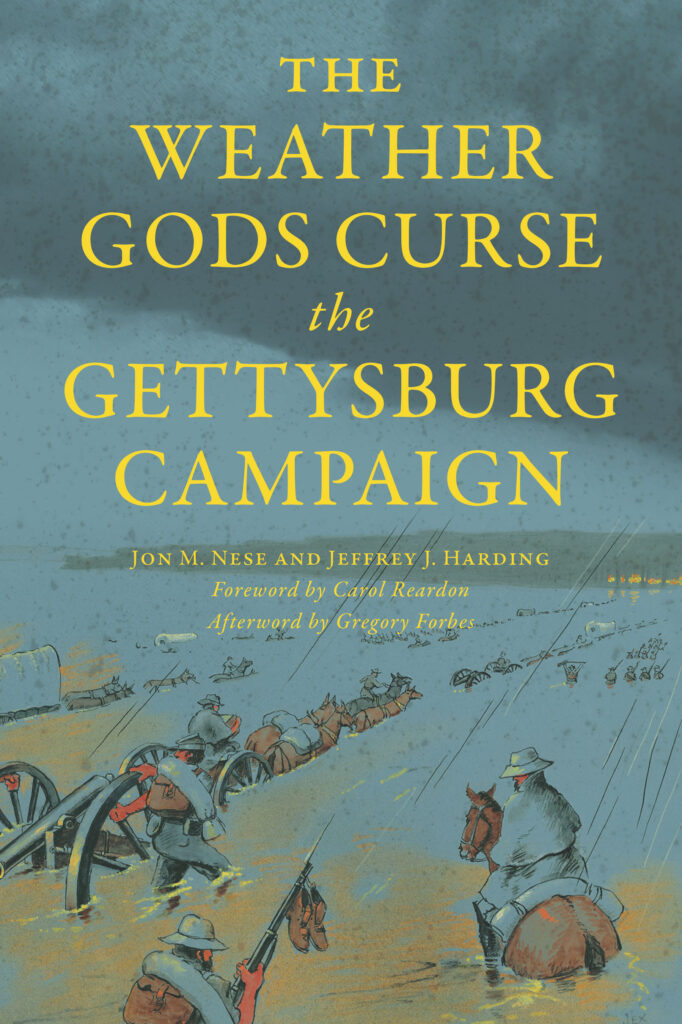
In The Weather Gods Curse the Gettysburg Campaign, meteorologist Jon M. Nese and historian Jeffrey J. Harding combine expertise to reconstruct, day by day, the atmospheric conditions that influenced one of the most consequential campaigns of the Civil War. Drawing on official observations, firsthand soldier accounts, and advanced data from NOAA reanalysis systems, their interdisciplinary collaboration offers new insight into how heat, humidity, and flooding may have affected both strategy and human endurance. Here, they discuss the project’s origins, challenges, and what their findings reveal about weather’s powerful role in shaping history.
Why did you write this book?
The intersection of weather and historical events has long fascinated us. This collaboration grew from a shared interest in the weather during the Battle of Gettysburg. A general picture of conditions during the battle had been available thanks to thrice-daily observations by Professor Michael Jacobs, who officially recorded data in Gettysburg on behalf of the Smithsonian Institution.
However, Jacobs’s observations did not include humidity, leaving questions about “what it really felt like”—essentially, the heat index—unanswered. Visitors to Gettysburg frequently raise this topic. In 2022, we published the first estimates of heat index during the battle. The positive response from historians and meteorologists encouraged us to expand the project to examine the entire six-week Gettysburg Campaign (June 3–July 14, 1863).
By combining official weather observations—including previously underused data from the United States Naval Observatory in Washington, D.C.—with numerous primary-source accounts and reanalysis data, we produced The Weather Gods Curse the Gettysburg Campaign. To our knowledge, it is the first study of its kind to merge meteorological and historical expertise into a day-by-day reconstruction of campaign weather.
Who is the book for?
The book is intended for historians and meteorologists alike, with particular appeal to students of the Civil War and the Gettysburg Campaign, as well as those interested in forensic meteorology. It will also interest readers curious about weather’s influence on history, especially how extreme conditions affected individuals during pivotal events.

What obstacles did you face?
One “positive” obstacle was the abundance of firsthand accounts from Union and Confederate soldiers. While welcome, identifying, gathering, and analyzing these sources proved very time-consuming (i.e., several years).
Conversely, a significant limitation was the lack of official observations from Confederate territory, particularly Virginia. Several observers within the campaign’s geographic footprint in Maryland and Pennsylvania also failed to submit reports during key periods.
What did you learn? What surprised you?
At a broad level, we learned how interdisciplinary collaboration can yield results greater than the sum of its parts. Among the most notable findings:
● The heat wave that afflicted both armies for four days as they advanced north was historically intense for June in the mid-Atlantic. On at least one day, the estimated maximum heat index likely exceeded 115°F.
● Weather conditions during the battle—especially July 2–3—were far more physically stressful than previously understood. Historians often cite Jacobs’s 2 p.m. reading of 87°F on July 3 as the “high temperature” during the battle; our analysis suggests the heat index likely exceeded 100°F that afternoon. Prolonged exposure to direct sun, often while lying on the ground, would have significantly increased strain.
● The rise of the Potomac River that delayed the Confederate retreat near Williamsport, Maryland, was quite unusual for July. By analyzing modern crests comparable to the one that trapped Lee’s army, we generated the first estimate of rainfall totals between July 4–8, 1863 in that portion of the basin.
What are the implications of this work?
By integrating first-person accounts, meteorological observations, and reanalysis data, we created a framework for examining weather’s influence on other Civil War campaigns, battles and historical events.
Our research also opens new lines of inquiry for campaign historians—for example, how the mid-June 1863 heat wave may have affected troop movement, endurance, and readiness, and how extreme heat during the battle’s final two days may have influenced soldiers’ physical condition and combat effectiveness.
Where do you go from here?
We are continuing our collaboration by studying weather’s impact on two additional Gettysburg-related topics: the aftermath of the battle, when thousands of wounded soldiers remained in town and vicinity, and the conditions during the Gettysburg Address on November 19, 1863.
The response to our work—particularly from the Civil War community—has been overwhelmingly positive, leading to a full schedule of interviews, podcasts, roundtables, and conference presentations.
Author Biographies
Jon M. Nese is a teaching professor and associate head for undergraduate programs in the Department of Meteorology and Atmospheric Science at Pennsylvania State University. He also directs the Weather and Climate Communications Group, producer of Weather World, the department’s long-running weekday weather magazine program. In 2015, he received a Mid-Atlantic Emmy Award for his contributions to the show.
Before joining Penn State, Nese served as chief meteorologist at the Franklin Institute and as an on-air storm analyst for The Weather Channel. He has coauthored three books, including the AMS Louis J. Battan Award–winning The Philadelphia Area Weather Book and the textbook A World of Weather: Fundamentals of Meteorology (6th ed.). The Weather Gods Curse the Gettysburg Campaign is his most recent book.
Jeffrey J. Harding is a Licensed Battlefield Guide Emeritus at Gettysburg National Military Park and an independent historian and leadership consultant known for solving long-standing Civil War mysteries. His research has appeared in Civil War Times, Naval History Magazine, and Gettysburg Magazine, among other publications.
His previous book, Gettysburg’s Lost Love Story: The Ill-Fated Romance of General John Reynolds and Kate Hewitt, investigated and resolved a mystery debated since 1863. The Weather Gods Curse the Gettysburg Campaign is his latest project.