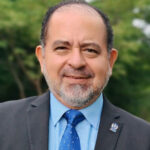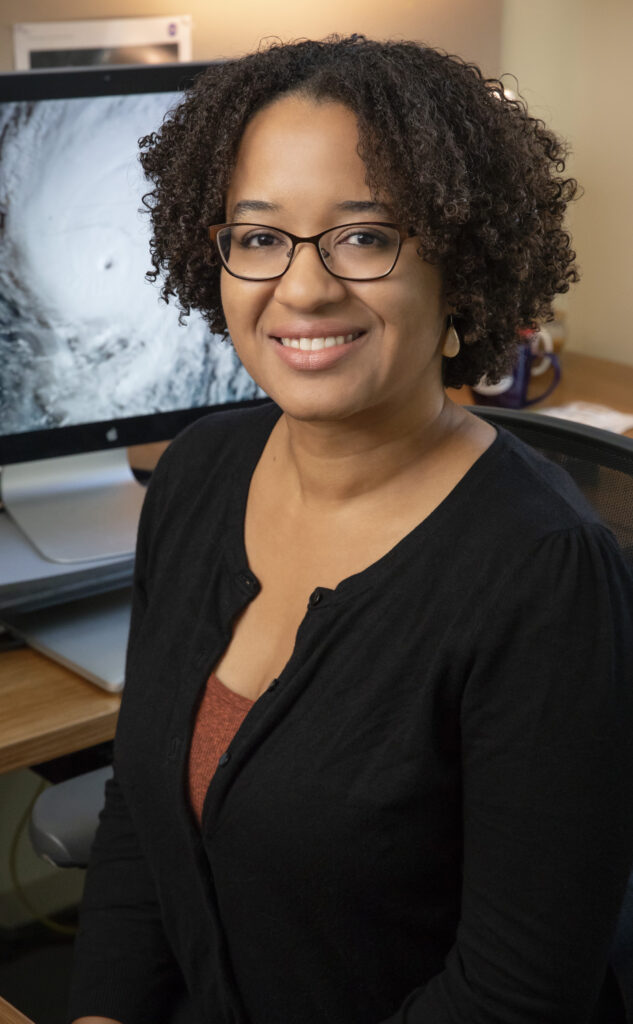
February is Black History Month. In this post, we spotlight the exceptional career of one of our African American community members: Deanna Hence.
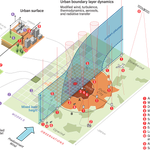
Deanna Hence is an associate professor of climate, meteorology, and atmospheric science at the University of Illinois Urbana-Champaign. Her research program uses field campaign observations and high-resolution numerical modeling to study the interactions of high-impact convective storm systems with their environments, and how the evolution of these storms influences their impacts on human systems. Her research spans phenomena across the tropics and the midlatitudes, with a focus on the spatial and temporal characteristics of cloud processes and precipitation-related hazards. Through her research, leadership, and focus on public engagement, Hence merges her interests in societally oriented, community-driven interdisciplinary research with fostering inclusive science communication, solution-focused conversations, and holistic science mentorship opportunities.
Can you tell us a few highlights from your career?
Ever since I was an undergraduate student, probably the biggest highlight has been the opportunity to travel the world for precipitation research. To date, I have participated in seven large-scale field campaigns, from everything as familiar as the city of Chicago to as far-flung as the Maldives. Each one has been a major learning experience in the meteorology and scientific sensing aspect of the operation, but also the myriad and fascinating ways people around the world can be strong in the face of extreme circumstances.
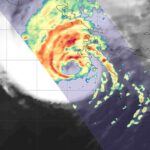
Of all of them, my graduate school experience of doing flight-based research in Hurricane Katrina did the most to heavily shape my trajectory in wanting to help make the atmospheric sciences more useful to more people. While the multiscale precipitation analyses continue, many of my career highlights focus on efforts to ensure the atmospheric sciences are a part of the broader conversation around how we live with our environment. I’ve continued my learning in this arena through varied experiences throughout my career, such as participating in the AMS Science Policy Colloquium as a student, to discussing interwoven issues with scientists from multiple disciplines as a NASEM Kavli Fellow, to now contributing extreme weather expertise to climate sustainability research and discussions with stakeholders. I currently both do (inter)disciplinary research and lead the engagement and partnership team for an NSF-funded multidisciplinary geospatial institute. I most enjoy being in spaces that are working to bring varied perspectives together.
What are you most proud of in your professional life?
Two things bring me the most pride and joy in my career: figuring out how to craft a science narrative that connects with people in a deep and meaningful way, and helping students learn how to use their own voice to do the same. That can be anything from seeing students grow in how they think about relating science to stakeholders in the classroom, to watching them apply that knowledge in their engagement with community in the field. Our discipline requires a remarkable mix of physical scientific understanding with human empathy, and it makes me incredibly proud to have a role in helping students learn how to apply both qualities.
In general, ideas around how to holistically support scientists in their development have evolved a lot over my career, and I am proud to have contributed to those efforts. I ascribe to the campsite rule: I try to leave things a bit better than I found them. In that spirit, I have been proud to lead or contribute to many conversations about how to make our discipline a better place to be for more people: how to make space for scientists to be their full selves in their education or work; how to cope with and improve the mental health realities of our discipline and certain career paths; how to more effectively merge the physical and social aspects of our science for those who are interested in pursuing that path. From those efforts, I hope both current and new generations will benefit from greater space to be amazing scientists, just as previous generations’ efforts bought me that space.
Have things changed for Black meteorologists or scientists over the years? What still needs to change?
Over the years, the community of Black meteorologists and scientists has grown, and with that growth comes community support. I was fortunate to land amongst elder scientists who mentored and supported me, and it makes me proud to be in a position to pay that investment back with supporting the next generation of scientists. The role of the HBCU programs has been critical in this community building, even for folks like me who didn’t attend them. In addition, Black meteorologists and scientists have played critical roles in expanding thinking around the myriad levels of support people need to become effective scientists. The barriers facing Black meteorologists and scientists are much more widely known, as is the wisdom gained from experience trying to fix them.
That said, from what I observe being in an academic space: although there has been some improvement, biases persist around perceptions of the inherent capability of certain groups, especially around educational preparedness. Ongoing and intensifying negative perceptions around opportunities geared at correcting systemic injustice in that area are extensions of that bias. But of all the other issues I could mention, I will focus on a very important one: belonging. The perception of who someone has to be, what their interests must be focused on, or in some arenas even what they have to look like to be successful continue to be very narrow in a lot of ways. This issue doesn’t affect only Black meteorologists and scientists, and has many intersections, but can be particularly brutal for those who feel forced to choose between their science and their cultural identity and community.
Are there other Black meteorologists/atmospheric scientists who have particularly influenced or inspired you?
I have been incredibly fortunate to have a network of Black meteorologists over the years who inspired me, supported me, and continue to be mentors. To name a few: the story of the Black weather officers of the Tuskegee Airmen is incredibly inspiring, as both a stunning example of perseverance in extreme adversity and an example of the critical support role our expertise plays in important operations. Warren Washington was the first Black scientist I met in the discipline, during a summer internship at NCAR. His story was influential at a critical early moment when I was trying to figure out where and how I could fit in the field. Later on, Alan Sealls and Marshall Shepherd became two inspiring examples of bringing excellent science and communication together for significant impact. Vernon Morris and Greg Jenkins remain powerful examples of interweaving scientific and community priorities in their research. There are so many other examples of excellent contributions from our Black colleagues, but these have been some of the most relevant to my own experience and career priorities.