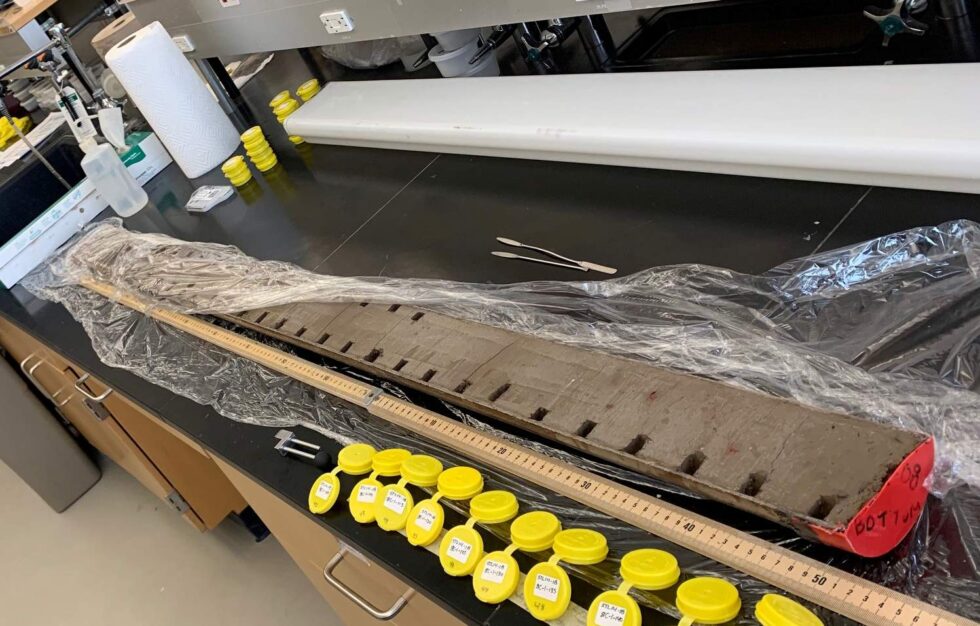
~230,000 years—The age of a sediment core taken from a lake in Arizona that was used to study the history of dust activity in the region. The bed of Stoneman Lake contains sediments that washed in from local areas as well as more fine-grain material that was probably carried by winds from more distant locations. “Stoneman Lake has been around for over a million years, and it’s been collecting sediment and recording paleo environments for that entire time,” notes lead author Spencer Staley of the Desert Research Institute. “In that region, a lake that’s been around that whole time, even during the drier periods, is kind of unheard of. It’s been recording history for a very long time.” Staley and colleagues analyzed volcanic ash to determine the age of the sediments in the core and discovered that in contrast with other parts of the world, dust levels in the Southwest decreased during ice ages and increased in the interim periods—dust production was 1.2–10 times greater during peak interglacial periods than during ice ages. According to the study, which was published in Nature Communications, this is because the region was wetter and more lush during ice ages, stabilizing the landscape, while water became more scarce during warmer periods, causing erosion that sent dust into rivers and the atmosphere. “Aridity and dust and sediment exposure do go together,” Staley says. “But if you’re looking to put a fine pin on it, it really doesn’t matter how dry it is—you need sediment to blow around.” The core also contained preserved pollen that provided details on how plant life changed over time, and the study provides clues into how climate variability in the region impacted ecosystems, as well as how changes in landscape can affect atmospheric dust loads and weather patterns. “When we look at paleo records, we look back in time, providing context for what we’re seeing in the present and what we might see in the future,” Staley says. “We’re seeing a lot of dust resulting from human activities, and this study can provide a baseline for comparison.” [Source: Desert Research Institute]