Was sorrowed this morning to read the news of Craig Venter’s passing. The link1 (one of many) contained this summary:
The American scientist Craig Venter passed away at the age of 79 in San Diego on April 29, 2026, as confirmed by the institute he founded, the J. Craig Venter Institute. According to available information, he died after a brief hospitalization due to the side effects of treatment for a recently diagnosed cancer. His passing has been reported by international media and confirmed by official sources linked to his scientific circle.
Venter was one of the key figures in modern biology, especially for his role in the sequencing of the human genome, one of the greatest scientific milestones of the late 20th century.
In the late nineties, Venter drove a parallel project to the Human Genome Project, the public international program funded by governments. His private initiative accelerated the process of sequencing human DNA, in a scientific race that marked a before and after in genetic research.
On June 26, 2000, both the public team and the one led by Venter jointly announced that they had managed to sequence the human genome, in an event held at the White House.
Why post on this topic on AMS Headlines—a meteorological platform? To start, because of Venter’s connection to a member of our community, who is fortunately very much still with us—and who happens to be one of the people on this planet I admire most: Aristides (Ari) Patrinos.
Here is the story (greatly truncated and oversimplified—my apologies in advance). The Human Genome Project got underway as gene mapping and DNA sequencing became feasible. Estimates were that the cost would be about 10 dollars per gene—amounting to something like several billion dollars for the total project. The government methods would be brute force, but something that the United States could easily afford, given the extraordinary potential benefits. About that same time, Craig Venter and his team argued they could reduce the cost to about a dollar per gene using a new approach—and this lower cost would open the door to mapping other genomes, such as that for the mice and primates used in laboratory experiments, etc. The race was on, and as the news snippet above indicates, resulted in something of a tie.
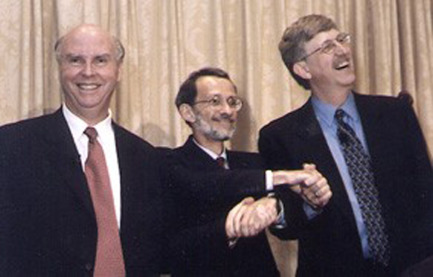
[Photo courtesy: National Institutes of Health]
This is where Ari Patrinos comes in. Much of the heavy lifting for the Project was housed in the Department of Energy, in Ari’s group. But this was only Ari’s part-time focus. Simultaneously, he was working with Shelby Tilford (NASA), Dallas Peck (USGS), Mike Hall (NOAA), and Bob Corell (NSF) under the coordination of Jack Fellows (OMB) to stand up the U.S. Global Change Research Program.
Reflect for a moment. If you or I had either of those two efforts as the centerpiece of our resume, we’d be more than pleased with ourselves. But Ari had a major hand in leading both. (Later he would work with and for Craig Venter at Synthetic Genomics, now Viridos).
(Expanding the focus, and coming to the second reason for this post) when advances in science and technology matter, it’s both natural and useful to fund and employ multiple (redundant, parallel) paths to ensure success. Redundancy becomes a feature, not a flaw. Competition and democracy favor good outcomes. Two historic examples: First, the building of the transcontinental railroad, accomplished from the East and from the West, respectively, by competitive private groups, each funded in proportion to the miles of track laid. Second, the Manhattan Project, which funded both diffusive separation and centrifuge techniques to obtain sufficient amounts of urgently needed fissionable material.
Closer to home, AI’s value to meteorology is still being explored and assessed, but it is clearly democratizing the forecast process. Formerly, global numerical weather prediction has been the province of a mere handful of big national and international computing centers; today AI-enabled forecasting efforts are proliferating, across both governments and the private sector. Forecast products can be generated in seconds, not hours. In a similar way, the expense of space launches once posed a daunting barrier to entry. But today, smallsats comprise the vast majority of sensors and systems put into orbit—one estimate puts the figure at 98% of total launches. Much of the activity is directed toward telecommunications. But Earth remote sensing is a major beneficiary.
Political headwinds notwithstanding, it’s a good time to be a meteorologist.
- (the first link I found that wasn’t behind a paywall) Demócrata is a leading newspaper for public policy and parliamentary news in Spain. News from congress, the senate, the government, the autonomous communities, Europe, and the business sector. Brazilian publication. The source a coincidence, but perhaps fitting given today’s topic. ↩︎