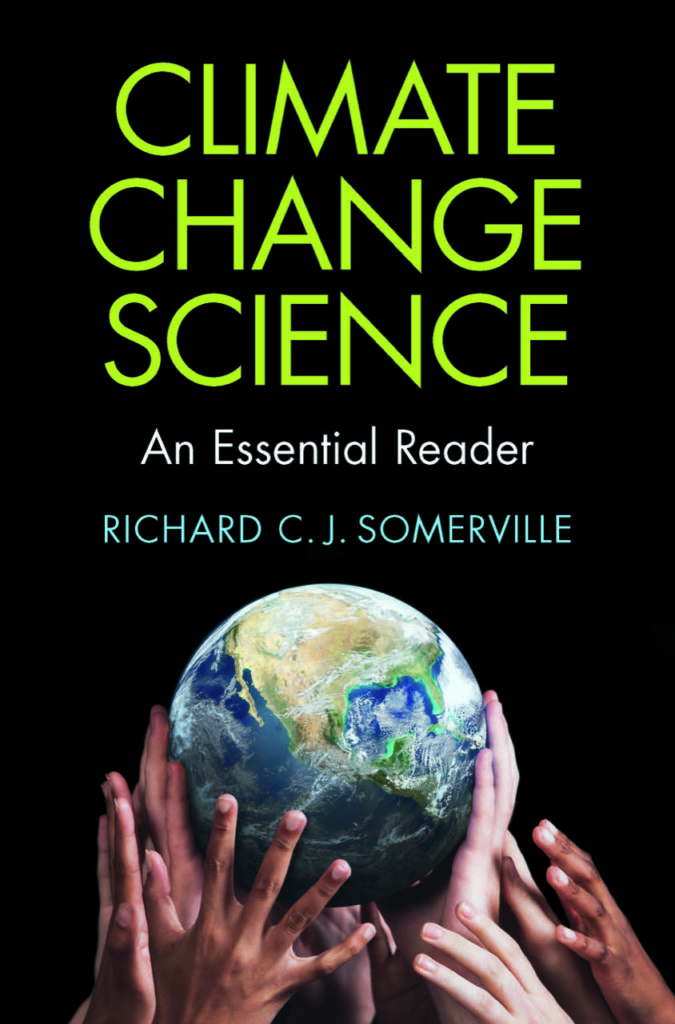
In his new book, Climate Change Science: An Essential Reader, Richard C. J. Somerville describes cutting-edge climate change science in language that everyone can understand.
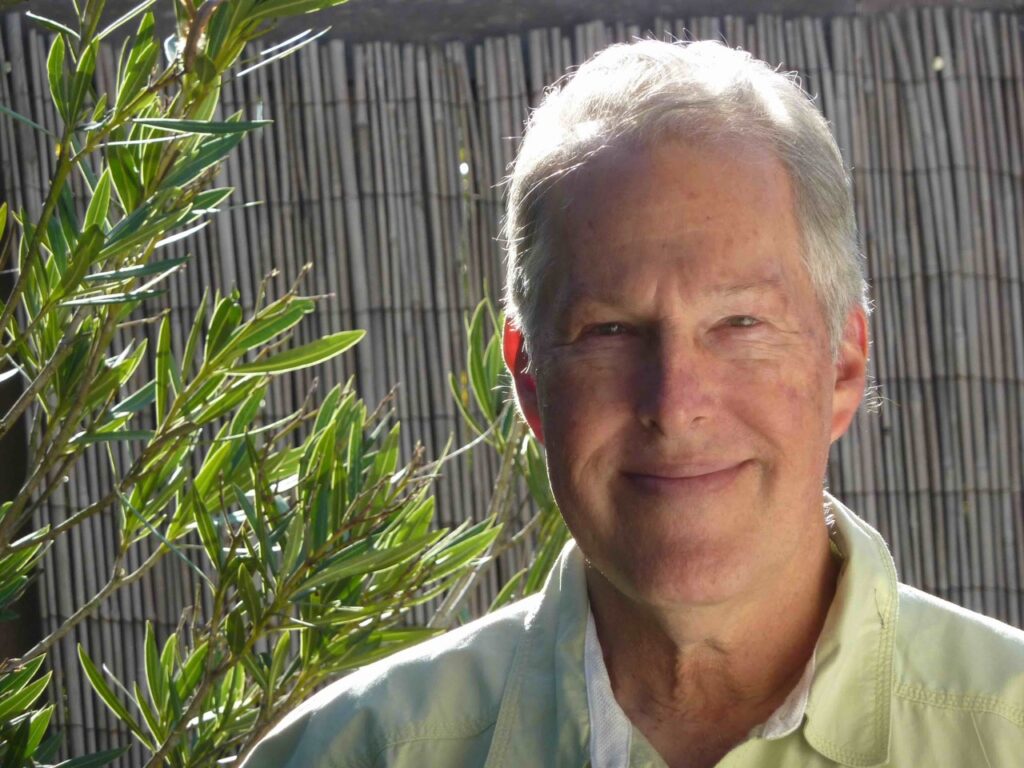
Somerville is Distinguished Professor Emeritus at Scripps Institution of Oceanography, University of California, San Diego. He is a Fellow of the American Association for the Advancement of Science, the American Geophysical Union, and AMS. He has received awards from the AMS for both his research and his popular book, The Forgiving Air: Understanding Environmental Change. From AGU, he has received the Climate Communication Prize and the Ambassador Award. Somerville is a coauthor (with Sam Shen) of Climate Mathematics: Theory and Applications and also a coeditor of The Development of Atmospheric General Circulation Models: Complexity, Synthesis and Computation.
AMS Headlines spoke with Somerville about his motivation for writing his latest book.
Why did you write this book?
The University of California, San Diego (UCSD), where I am a professor of climate and atmospheric science, recently announced that all undergraduate students must take an approved climate change course in order to graduate from UCSD. Other universities may adopt similar policies, and new books about climate change science will be needed.
Who is the book for?
We know that many university students avoid taking courses in science and mathematics. Of course, these students are not inferior in any way. They simply are not enrolled in majors that require extensive course work in science and math. Many of these students may be studying humanities, for example. I enjoy writing about climate change science for general readers. I decided to write a book in clear, plain English, based on an anthology of some of my writings.
What obstacles did you face while writing it?
There are difficult barriers to communicating science in general and climate change science in particular. For example, computer models are important tools helping scientists to understand the climate system. Yet many people distrust and are mystified by computer models. To these people, models may look like strange computer code plus incomprehensible mathematics. They see no reason to have confidence in them. This book explains the models in understandable language.
A key theme in the book is urgency. Can you elaborate?
People need to understand the urgency of acting to limit climate change. This urgency has nothing to do with politics or economics. Instead, it arises directly from the physics and chemistry of the climate system. Some of the carbon dioxide (CO2) we add to the atmosphere will remain there for centuries or longer until natural processes remove it. On human time scales, it will be there essentially forever. No practical and inexpensive method is available for removing large amounts of CO2 from the atmosphere. Climate depends on atmospheric CO2 amounts. The only known way to prevent atmospheric CO2 amounts from increasing is to stop emitting CO2 into the atmosphere. That is why acting swiftly to make large reductions in global CO2 emissions, in order to limit climate change, is urgent.
What did you learn from writing the book?
Writing means revising. Every writer needs a good editor. Leave marketing decisions to the publisher, who understands how to create a good cover design and an appropriate title for the book.
What surprised you in the process?
I expected to spend a weekend choosing about 20 articles and book chapters I had written over the years, and that anthology would become a book. I discovered that I needed to update the science, to get permissions, to eliminate redundant elements, to check and recheck everything for accuracy, to produce a glossary, to select recommended books and write a description of each, to compile an index, to revise proofs, and to have hundreds of email conversations. My weekend of work turned into three years.
What are the broader implications of this work?
When a politician on television proudly announces, “I am not a scientist, but…” and then proceeds to claim that climate change science is a hoax, he is mistaken. That politician is demonstrating that he knows little and cares less about science. He is being foolish and arrogant, because he is unable to recognize that science can provide important information to the government that employs him and the people he serves.
What’s next for you?
I have been flunking retirement for a long time. This needs to change. I intend to spend more time with my family, to indulge my hobbies, and to take long walks on the beach. I plan to resist all suggestions that I should find some additional work to do. Some people have advised me to work forever. However, as Humphrey Bogart’s character says in Casablanca, “I was misinformed.”
Information on obtaining the book can be found at https://richardsomerville.com/.