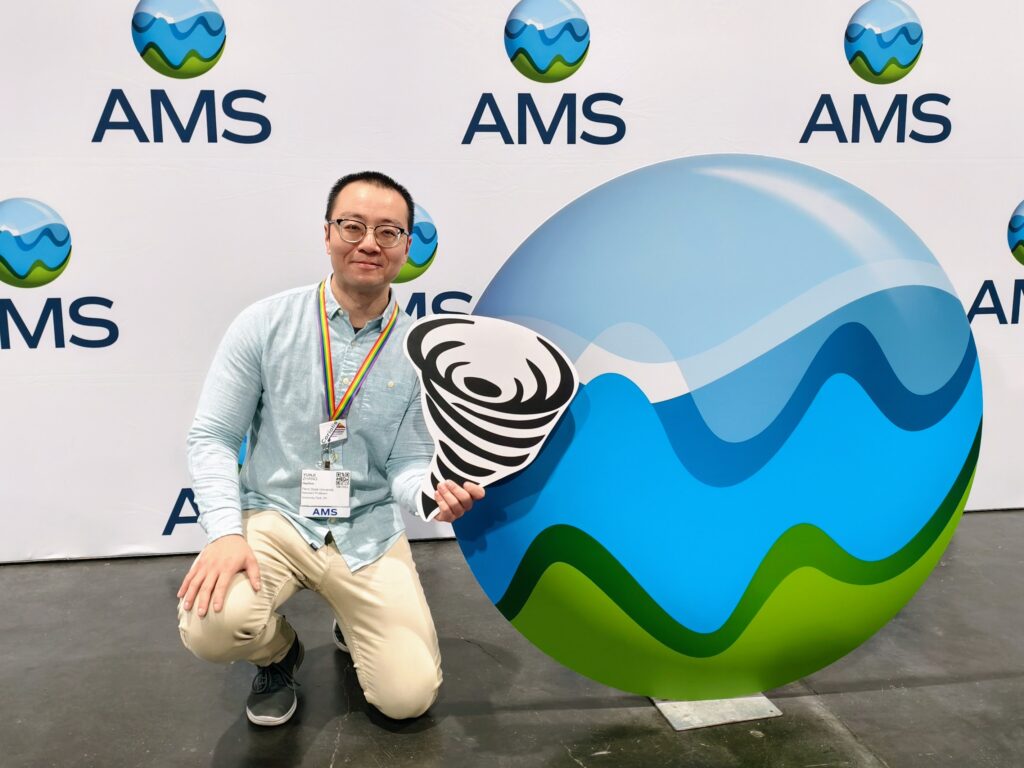
June is LGBTQ+ Pride Month. In this post, we spotlight the career of one of our LGBTQ+ community members, Yunji Zhang.
Zhang is an assistant professor in the Department of Meteorology and Atmospheric Science at The Pennsylvania State University, and affiliated with the Penn State Center for Advanced Data Assimilation and Predictability Techniques (ADAPT), and the Alliance for Education, Science, Engineering and Design with Africa (AESEDA). He received his BS in atmospheric science and PhD in meteorology from Peking University in China, and has been working at Penn State since 2016. His research has mostly been focused on the predictability (where forecast errors originate and how they evolve) and data assimilation (how we can reduce forecast errors by incorporating observations into computer weather models) of severe weather, with a particular interest in using readily available but under-utilized observations. His research combines high-resolution computer modeling, ensemble data assimilation and forecasting, remote sensing, and mesoscale meteorology.
What are a few highlights from your career?
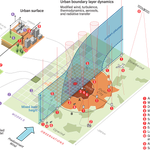
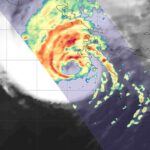
I love severe weather, and I love understanding how severe weather might be forecasted more accurately. My doctoral work suggested that we may not be able to forecast the locations and evolutions of severe thunderstorms accurately beyond about 6 hours; a few years later, I presented the first studies that assimilated observations from geostationary and low-Earth-orbit satellites that are cloudy or precipitating into high-resolution computer models for severe weather events, proving that there are still many possibilities that we can improve our current capabilities in severe weather forecasting. Right now, I am working with a few colleagues to use existing operational weather radars in a novel way to understand the boundary layer, where many severe weather events originate.
What are you most proud of in your professional life?
My students! They can be headaches sometimes (of course), but working and chatting with them has always been inspiring. All my previous students (there aren’t many) have jobs, and they love their jobs, which is all I can ask for.
Have things changed for LGBTQ+ meteorologists or scientists over the years? What still needs to change?
More and more people are willing to show who they are—just look at the growing number of attendees at the Coriolis receptions. That being said, I still hope we could educate ourselves more about our own history, especially how decades of fighting led to us having the rights we have now. This part of the history is important for all of us to understand where we are at right now and direct where we are going in the future.
Are there other LGBTQ+ meteorologists/atmospheric scientists who have particularly influenced or inspired you?
I would like to shout out to all the LGBTQ+ people in the weather, water, and climate enterprise who openly express their queer identity to everyone. I didn’t know any queer people when I was a teenager; I didn’t openly express my identity until years and years of seeing people mention or thank or simply talk about their queer partners. Visibility still matters, now more than ever!