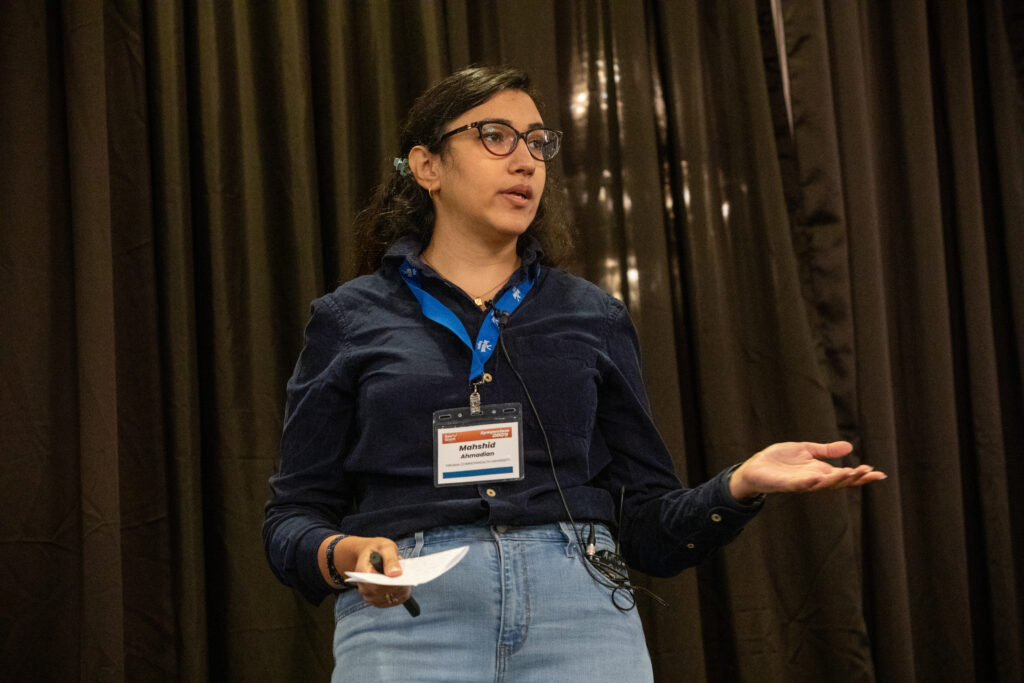
The American Meteorological Society and Virginia Sea Grant (VASG) have launched a new partnership designed to strengthen the pipeline between Earth system science and public policy. Through the inaugural VASG-AMS Policy Fellowship, recent PhD graduate Mahshid Ahmadian will spend the next year working with the AMS Policy Program, gaining firsthand experience at the intersection of science, policy, and decision-making. The fellowship reflects a shared commitment by both organizations to prepare the next generation of leaders in the weather, water, and climate enterprise.
According to Virginia Sea Grant Director Mona Behl, the partnership grew naturally from the organizations’ common mission of advancing science-informed decision-making.
“Both VASG and AMS share a mission of making science more usable, useful, and actionable for decision-makers,” said Behl. “One way we advance that goal is through science–policy fellowships that prepare scientists to engage effectively in the policy process.”
The fellowship addresses a critical need at a time when Congress and other policymakers face increasingly complex decisions related to weather, water, climate, and coastal resilience. While scientific expertise is essential to informing those decisions, relatively few policymakers have formal scientific training. Programs such as the VASG-AMS Policy Fellowship help bridge that gap by preparing scientists to communicate evidence clearly and effectively in policy settings.
“Science–policy fellowships serve as leadership incubators,” said Behl. “By training scientists to engage with government and decision-makers, we help ensure policymakers have access to trusted experts who can provide actionable information and data.”
“Policy choices have the best chance to improve people’s lives when they are grounded in the best available knowledge and understanding,” added AMS Associate Executive Director Paul Higgins. “We are thrilled for this opportunity to partner with VA Sea Grant and to help Mahshid use her scientific training in the public interest.”
Following a competitive selection process, Ahmadian was chosen as the first VASG-AMS Policy Fellow. She recently completed a PhD in Statistics and Data Science from Virginia Commonwealth University, where her research focused on marine animal movement and developing tools to support data-driven fisheries management decisions. She previously served as Virginia Sea Grant’s Commonwealth Coastal and Marine Policy Fellow with the Virginia Department of Conservation and Recreation.
For Ahmadian, the fellowship represents an opportunity to learn how scientific research is translated into public policy.
“Science does not automatically become action,” she said. “A scientific result can be significant and still never reach the people making decisions. I believe scientists have an important role to play in policy by helping ensure that evidence is available, understood, and carefully interpreted.”
During her year with AMS, Ahmadian hopes to better understand how research and technical evidence inform decisions made by agencies, legislators, and communities.
“My training has focused on turning complex data and information into something useful,” she said. “I’m excited to learn how that process works at the policy level, particularly on weather, climate, and coastal issues where scientific information increasingly shapes public health, infrastructure, resilience, and daily life.”
The fellowship will provide opportunities to work on a range of projects related to Earth system science and services while gaining exposure to the federal policy landscape, including the budget and appropriations process. Ahmadian also hopes to strengthen her skills in communicating technical information to decision-makers.
“I want to become stronger at writing for decision-makers, identifying which evidence matters for a particular audience, and communicating uncertainty in a way that is clear, honest, and actionable,” she said.
Looking ahead, Behl hopes the partnership will contribute to a growing community of scientists equipped to engage beyond academia.
“We hope this fellowship helps create a cadre of experts who can step into boardrooms, congressional hearings, or media studios and advocate for science-backed decisions,” she said.
In five to ten years, Ahmadian hopes to continue applying her expertise in statistics, data science, and scientific evidence to address complex environmental and public challenges.
“I want to be in a role where my technical skills contribute to decisions that genuinely help people,” she said.