Recently, the climate publication Carbon Brief announced its new Project Cosmos initiative, which is intended to map the past century of climate change research. The project includes rankings of the most influential academic publications, authors, and institutions in the climate disciplines. The rankings are based on citations, through which researchers reference the work of others, thus making clear whose previous work they are building on or challenging.
AMS’s publications appear prominently in the Cosmos 500 list: BAMS articles ranked as the second– and fourth-most highly cited publications, and four of the top seven journals with the most studies on their list are AMS publications: the Journal of Climate (third), BAMS (fourth), Monthly Weather Review (sixth), and the Journal of the Atmospheric Sciences (seventh). The Project Cosmos analysis is one measure of the impact and influence of the papers published in AMS’s journals.
Another such measure is the Journal Impact Factor (JIF), an annual scorecard familiar in academic publishing that also calculates citation frequency, but within broader scientific categories than those used by Project Cosmos. The recent release of the newest (2025) JIFs continues a longstanding pattern of AMS journals ranking among the most impactful in the atmospheric sciences. BAMS ranked in the first quartile of meteorology journals, while Artificial Intelligence for the Earth Systems, the Journal of Climate, the Journal of the Atmospheric Sciences, the Journal of Hydrometeorology, Monthly Weather Review, and the Journal of Physical Oceanography all ranked in the second quartile in their categories. Nine AMS journals saw their JIF increase from the previous year and every AMS journal saw an increase in total number of citations compared to 2024.
To gain more insight about journal and article rankings, AMS Headlines spoke to the current commissioner of the AMS Publications Commission, Walt Robinson of North Carolina State University, as well as former commissioner Tony Broccoli of Rutgers University.

What do these kinds of rankings tell us, and what don’t they tell us?
Robinson: Impact Factors (IFs) are counts of the average number of times papers in a journal are cited in published papers in the 2 or 5 years after their publication, full stop. Calling this “impact” is an exaggeration, or at least an oversimplification, in that it ignores many other ways that published work can contribute to the development of our science (or the good of society). In the weather/water/climate enterprise, a paper might be little cited and still have an impact on operational practice or policy. Also, IFs look at short time horizons, while the best scientific work has “legs.” I’ll give an example from my own work (while not pretending to be some big research star—I’m not!). Here’s the citation record for a Journal of the Atmospheric Sciences paper a grad student and I published in 1993:
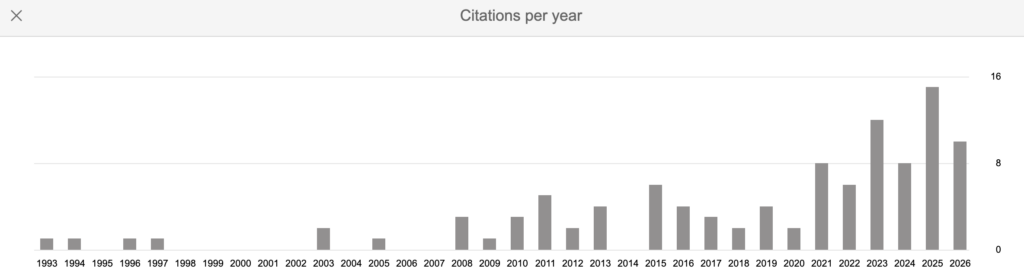
Zero contribution to JAS‘s 2-yr IF, and minimal to its 5-yr IF, but apparently the work has some lasting value. To a large extent, that value derives from it having undergone a rigorous process of well-informed peer review (major revisions, I recall).

Broccoli: Certain types of papers are more likely to be highly cited. Papers describing important datasets and analysis tools are in this category, as are review papers that summarize previous work on a topic without necessarily presenting new findings. That Carbon Brief’s #1 paper describes the R statistical software is an example of a valuable tool, and the reanalysis papers ranked #2 and #3 are examples of important datasets. This is not to say that such papers aren’t important, but rather that there can be an “apples and oranges” problem if their statistics are compared with those of research papers that present new findings.
As past commissioner of the AMS Publications Commission, what could you use the ratings for?
Broccoli: Wise use of rankings requires an understanding of the metrics they’re based on. There are a variety of metrics provided to Publications Commission members, and they measure different things. Walt alluded to the difference between papers that make a quick splash but may be soon forgotten and papers that have staying power.
Not all truly influential papers find their way into the Carbon Brief rankings. For instance, the pioneering paper by Syukuro Manabe and Richard Wetherald (“Thermal equilibrium of the atmosphere with a given distribution of relative humidity”) has been cited over 2,600 times (per Google Scholar) yet does not appear in the Carbon Brief top 500. And it may be one of the most influential papers on climate change ever published in an AMS journal (Journal of the Atmospheric Sciences). Here is the time series of citations of this paper:
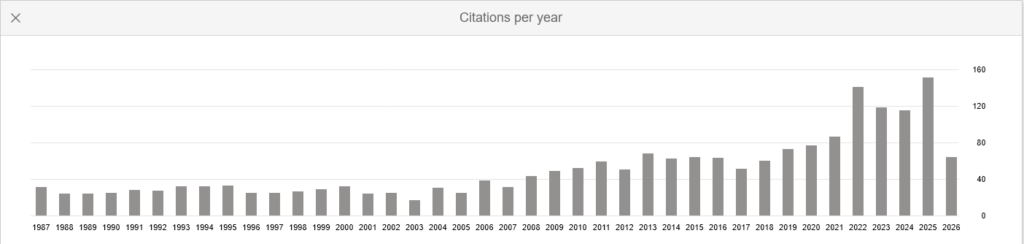
The largest number of citations to date was last year, a full 58 years after it was published!
What do the rankings of AMS journals and articles say about the value of AMS publications?
Robinson: A strong author community, excellent peer review, together with high production quality, builds a lasting edifice of weather/water/climate knowledge. That is what AMS journals are, and always have been, about. And this shows up in places like that Carbon Brief report—to me that matters much more than IFs. But we can’t completely ignore IFs, since they do matter to some potential authors, especially overseas. So it’s better for IFs to go up than go down, but 1) year-to-year changes are essentially stochastic, and 2) journals can “game” their IFs (cf. here), which we’ve never done.
Broccoli: To reinforce a point Walt made, I think of Journal Impact Factors the same way I think of US News rankings of academic institutions. The rankings shouldn’t be thought of as the most important indicator of journal quality, but they certainly mean something. We should be pleased that AMS journals (and the individual papers published therein) have good metrics to go with our more subjective assessment of their quality.