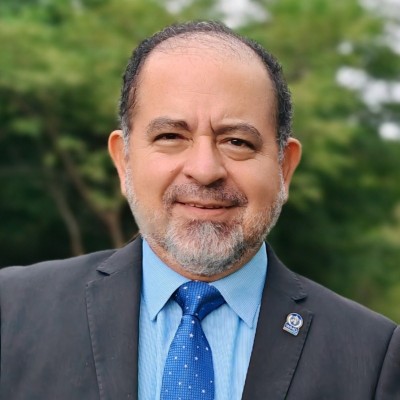
September is Hispanic & Latino/a Heritage Month. In this post, we spotlight the exceptional career of one of our community members: Rodney Martinez.
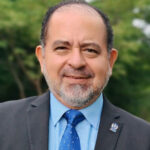
Oceanographer Rodney Martinez is the World Meteorological Organization representative for North America, Central America, and the Caribbean, a position he has held since 2019. A former officer in the Ecuador Navy, Martinez has a BMA in development projects management. He is the author or coauthor of 80 research papers and has been the coordinator of more than 12 regional projects and activities related to climate risk management, early warning, information and data management, and climate applications and adaptation. His main research areas include ENSO regional impacts in the Americas, risk/adaptation management, and climate user interface development. Martinez has been the coordinator of 34 regional training courses and lecturer at more than 100 international conferences. He was head of the Marine Sciences Department at the Ecuadoran Oceanographic Institute of the Naval Forces (INOCAR) and executive secretary of the Ecuadorian Antarctic Programme (1997–2003), the regional coordinator of ODINCARSA-IOC-UNESCO (2001–09), and the scientific coordinator (2004–15) and international director (2015–19) for the International Center for Research on the El Niño Phenomenon (CIIFEN). Martinez was also a member of the CLIVAR Pacific Panel (2005–12), cochair of the Open Program Area of Climate Experts on Climate Information for Risk Management and Adaptation from the Commission of Climatology-World Meteorological Organization (2010–19), a member of the Joint Scientific Committee of the World Climate Research Programme (2013–18), and a member of the Steering Committee of the Global Climate Observing System (2015–19).
https://www.linkedin.com/in/rodney-martinez-226b5720/
https://www.researchgate.net/profile/Rodney_Martinez
Rodney Martínez, Representante de la OMM para Norteamérica, Centroamérica, y el Caribe
Oficial de la Armada del Ecuador en Servicio Pasivo, oceanógrafo con postgrado en gestión de proyectos para el desarrollo. Representante de la OMM para Norteamérica, Centroamérica y El Caribe (2019 a la actualidad). Autor o coautor de 60 publicaciones científicas y conferencista invitado en 106 conferencias internacionales. Jefe del Departamento de Ciencias del Mar de INOCAR y secretario ejecutivo del Programa Antártico Ecuatoriano (1997–2003). Coordinador regional de la red de ODINCARSA COI-UNESCO (2001–2009). Coordinador científico del CIIFEN (2004–2015). Director internacional del CIIFEN (2015–2019). Miembro del Panel de CLIVAR para el Pacífico (2005–2012). Miembro de la Comisión de Climatología de la OMM: Información climática para la gestión de riesgo y adaptación (2005–2019). Miembro del Comité Directivo del Programa Mundial de Investigación del Clima WCRP (2013–2018) y miembro del Comité Científico del Sistema Mundial de Observación del Clima GCOS (2005–2019). Coordinador de varios proyectos regionales y actividades relacionadas con gestión de riesgo climático, alerta temprana, gestión de datos e información, servicios y aplicaciones climáticas, y adaptación. Áreas de investigación principal: Impactos regionales del ENSO en el Pacífico Oriental, gestión de riesgo y adaptación, y desarrollo de interfaces con usuarios de información climática. Coordinador de 34 cursos regionales de entrenamiento.
https://www.linkedin.com/in/rodney-martinez-226b5720
https://www.researchgate.net/profile/Rodney_Martinez
What are a few highlights from your career?
I was a navy officer in Ecuador and become an oceanographer, and one of my first and most relevant experiences was to cope with El Niño in 1997–98 as chief of Marine Sciences of the Oceanographic Institute of the Navy. Jointly with the Met Service and other institutions we delivered information to the government and learned painfully that operational information is not enough to succeed with early-warning services and mitigate social and economic impacts. That has influenced my entire further professional development until today.
What are you most proud of in your professional life?
I was part of the founding staff of the International Research Center on El Niño (CIIFEN), based in Guayaquil, Ecuador, which started in 2003. I served 16 years there, first as scientific coordinator and the last 5 years as international director. CIIFEN became a WMO Regional Climate Center for western South America in 2014; we were awarded the Sasakawa Mention on Disaster Risk Reduction in 2009, and we developed more than 10 regional projects, especially in the Andean region, and trained hundreds of experts in Latin America. I am very proud of all what we did in this period.
Have things changed for Hispanic meteorologists or scientists over the years? What still needs to change?
Yes, Latin American meteorologists and scientists are more visible in the global and regional community and within the United States, but current times are not favorable for increasing participation. More spaces to gather Latin American experts and showcase their work are needed.
Are there other Hispanic meteorologists/atmospheric scientists who have particularly influenced or inspired you?
Yes, I have several outstanding colleagues that have influenced my work: Jose Marengo, Carolina Vera, Celeste Saulo, Roberto Mechoso, Rene Garraud, and Jose Pabon.