The American Meteorological Society continuously publishes research on climate, weather, and water in its 12 journals. Many of these articles are available via early online access–they have been peer-reviewed, but are not yet in their final published form. Below are some examples of recently accepted research. Note: Some articles may require a subscription for full access.
JOURNAL ARTICLES
What follows are summaries that have not been peer-reviewed or vetted by the article authors; read the full article for peer-reviewed conclusions. Please note that no single study is ever definitive, and each must be taken in the context of the broader scientific literature.
Novel Real-Time Global Kilometer-Scale Weather Model Forecasts
Bulletin of the American Meteorological Society
A new frontier in global weather modeling. Weather models with resolutions of 1–5 km have become key to local and regional forecasting, as they can better model finescale structures. Yet it has been too computationally expensive to routinely model at such resolutions across the whole globe. In 2025 the National Center for Atmospheric Research (NCAR) broke new ground by producing two sets of worldwide 3–3.75- km scale forecasts daily for more than a month each. Such advances may improve long-term forecasting and help us understand global-scale interactions.
No Longer Polar Opposites: the Arctic and the Antarctic Are Converging towards a Seasonally Dominated Sea-Ice Regime
Bulletin of the American Meteorological Society
Lower summer sea ice extent may be the new normal at both poles. From the start of satellite observations, Arctic sea ice coverage experienced a strong decrease, while Antarctic sea ice appeared to be slowly increasing. Since 2015, Antarctic sea ice has sharply declined while Arctic sea ice loss appears to have stabilized. The poles appear to be converging toward a state of substantially lower summertime sea ice coverage, with reduced multiyear ice and greater variability. The authors argue that this is due to a breakdown in ocean stratification, with increased surface salinity making sea ice more vulnerable.
Observed Decreases in Seasonal Drought across the Northeastern United States
Journal of Hydrometeorology
Northeast U.S. droughts have declined despite global warming. While anthropogenic climate change is predicted to increase drought in the U.S. Northeast, observations suggest that spring/summer drought has become less frequent and intense since 1984, compared with 1901–83. The authors find that this is likely driven by regional precipitation increases, which have outpaced warming-driven evaporation and drying. This does not rule out future drought increases as climate change progresses.
Identifying Barriers and Resources for Equitable Tornado Warning Systems Among Latinx Communities in the Southeast
Bulletin of the American Meteorological Society
Building trust to reduce tornado casualties. Tornadoes in the U.S. Southeast cause disproportionate damage and deaths among Latinx communities. Interviews and focus groups reveal language, cultural, and structural barriers to receiving and acting on tornado warnings. Latinx adults are also less likely to trust official warning sources and more likely to rely on informal networks and social media. Potential solutions include strengthening Spanish communications, use of visual materials, partnering with trusted community organizations and schools, and building sustained relationships between the National Weather Service and Latinx communities.
Tornado Emergency! A Review of Their History, Climatology, and Associated Tornadoes
Weather, Climate, and Society
How do you define a tornado emergency? The term “tornado emergency” has been used in National Weather Service warnings since 1999, yet no study has systematically examined how and when. This review finds that “emergency” tornadoes are more likely to be identified as EF2 or greater, and tend to have longer tracks and larger widths compared with other tornados. Tornado emergencies are most often issued in the southeastern United States, most commonly in early spring.
Effect of Spring Tibetan Plateau Snow Cover on the Frequency of Intense Tropical Cyclones over the Western North Pacific
Journal of Climate
Tibetan snow cover variability strongly linked to intense tropical cyclones in the western North Pacific. This paper uncovers a significant negative relationship between the extent of spring snow cover on the Tibetan Plateau and the frequency of intense tropical cyclones (TCs) over the western North Pacific the following July-November. High snow cover influences atmospheric heat and circulation to suppress intense TCs, while low snow cover does the opposite. A forecasting model incorporating this relationship shows robust skill in predicting intense TCs.
Assessing Lightning Risk in Africa: A Framework Integrating Hazard, Exposure, and Vulnerability via the African Lightning Incident Database
Weather, Climate, and Society
Lighting casualties high across many African nations. Analysis of the African Lightning Incident Database reveals over 3,000 lightning fatalities in 2018–23. Some African countries have lightning casualty rates 20 times higher than most non-African countries, with an average of 5.3 casualties per event. Over half of the victims are children, often at schools unprotected from lightning.
Forecasted Heat and Vulnerable Populations: Understanding Limitations Associated with New Tools
Bulletin of the American Meteorological Society
NWS HeatRisk tool may not capture individual heat discomfort. The National Weather Service’s new HeatRisk tool attempts to help decision-makers determine action thresholds for extreme heat, incorporating local factors. This study, comparing HeatRisk with the existing Heat Index, finds that HeatRisk may not currently be ideal for determining individual-level heat risk, as it often underestimates heat-induced discomfort among vulnerable populations like outdoor workers compared with the Heat Index.
Estimating Medicane Precipitation Hazard
Journal of Climate
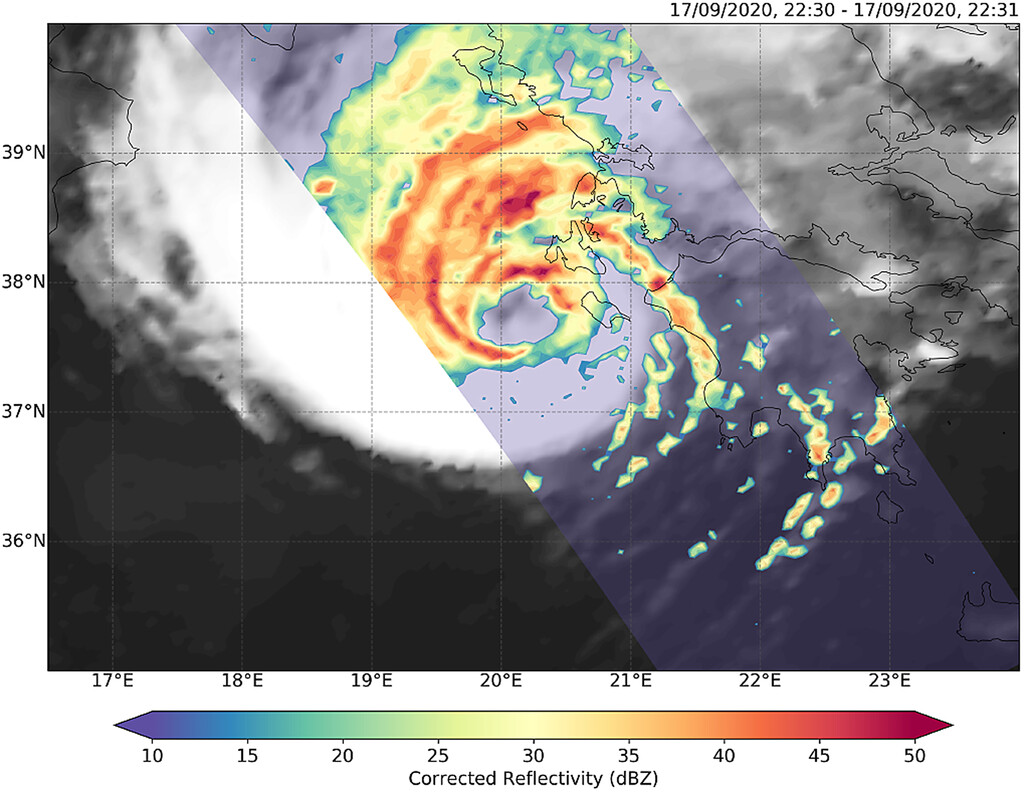
Extreme rainfall from “Medicanes” likely to increase with climate change. Rare and hazardous “Mediterranean hurricanes,” aka Medicanes, are hurricane-like storms that form over the Mediterranean Sea. This modeling study predicts that intense Medicane-induced rainfall is expected to increase significantly in many Mediterranean regions with climate change, including southern Italy, northern Algeria, Sardinia, and Corsica.
From ENSO Prediction to Regional Climate Services: The Scientific Evolution of Seasonal Forecasting in Southern Africa within a US–South Africa Collaborative Framework
Bulletin of the American Meteorological Society
U.S.-South Africa collaboration improves local and international climate forecasting. Over the past three decades, sustained collaboration between South African and U.S. institutions has built a southern Africa climate forecasting system with measurable skill, note the authors. Forecasts produced by this system are useful for regional public and private applications as well as for calibrating international climate models, demonstrating the value of these collaborations for all involved.
Insights from Ex-Typhoon Halong (2025) – An Arctic Cyclone of Tropical Origin
Bulletin of the American Meteorological Society
Tropical-to-Arctic cyclones have increased in frequency. Ex-typhoon Halong devastated Alaskan coastal communities in 2025. Halong “demonstrates that tropical cyclones can transition into extratropical systems that are intensified by anomalously warm ocean waters, exacerbating impacts in high latitudes,” say the authors. They find that the frequency of Arctic cyclones of tropical origin has increased three- to fourfold in August-September during 1980–2025 compared with 1940–79.
Threat of Flash Floods to Galleries, Libraries, Archives, and Museums in the United States
Weather, Climate, and Society
Northeast, Great Plains museums/collections at higher risk from flash floods. Galleries, libraries, archives, and museums house the nation’s most important historical and cultural information. Analysis of National Weather Service flash flood warnings reveals that facilities in the northeastern United States and throughout the Great Plains experience a higher threat of flash floods than other regions, information that may help inform hazard mitigation.
Can Andean Uplift Enhance the Pacific Meridional Overturning Circulation?
Journal of Climate
Rising Andes influence Pacific ocean circulation. The Andes mountains have been uplifting at a rapid rate for millions of years. Simulations reveal that Andean uplift helps shape the Pacific climate. In the model, increased uplift causes local cooling, intensifies the Pacific Meridional Overturning Circulation, and leads to surface warming and salinity increases, among other effects (even without increased atmospheric CO2).
From Grand Narratives to Riverbank Realities: How Local Experience Influences Perceptions of Climate Risk and Adaptation in Rural Australian Freshwater Tourism
Weather, Climate, and Society
Climate change is disrupting Australian freshwater tourism. Local freshwater tourism operators in rural Australia experience increasingly frequent climate hazards, floods, droughts, bushfires, and heat waves that disrupt operations and threaten both visitor safety and ecosystem health, finds an interview-based study. Local adaptation is often individual and reactive rather than systemic, illustrating the need to incorporate local lived experience into policy.
You can view all research published in AMS Journals at journals.ametsoc.org.
About the American Meteorological Society
The American Meteorological Society advances the atmospheric and related sciences, technologies, applications, and services for the benefit of society. Founded in 1919, AMS has a membership of around 12,000 professionals, students, and weather enthusiasts. AMS publishes 12 atmospheric and related oceanic and hydrologic science journals; hosts more than 12 conferences annually; and offers numerous programs and services. Visit us at www.ametsoc.org/.
About AMS Journals
The American Meteorological Society continuously publishes research on climate, weather, and water in its 12 journals. Some AMS journals are open access. Media login credentials are available for subscription journals. Journals include the Bulletin of the American Meteorological Society, Weather, Climate, and Society, the Journal of Climate, and Monthly Weather Review.