by Daniel Fenner1
Understanding how cities and the atmosphere dynamically interact, from the surface through the atmospheric boundary layer (ABL), is crucial for forecasting weather and climate, including risks and climate change impacts. To improve our knowledge of city–ABL interactions, a multi-institutional observation campaign was conducted in Berlin and its surrounding region in Germany.
With global increases in urban population, density, and spatial extent combined with accelerating climate change, the risks to cities and their inhabitants have already risen substantially and will continue to rise in the future. Understanding and representing city–atmosphere interactions properly is key to providing high spatiotemporal forecasts and projections that approach neighborhood scales. Although most current operational weather and climate models do not resolve these highly complex interactions, many of the next generation are aiming for this.
To support this next-generation high-resolution modeling, the urbisphere-Berlin campaign was conducted from October 2021 to September 2022. The resulting unique observational dataset addresses subdaily-to-annual time scales. This is part of the European Research Council (ERC) Synergy Grant urbisphere project, which aims to advance our understanding of dynamic cities, both within the city (intraurban) and region (urban-rural), considering the variability of three-dimensional urban–atmosphere exchanges.
In our study we use two days to showcase the benefits of the multiscale observational and modeling approach taken in urbisphere-Berlin and highlight the diversity of urban impacts on the ABL.
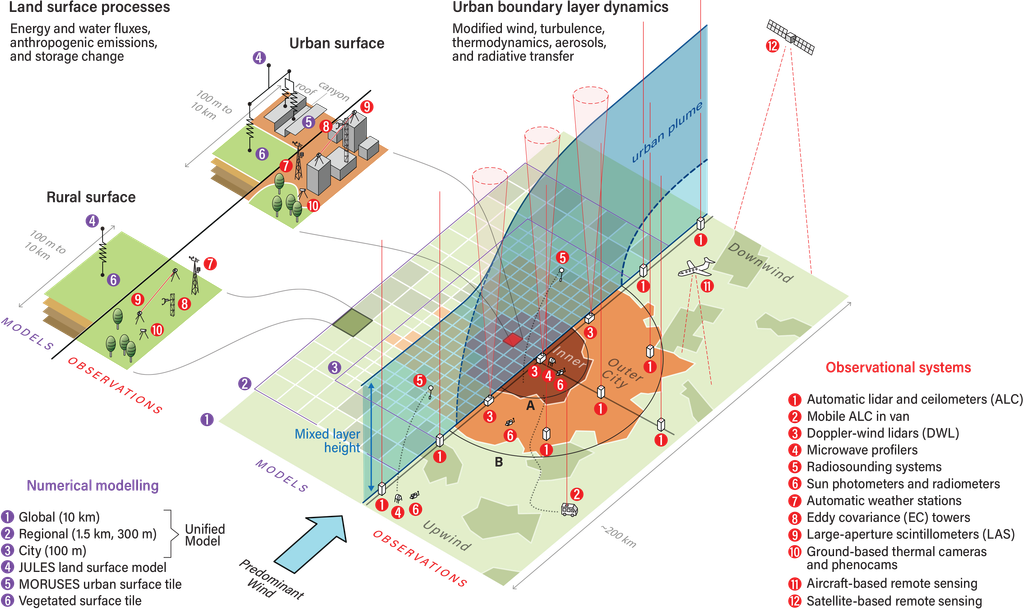
The systematic design for our dense ground-based observational network combines remote sensing (ceilometers, Doppler-wind lidars) and other sensors (e.g., eddy covariance flux towers, scintillometry, radiation flux measurements), complemented with satellite, airplane, and drone Earth observations, plus numerical modeling.
During a spring day, we observe substantial urban–rural and intraurban differences in surface energy fluxes of sensible and latent heat. These lead to a deeper mixed layer (resulting from strong convective turbulent mixing within the ABL) of several hundreds of meters above the city compared to upwind rural locations. On this day (April 18, 2022), consistent wind occurred from the northeast, causing an urban plume of enhanced mixed-layer depth above the rural areas downwind of the city. Further, near-surface air temperature, observed by several thousand crowdsourced weather stations, showed the advection of urban heat to the downwind edge of the city. Additionally, satellite-derived tropospheric nitrogen dioxide concentrations indicated a pollutant plume extending several tens of kilometers beyond the city boundaries. Thus, urban ABL impacts are not only within and above a city but also affect the rural areas downwind.
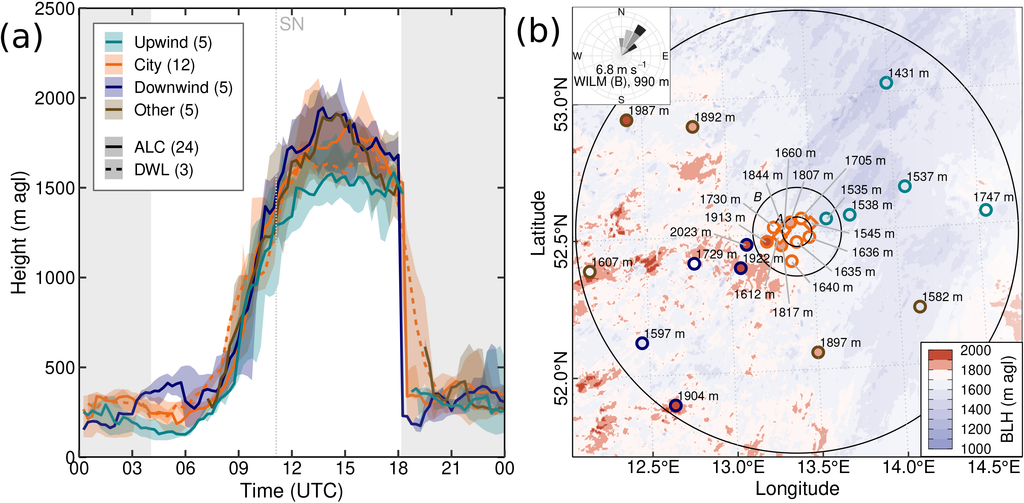
On a summer heat wave day, following a regional drought of two months, different city–ABL interactions occur. With drought conditions causing dry soils, the turbulent surface energy fluxes are more similar across the region, leading to similar mixed-layer heights across the urban and rural areas as observed by our network and numerical model. During the intense heatwave with near-surface air temperature close to 40°C, this summer day (August 4, 2022) resulted in an exceptionally deep ABL of >3 km above the surface. Our two-hourly radiosoundings, taken concurrently within and upwind of Berlin, also show similar ABL depths and characteristics for the city and the surroundings during the day. However, that night, conditions inside the city substantially differed from the surroundings, with prolonged city heat creating a pronounced urban heat island. Such conditions can be particularly hazardous for urban citizens.
Our data and findings are valuable for guiding efforts to enhance and evaluate high-resolution numerical weather prediction and climate models at urban and intra-urban scales. As the campaign covers a full year, we are able to capture different human-activity cycles (e.g., weekend–weekday, seasonal differences), the impacts on the atmosphere, and the atmospheric impacts (e.g., energy use in the city for heating or cooling).
Further urbisphere-Berlin analyses are examining the annual variability of observed processes and variables. The rich dataset is also being used for a wide variety of model developments and evaluations. More recently, urbisphere-Paris, France, (2023–24) and urbisphere-Bristol, UK, (2024–25) have been undertaken in conjunction with other partners to collect city-wide high-resolution datasets in different environments.
With urbisphere being an interdisciplinary project involving scientists in ground-based observations, remote sensing, modeling, and spatial planning, we are creating research synergies and training next-generation research to develop and link urban-surface models, human exposure, and vulnerability models to better forecast exposure, emissions, and intervention potential for cities.
A Brief Conversation
with the Author
“My initial interest in atmospheric sciences was sparked during my undergraduate study abroad in Montreal, Canada, where I took courses in micrometeorology and climatology. Upon returning to Berlin, I was inspired by my ever-enthusiastic mentor and later PhD supervisor, Dieter Scherer, who encouraged me to explore the field further. Relatively quickly, this led me to focus on urban meteorology and climatology, which has since become my passion in my professional life. I am thankful to be able to pursue this passion and work alongside many wonderful people who share the same enthusiasm.”
—Daniel Fenner, Technical University Berlin
AMS Headlines: What would you like readers to learn from this article?
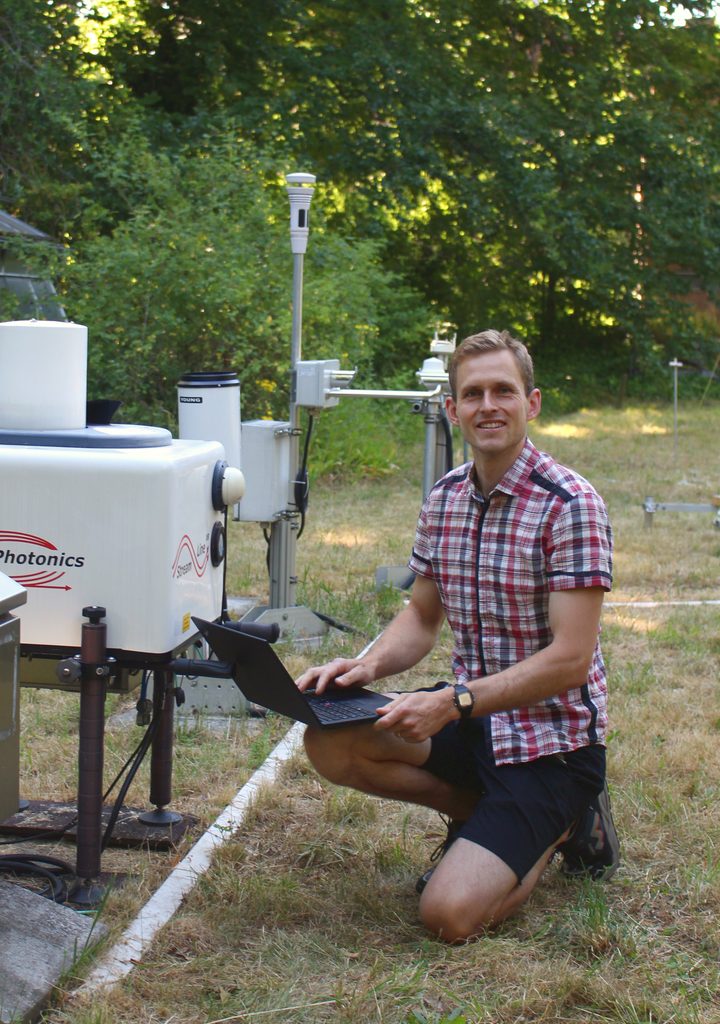
Daniel Fenner (Technical University Berlin): Urban impacts on the atmospheric boundary layer are diverse and dynamic across space and time. Capturing and understanding these in a holistic manner requires synergetic efforts with many partners and diverse expertise, using a multitude of observations and modeling efforts. Our urbisphere-Berlin campaign aimed at such a holistic approach, and the obtained results, and in particular the rich dataset, are of high value for many researchers that work on urban weather and climate.
AMS Headlines: How did you become interested in the topic of this article?
DF: I became interested in this topic during my postdoc position in the urbisphere project. I enjoy working outdoors, as well as analyzing data and doing research work at my desk, so the campaign and connected research was the perfect opportunity to combine both aspects. Furthermore, the work has paved the way for me to gain deeper insights into the diverse urban impacts on the atmosphere of my home city, Berlin. My passion for learning new things motivated me to explore this research, as it also gave me the opportunity to extend my knowledge and experience in working with diverse observation systems and collaborating with a large team of distinguished scientists from different disciplines.
AMS Headlines: What surprised you the most about the work you document in this article?
DF: What surprised me the most was the incredible diversity of urban impacts on the atmosphere on different spatiotemporal scales that we captured with our observations and could resolve with our models. I was particularly struck by how dynamically regional weather and climate interact with a city, highlighting the complex and interconnected nature of urban climate phenomena, human activities, and the city’s impacts on the atmospheric boundary layer.
AMS Headlines: What was the biggest challenge you encountered while doing this work?
DF: During the campaign, locating and acquiring the necessary permissions to deploy the instruments in a rigorous and systematic manner according to the envisaged research design, as well as keeping them running for a year, presented my team and me with many challenges, particularly during the ongoing COVID-19 pandemic in 2021/22.
The biggest challenge encountered while working on the article itself was presenting the multifaceted work of urbisphere-Berlin in a way that provides a clear overview while also including all relevant details. It was important to strike a balance between offering a comprehensive summary and supplementing it with detailed metadata to ensure that all aspects of the campaign were accurately represented and understandable.
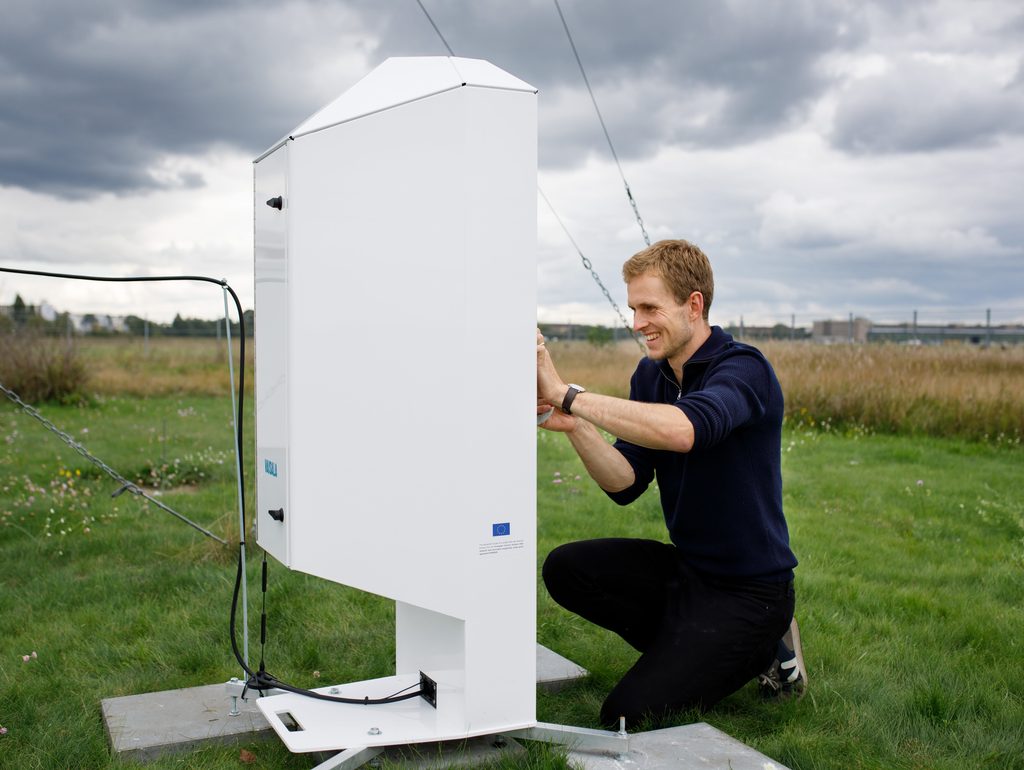
“Already ongoing and planned are year-round analyses based on the collected dataset from Berlin to better understand city–atmosphere interactions on diurnal-to-seasonal time scales. Additionally, we are working on model evaluation and development, as well as observation–model comparisons to further improve our current understanding of these interactions. Ultimately, within urbisphere we aim to develop forecasts and projections for urban futures and climates using a dynamic framework that incorporates weather, air quality, and the exposure and vulnerability of people in cities.”
—Daniel Fenner, Technical University Berlin
- Key messages from “urbisphere-Berlin Campaign: Investigating Multiscale Urban Impacts on the Atmospheric Boundary Layer,” by Daniel Fenner (University of Freiburg), Andreas Christen, Sue Grimmond, Fred Meier, William Morrison, Matthias Zeeman, Janet Barlow, Jörn Birkmann, Lewis Blunn, Nektarios Chrysoulakis, Matthew Clements, Russell Glazer, Denise Hertwig, Simone Kotthaus, Kai König, Dana Looschelders, Zina Mitraka, Dimitris Poursanidis, Dimitris Tsirantonakis, Benjamin Bechtel, Kit Benjamin, Frank Beyrich, Ferdinand Briegel, Gregor Feigel, Carlotta Gertsen, Nimra Iqbal, Jonas Kittner, Humphrey Lean, Yiqing Liu, Zhiwen Luo, Megan McGrory, Swen Metzger, Matthew Paskin, Marvin Ravan, Thomas Ruhtz, Bethany Saunders, Dieter Scherer, Stefan Thor Smith, Megan Stretton, Katja Trachte, and Melania Van Hove. Published online in BAMS, October 2024. ↩︎