by Guoqiang Tang et al.1
What happens to hydrologic simulations when the entered weather data are uncertain?
That’s the question we set out to answer in our study. Hydrologic models are a major tool for water studies, and precipitation and air temperature are the major forcings in hydrologic models. But these inputs are never perfect—particularly across vast regions of the world where observations are sparse or uneven. For global hydrologic modeling and water-related decision-making, that’s a big problem. And yet, the true scale and geography of this problem had not previously been fully mapped.
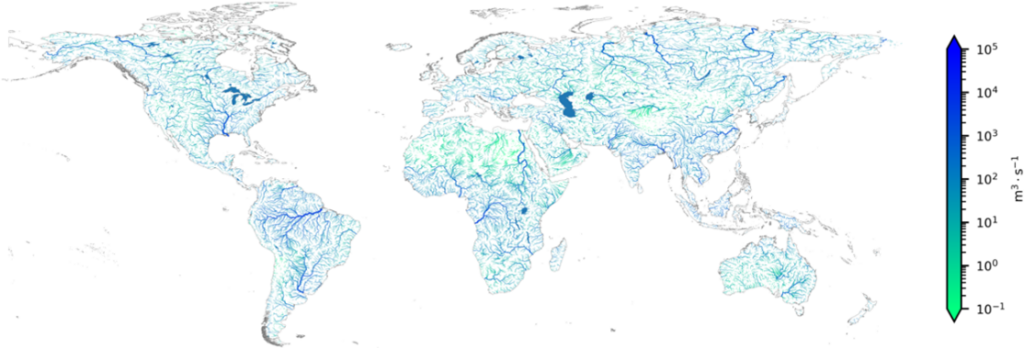
To tackle this challenge, we developed a modeling framework that combines a cutting-edge ensemble meteorological dataset (EM-Earth) with a process-based hydrological model (SUMMA) and a river routing model (mizuRoute). We conducted simulations for approximately 3 million subbasins worldwide, using 25 ensemble members from EM-Earth. Each member represents a plausible realization of historical daily precipitation and temperature—essentially creating 25 versions of the past that are all consistent with available observations and physical laws.
Running global hydrologic simulations across continents and climate zones, from alpine basins to tropical floodplains, allowed us to directly assess how uncertainty in meteorological inputs translates into uncertainty in hydrologic outputs. We focused on key variables like streamflow, surface runoff, baseflow, evapotranspiration, and soil moisture.
To make sense of the results, we developed metrics to measure two intuitive uncertainties: one is an indicator of the spread in the ensemble model outputs, with higher values indicating lower confidence in the ensemble mean, and the other quantifies the propagation of meteorological uncertainty into the hydrologic simulations.
With these two measures, we were able to uncover rich spatial patterns of “uncertainty hotspots” across the globe. In deserts, we flagged large uncertainty because rare rainfall events can lead to dramatic spikes in modeled runoff, even when total annual rainfall is low. On the other hand, we also revealed high sensitivity in humid regions like the Amazon Basin, Southeast Asia, and parts of Central Europe, where baseflow dominates and even small perturbations in input can propagate and amplify through the system.
Cryosphere regions such as northern Canada and High Mountain Asia showed relatively low hydrologic uncertainty, likely due to the buffering effects of seasonal snowpack. Snow acts as a natural integrator of variability, storing water during cold months and releasing it gradually during melt seasons. However, this buffer is fragile—climate change is rapidly reducing snow cover in many of these regions. As snowpack declines, we may see a sharp rise in sensitivity to short-term meteorological variability, potentially flipping these areas into new uncertainty hotspots.
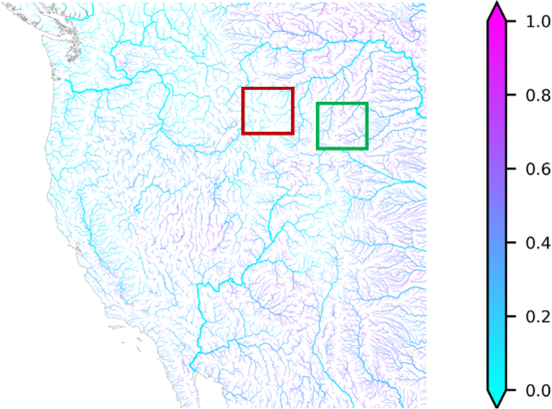
Another important insight came from looking at how uncertainty behaves downstream. While small headwater basins showed highly variable streamflow responses, large river systems—such as the Amazon, Mississippi, and Yangtze—tended to smooth out input noise through hydrologic routing. This “natural averaging” effect means that uncertainty tends to diminish as water moves through the network, providing some stability for downstream forecasts. But this also depends on flow regime and basin characteristics—fast-responding systems may not benefit as much from this buffering.
Among the variables we analyzed, surface runoff consistently showed the highest sensitivity to meteorological uncertainty. In contrast, deep soil moisture and total evapotranspiration were more resilient, with lower spread across ensemble members. These differences reflect how tightly coupled each variable is to daily weather fluctuations and suggest that not all outputs from hydrologic models are equally reliable in the face of uncertain inputs.
Why does this matter? Because some of the regions where uncertainty is highest—such as sub-Saharan Africa, the Andes, and Southeast Asia—are also places where hydrologic predictions are most needed and where data availability is lowest. In many of these areas, people rely on hydrologic forecasts for flood warning, agricultural planning, and water allocation decisions. If model outputs are most sensitive in these very regions, we must approach interpretation and use of those forecasts with appropriate caution—and seek ways to improve confidence.
Our work underscores an urgent need to improve not only hydrologic models themselves, but also the quality and coverage of meteorological inputs. Enhanced satellite observations, expanded in situ networks, and data assimilation frameworks can help reduce forcing uncertainty, especially in data-sparse regions.
A Brief Conversation
with the Author
“My initial interest in my field began with satellite-based precipitation measurements. Precipitation is one of the most important—and most challenging—components to observe accurately, especially over remote and data-scarce regions. This interest naturally led me into the broader field of hydrometeorology, where I could connect atmospheric processes with land surface responses, and study how weather shapes water availability, floods, droughts, and beyond.”
—Guoqiang Tang, Wuhan University

“After studying and working across different parts of the world, I have come to appreciate how people everywhere face unique but interconnected water challenges—from climate-driven snowpack changes to flood risks and water scarcity. I feel fortunate that my research in large-scale hydrometeorology can offer both global and region-specific insights to help address these pressing issues.”
BAMS: What would you like readers to learn from this article?
Guoqiang Tang (Wuhan University): That hydrologic model performance is not just about the model—it is heavily shaped by the quality of meteorological inputs. In many regions, improving weather data is just as important as tweaking the model itself.
BAMS: How did you become interested in the topic of this article?
GT: Working with hydrologic models, I kept running into a fundamental issue: large differences in results based on which dataset was used. That led me to wonder—where are the hot spot regions on the global scale suffering the most from this problem?
BAMS: What surprised you the most about the work you document in this article?
GT: How much the hot spot of uncertainty changes depending on how you define it. A dry region might show high relative uncertainty, while a humid one might show high impact on natural variability. Both are critical—but for different reasons.
BAMS: What was the biggest challenge you encountered while doing this work?
GT: One major challenge was the need to run global-scale hydrologic simulations across nearly 3 million subbasins using 25 ensemble members—an enormously computational task. But beyond the technical scale, a deeper challenge lies in parameter estimation. There is a pressing need for more efficient and effective large-scale parameter estimation frameworks to better represent hydrologic processes around the world.
“We plan to include more meteorological drivers, like radiation and humidity, and explore how model structure and parameter uncertainties interact with input uncertainty. I am particularly interested in how uncertainty responses may shift in cryosphere regions as snowpack declines under climate change.”
—Guoqiang Tang, Wuhan University

“Snow and ice are among the most affected elements of the Earth system under global warming. Snowpack has long served as a natural buffer, reducing uncertainty in hydrologic simulations and forecasts. But as snowcover retreats, our ability to accurately model the water cycle in cryosphere regions is being undermined. We must prepare for a future where hydrologic predictions in these regions come with greater uncertainty—and greater urgency.”
- Key messages from “Uncertainty Hotspots in Global Hydrologic Modeling: The Impact of Precipitation and Temperature Forcings,” by Guoqiang Tang (Wuhan University), Martyn P. Clark, Wouter J. M. Knoben, Hongli Liu, Shervan Gharari, Louise Arnal, Andrew W. Wood, Andrew J. Newman, Jim Freer, and Simon Michael Papalexiou. Published online in BAMS, January 2025. ↩︎